
Stuffy air despite a running ventilation system is no coincidence and no sign of a defective system — it is often the result of poor air distribution. The system does deliver the mathematically correct volume of air, but that air simply never reaches certain areas of the room, or only does so inadequately. The following questions shed light on the most common causes and show when a simple maintenance service is sufficient and when a more fundamental intervention is necessary.
Why doesn’t ventilation help with stuffiness?
When a ventilation system is running but the room still feels stuffy, the problem is almost never the volume of air being supplied — it lies in how the air is distributed within the room. The system is technically doing its job, but the air is not reaching the places where people are present and where it is needed.
Stuffy air despite ventilation occurs when fresh supply air and stale exhaust air do not mix sufficiently. Instead of flowing through the entire room, the air takes the path of least resistance: directly from the supply air outlet to the exhaust air grille, without ever reaching the zones that are actually in use. Structural factors such as built-in elements, furniture, or unfavorable room geometries further impede the airflow.
In offices with poor air quality, these phenomena are particularly noticeable because high occupancy density, heat loads from IT equipment, and often low ceiling heights compound the situation. The subjective perception of stuffiness frequently sets in before measured values such as CO₂ concentration exceed critical thresholds.
What is the difference between air volume and air distribution?
Air volume describes how much air a system introduces into a room per hour. Air distribution describes how that air is actually spread throughout the room. Both parameters are independent of each other — a high air volume does not guarantee good air distribution, and poor air distribution can lead to stuffy air even when the air volume is theoretically sufficient.
Air volume is determined during planning through standards and calculation methods — for example, based on room size, number of occupants, or heat load. It is a necessary but not sufficient condition for a good indoor climate. Air distribution, on the other hand, depends on the position of the outlets, the discharge velocity, the geometry of the air diffusers, and the room structure.
A concrete example: if all supply air outlets in an open-plan office are concentrated on one side and the exhaust air grilles are on the opposite side, air does flow through the room, but workstations in the middle receive hardly any fresh air. The air volume is correct; the indoor climate is not. Achieving uniform air distribution therefore requires a well-thought-out design of the air routing — not just correct sizing of the system.
How do dead zones and short-circuit flows develop in rooms?
Dead zones are areas of a room that are barely or not at all reached by the airflow. Short-circuit flows occur when supply air and exhaust air are so close together that the fresh air is drawn off directly before it has mixed throughout the room. Both phenomena can occur in almost any type of room and are common causes of stuffy air despite a running ventilation system.
Dead zones typically form in corners, behind room dividers, or beneath suspended ceilings when the airflow does not reach these areas. Rooms with complex floor plan geometries or partition walls added after the original ventilation planning are particularly at risk, as these features were not taken into account in the initial design.
Short-circuit flows often develop when supply and exhaust air openings are positioned too close together, or when the discharge velocity is so high that the air bypasses the room rather than mixing through it. High discharge velocities also create drafts — a problem that significantly undermines acceptance of the ventilation system in offices and other comfort-oriented spaces.
What role does outlet geometry play in the indoor climate?
The geometry of the air outlet largely determines how air is introduced into the room: at what velocity, in which direction, and over what surface area. An unsuitable outlet can lead to drafts, dead zones, or uneven temperature distribution even when the air volume is correct and the system has been well planned.
Conventional sheet metal outlets and slot nozzles concentrate air in specific areas and often generate high local flow velocities in the process. In summer, this can cause uncomfortable cooling directly at the workstation while simultaneously leaving other areas of the room undersupplied. Avoiding drafts with such systems requires elaborate control mechanisms and precise alignment of the outlets.
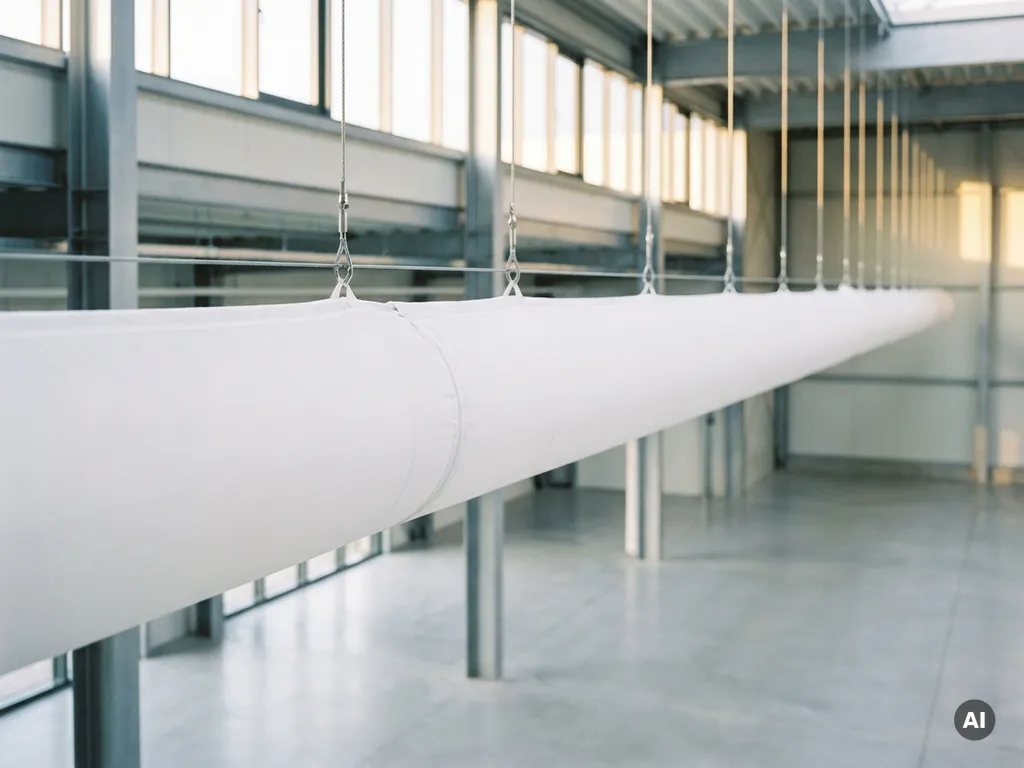
Textile ventilation systems take a fundamentally different approach: air exits across the entire surface of the textile air duct at very low velocity. The result is uniform, area-wide air distribution without any drafts. This effect is achieved through the permeability of the textile material, which distributes air evenly along the entire length of the duct and thereby creates a homogeneous room airflow.
When is maintenance enough, and when does the system need a fundamental overhaul?
Maintenance is sufficient when the system is fundamentally designed correctly and the problems are attributable to contamination, filter blockage, or misadjustment. A fundamental overhaul is necessary when the design itself is flawed, when the use of the room has changed significantly, or when the air distribution has structural deficiencies.
Typical maintenance triggers include dirty filters that reduce volumetric flow, blocked outlets that alter the direction of airflow, or incorrectly set dampers. These issues can be resolved during a routine inspection and explain why ventilation systems quickly lose effectiveness without regular maintenance.
A structural overhaul, on the other hand, is required when:
- Rooms are converted or put to new use and the original design no longer fits
- Dead zones and short-circuit flows persist despite maintenance
- The outlets are fundamentally incorrectly positioned or sized
- The system continuously generates drafts that cannot be eliminated through adjustment
- Energy consumption and comfort are in no reasonable proportion to each other
In such cases, a complete review of the air routing is advisable — often combined with the replacement or addition of outlets. Textile ventilation systems can frequently be retrofitted in these situations and offer a cost-effective alternative to a complete reinstallation of conventional systems.
How Kienzler Klima helps with poor air quality and uneven air distribution
At Kienzler Klima, we have been developing and manufacturing textile ventilation systems for over 30 years — systems that solve exactly the problems described in this article: stuffy air despite ventilation, drafts, dead zones, and uneven temperature distribution. Our textile air ducts are not off-the-shelf products; they are individually designed for each application and produced within an average of 14 days.
What our solution delivers in concrete terms:
- Uniform air distribution: Air exits across the entire surface at low velocity — no drafts, no dead zones
- Individual design: Every duct is tailored to the specific room, its use, and its requirements
- Savings of up to 60%: Compared to conventional sheet metal systems in terms of material and installation costs
- Made in Germany: Production at our Allgäu facility, short lead times, rigorous quality control
- Cradle-to-Cradle certified: Sustainability across the entire value chain
- Permanent fire protection: Chemically anchored in the yarn, not washable out
Whether office, laboratory, production hall, or food processing facility — we find the right solution for your application. Get in touch with us and let us analyze together why your rooms remain stuffy despite ventilation — and how that can be changed permanently.