
Humidity and indoor comfort are directly linked: relative humidity affects how warm or cold we feel, how well we can breathe, and how productive we are in everyday life. When it falls outside the optimal range, wellbeing suffers noticeably — regardless of whether the room temperature is right. The following questions explore why this is the case and how you can maintain a healthy indoor climate on a lasting basis.
What effect does relative humidity have on wellbeing?
Relative humidity plays a decisive role in how people perceive temperature and air quality. It describes how much water vapor the air contains relative to its maximum capacity. When this value is too high or too low, the body responds with complaints — from dry mucous membranes to feelings of sweating and difficulty concentrating.
Particularly relevant is the interaction between temperature and humidity: at high humidity, sweat evaporates less effectively, the body cools down less efficiently, and heat feels more oppressive. At low humidity, eyes and airways dry out, promoting irritation and increased susceptibility to infections. Wellbeing is therefore not solely a matter of temperature, but always also a matter of the moisture content of the indoor air.
What humidity level is optimal indoors?
The optimal humidity level indoors is between 40 and 60 percent relative humidity. Within this range, the indoor air feels comfortable for most people, mucous membranes remain moist, and the risk of mold growth or excessive dryness is low.
For certain types of use, narrower target values apply. In offices and workspaces, experts frequently recommend a target of 45 to 55 percent, as concentration and performance are most stable within this range. In bedrooms, a slightly lower humidity of 40 to 50 percent may be appropriate. Special requirements exist in laboratories, hospitals, or food production facilities, where precise humidity values are part of the technical specification.
What happens when indoor air is too dry or too humid?
Air that is too dry — meaning relative humidity below 40 percent — irritates mucous membranes, dries out skin and eyes, and promotes the transmission of viruses. Air that is too humid, above 60 percent, encourages mold growth, increases the perceived warmth, and can permanently damage building materials.
Consequences of air that is too dry
Dry indoor air occurs particularly during the heating season, when cold outdoor air with little absolute moisture content enters buildings and is warmed up. The result: relative humidity drops significantly. Those affected frequently complain of a scratchy throat, headaches, dry eyes, and increased susceptibility to infections. Electrostatic charges on surfaces and sensitive equipment also increase.
Consequences of air that is too humid
Excessively high humidity often results from inadequate ventilation in rooms with high moisture production — such as kitchens, bathrooms, or heavily occupied offices. Persistently humid indoor air promotes mold spores, which not only attack building structures but can also trigger respiratory illnesses. At the same time, rooms with high humidity and normal temperatures feel stuffy and uncomfortably warm.
How does the ventilation system affect indoor air humidity?
A ventilation system regulates indoor air humidity by exchanging moist indoor air with drier or conditioned outdoor air. Depending on the system type, it can actively influence humidity, passively control it, or regulate it to a specific target value.
Simple supply and exhaust air systems ensure a defined air exchange rate and prevent moisture from building up uncontrollably. Comfort ventilation systems with heat recovery retain the heat within the building without sacrificing air exchange. Systems with integrated humidification and dehumidification go one step further: they actively maintain relative humidity within a specified range, regardless of outdoor conditions or intensity of use.
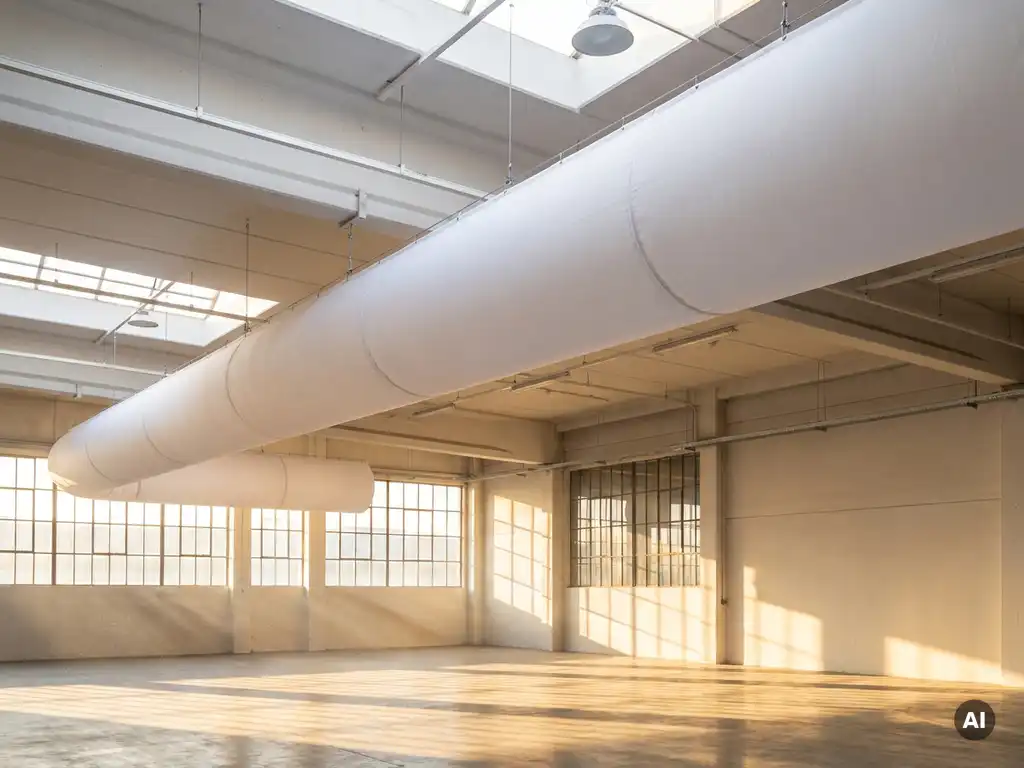
Also critical is how the conditioned air is introduced into the room. Textile air distribution systems distribute supply air evenly across the entire room area, avoid drafts, and ensure that temperature and humidity are delivered homogeneously throughout the room — without cold or dry zones.
When is natural ventilation insufficient for humidity control?
Natural ventilation is insufficient for humidity control when moisture production in the room is persistently high, outdoor conditions are unfavorable, or the air exchange rate is structurally inadequate. In these situations, a mechanical ventilation solution is required.
Specifically, natural ventilation reaches its limits in the following cases:
- High occupancy: Each person releases up to half a liter of moisture into the indoor air per hour. In offices, event spaces, or production halls, this adds up quickly.
- Industrial processes: Food production, cleanroom technology, or laboratories generate defined quantities of moisture that cannot be controlled through window ventilation.
- Summer heat periods: When outdoor air is itself humid and warm, opening windows provides no relief — quite the contrary.
- Winter operation in well-insulated buildings: Modern building envelopes are so airtight that natural air exchange barely occurs. Without mechanical ventilation, indoor humidity rises.
In these use cases — such as in various industries and applications — a technical solution is not optional, but an integral part of the room concept.
How can the indoor climate be maintained at optimal levels on a lasting basis?
The indoor climate can be optimized on a lasting basis by coordinating air exchange, temperature control, and humidity regulation. The key is a ventilation concept that takes into account the specific requirements of the space — use, occupancy, outdoor climate — and implements them technically.
The following measures form the foundation for a permanently comfortable indoor climate:
- Adequate, regulated air exchange through mechanical ventilation
- Demand-based humidification or dehumidification of supply air
- Even air distribution throughout the entire room without drafts
- Monitoring and control of indoor humidity via sensors and control technology
In the short term, mobile humidifiers or dehumidifiers can help, but they do not resolve structural problems. Anyone looking to improve the indoor climate sustainably cannot avoid a well-conceived system solution.
How Kienzler Klima supports indoor climate optimization
At Kienzler Klima, we develop and manufacture textile air distribution systems that make a central contribution to a balanced indoor climate. With more than 30 years of experience in air and climate technology, we know that effective humidity control only works when conditioned air is also distributed evenly and draft-free throughout the entire room.
Our solutions offer concrete advantages:
- Even humidity and temperature distribution through permeable textile surfaces, from which air exits at low velocity
- Individual design for every application — whether office, laboratory, food production, or sports hall
- Short delivery times of an average of 14 days for custom manufacturing in Germany
- Savings of up to 60% on material and installation costs compared to conventional sheet metal systems
- Cradle-to-Cradle certification for a sustainable value chain
Whether new construction or renovation — our textile air distribution systems can be integrated into virtually any ventilation concept. Get in touch with us: we are happy to advise you on how to bring the indoor climate in your building to optimal levels on a lasting basis. Contact us now and request a personalized consultation.