
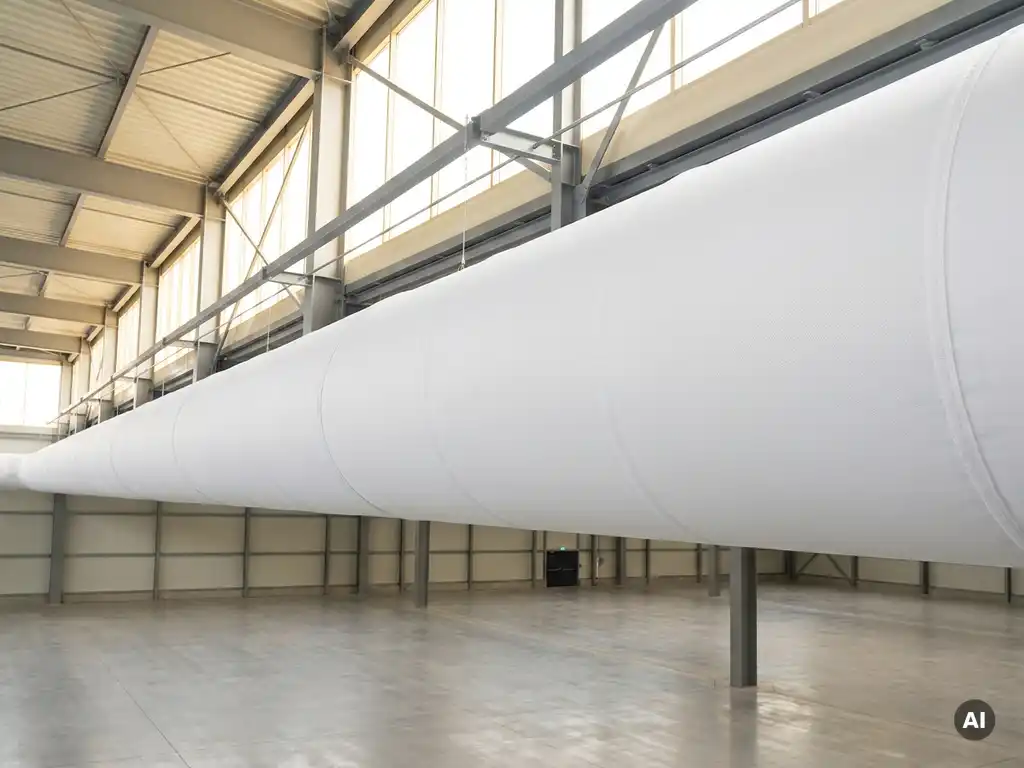
Modern ventilation systems achieve draft-free air distribution by distributing air over a large surface area at very low outlet velocities, rather than injecting it at a single point at high speed. The decisive factor is the outlet velocity: if it remains permanently below 0.15 to 0.20 m/s in the occupied zone, people no longer perceive the air movement as disruptive. The following sections answer the most important questions about draft-free air distribution and textile ventilation systems.
How does drafts occur in conventional ventilation systems?
Drafts occur in conventional ventilation systems because air exits at a few concentrated outlet points at high flow velocities. Ceiling diffusers or sheet metal slot nozzles generate directed air jets that only slow down as they travel through the room. In the occupied zone, flow velocities of 0.3 m/s and more can occur, which people clearly perceive as a draft.
In addition, sheet metal duct systems distribute air unevenly: near the outlet, air movement is intense, while poorly ventilated areas develop further away. This combination of local over-supply and under-supply leads to temperature differences in the room and an uncomfortable indoor climate. This problem is particularly noticeable in large halls, production facilities, or offices with many workstations.
How does air distribution work in textile ventilation systems?
In textile ventilation systems, air does not exit at individual points but distributes evenly across the entire surface of the textile air duct. The permeable textile material acts like a fine-pored filter: air permeates through the fabric and reaches the occupied zone at very low velocity. This principle guarantees permanently uniform air distribution without local flow peaks.
The textile duct simultaneously serves as both the duct and the air outlet. Because the entire outer surface is used for air discharge, the volume of air introduced is distributed over a much larger outlet area than with conventional systems. The result is a uniform air cushion throughout the room that reliably prevents drafts while also ensuring homogeneous temperature distribution.
What air velocities are considered draft-free for people?
Air movement is considered draft-free when the flow velocity in the occupied zone remains permanently below 0.15 m/s. Values between 0.15 and 0.25 m/s are still tolerated by many people, but above approximately 0.30 m/s, the majority of individuals perceive the air movement as an uncomfortable draft. These threshold values are defined in DIN EN ISO 7730 and the comfort standards for indoor climate.
It is important to note that these are not just peak values: even brief, repeated flow peaks, such as those produced by pulsed outlets, can be perceived as disruptive. Textile ventilation systems keep the outlet velocity permanently in the draft-free range by design, because air is distributed across the entire duct surface and no directed air jets are created.
In which building types are textile ventilation systems particularly effective?
Textile ventilation systems are particularly effective wherever uniform air distribution over large areas is required and conventional sheet metal systems reach their limits. Typical areas of application include production halls, logistics centers, sports halls, laboratories, hospitals, and open-plan offices. But textile systems also demonstrate their strengths in the food industry and commercial spaces.
The advantages are especially pronounced in the following building types:
- Industrial halls and logistics centers: Large room volumes can be supplied uniformly and draft-free across the entire area, without complex duct branching.
- Sports halls and leisure facilities: Athletes are particularly sensitive to drafts; textile systems enable high air volumes with minimal draft risk.
- Food industry and laboratories: Hygiene requirements and uniform temperatures can be maintained more effectively with textile systems than with sheet metal ducts.
- Hospitals: Infection control and patient comfort benefit from uniform, draft-free air guidance.
- Offices and commercial spaces: Thermal comfort at the workplace increases, and complaints about drafts are eliminated.
A detailed overview of industry-specific applications can be found on the industry overview for textile air ducts.
What distinguishes textile ventilation ducts from sheet metal ducts?
The fundamental difference between textile air ducts and sheet metal ducts lies in the way air is discharged: sheet metal ducts transport air and release it at defined outlets, while textile ducts allow air to permeate across their entire surface. This leads to fundamentally different flow patterns in the room and has far-reaching consequences for comfort, installation, and costs.
Comfort and indoor climate
Textile systems do not generate directed air jets and therefore prevent drafts by design. Sheet metal systems, on the other hand, rely on targeted outlets and require careful planning to minimize drafts, which in practice is not always fully achieved.
Installation, hygiene, and costs
Textile ventilation ducts can be installed and removed considerably faster than rigid sheet metal systems. They are washable, which is a decisive advantage in the food industry or hygiene-sensitive environments. In terms of material and installation costs, textile systems can achieve savings of up to 60% compared to conventional sheet metal systems. In addition, textile ducts are lighter, which reduces the demands on the supporting structure.
How is a textile ventilation system designed for a specific project?
The design of a textile ventilation system begins with recording the room-specific parameters: room geometry, air volumes, cooling and heating loads, and the type of use of the building. On this basis, duct diameter, textile permeability, duct length, and arrangement in the room are calculated so that the desired outlet velocity in the occupied zone is permanently achieved.
Individual customization is crucial: no two rooms are alike, and a textile air duct tailored to a specific application delivers significantly better results than a standard product. Parameters such as perforation pattern, material selection, and duct diameter are determined on a project-specific basis. The product overview for textile air ducts provides an initial overview of the available variants and configurations.
Planning typically involves the following steps:
- Needs analysis: Recording room dimensions, occupancy load, air volume, and requirements for temperature and hygiene.
- System design: Calculation of duct diameter, permeability, and arrangement based on room data.
- Custom manufacturing: Production of the textile duct to measure, with an average production time of 14 days.
- Installation and commissioning: Fast installation thanks to the low weight and flexible handling of the textile system.
- Service and maintenance: Regular cleaning by washing, without the need for complex disassembly of rigid components.
How Kienzler Klima achieves draft-free air distribution for your project
At Kienzler Klima, we have been developing and manufacturing custom textile ventilation systems for over 30 years — systems that not only promise draft-free air distribution but ensure it by design. Every textile air duct is tailored by us to the specific application and produced at our facility in the Allgäu region, with an average delivery time of just 14 days.
What we deliver for your project:
- Individual planning and design based on your room geometry, air volumes, and usage requirements
- Custom-made textile air ducts with project-specific permeability, project-specific diameter, and project-specific length
- Production in Germany with Cradle-to-Cradle certification and permanently integrated fire protection
- Savings of up to 60% on material and installation costs compared to sheet metal systems
- Service and maintenance throughout the entire product lifecycle
Whether production hall, hospital, sports hall, or office: we support planners, installers, and operators from the initial inquiry through to commissioning. Get in touch and tell us about your project. We will respond promptly with a concrete assessment.