
Heat recovery in modern ventilation systems works by using the thermal energy of the exhaust air to pre-heat the fresh outdoor air before it enters the room. This significantly reduces the energy demand for heating and air conditioning without compromising comfort or air quality. How efficient this process is depends greatly on the technology used and the type of air distribution. The following questions shed light on the most important aspects of heat recovery and draft-free ventilation.
How much energy can actually be saved through heat recovery?
Modern heat recovery systems achieve recovery rates of 70 to over 90 percent. This means: the majority of the heat that would otherwise be lost with the exhaust air remains in the system and noticeably reduces heating demand. In well-insulated buildings, heat recovery can cover a significant portion of the heating energy requirement.
Several factors are decisive for actual savings:
- The temperature difference between indoor and outdoor air (the greater the difference, the more potential)
- The efficiency of the heat exchanger used
- The operating hours of the ventilation system
- The tightness of the overall system to avoid leaks
Especially in industrial and commercial buildings that are ventilated year-round, the investment pays off quickly. Heat recovery also makes a contribution in summer: through enthalpy exchange, cool exhaust air can be used to pre-cool the warm supply air, an effect that reduces the cooling load and thus the energy consumption of the air conditioning system.
What types of heat exchangers are used in modern ventilation systems?
In modern ventilation systems with heat recovery, three main types of heat exchangers are used: cross-flow heat exchangers, counter-flow heat exchangers, and rotary heat exchangers. Each type has specific strengths that make it particularly suitable for certain applications.
Cross-flow and counter-flow heat exchangers
In a cross-flow heat exchanger, supply and exhaust air flow at right angles to each other through a plate pack. It is compact, low-maintenance, and well suited for medium-level requirements. The counter-flow heat exchanger directs both air streams in opposite directions, which is thermodynamically more favorable and enables efficiencies of over 85 percent. Both variants are purely recuperative — the air streams remain physically separated, which is hygienically advantageous.
Rotary heat exchangers
The rotary heat exchanger, also known as a heat recovery wheel, operates regeneratively: a rotating, heat-storing wheel absorbs heat from the exhaust air and transfers it to the supply air. It achieves very high recovery rates and can also transfer moisture (enthalpy recovery). However, a small transfer of exhaust air particles to the supply air cannot be completely ruled out — a point that should be carefully considered in sensitive applications such as hospitals or clean rooms.
How does air distribution affect the efficiency of heat recovery?
Air distribution directly influences the efficiency of heat recovery: if the pre-heated supply air is distributed inefficiently and mixes unevenly with the room air, temperature zones and short-circuit flows develop. This reduces the actually usable heat quantity in the room and lowers the perceived efficiency of the overall system.
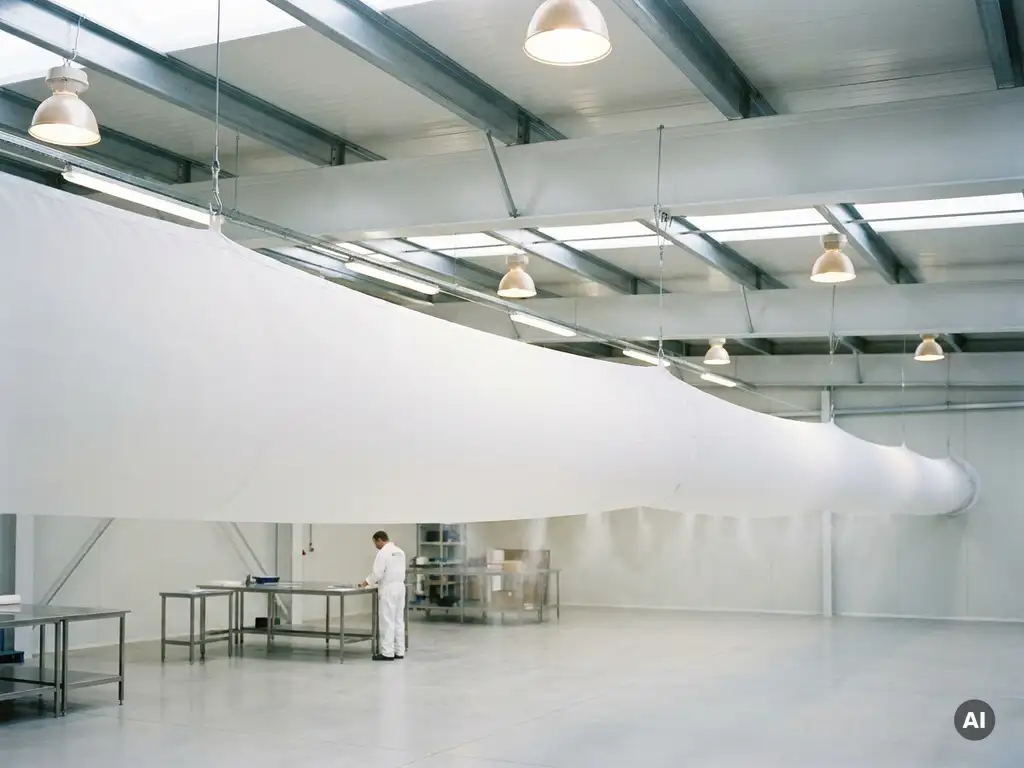
Uniform, area-wide air distribution ensures that the pre-heated supply air penetrates the entire room without any areas being overheated or undersupplied. Textile air distribution addresses exactly this: due to the permeability of the textile material, air exits at very low velocity over the entire surface of the duct. This creates a homogeneous temperature distribution in the room that fully exploits the potential of heat recovery.
In contrast, conventional sheet metal ducts with point-source outlets can generate local turbulence that reduces the efficiency of the recovered heat. The choice of air distribution system is therefore not a minor detail, but an integral part of an energy-efficient ventilation concept.
Why is draft-free air supply relevant for heat recovery?
Draft-free air supply improves heat recovery because it prevents short-circuit flows. When supply air is introduced into the room at high velocity and in a directed stream, it can travel directly to the exhaust air opening without fully mixing with the room. This reduces the actually utilized thermal energy and deteriorates air quality.
With draft-free ventilation, air exits slowly and evenly, spreads throughout the room, and mixes gently with the existing room air. This has two advantages for heat recovery:
- The exhaust air returning to the heat exchanger has actually absorbed heat from the room — the recovery process is thermally meaningful.
- The room temperature remains homogeneous, so no unnecessary reheating of individual areas is required.
Draft-free ventilation systems thus not only improve user comfort, but also optimize the overall energy balance of the building. The relationship between air distribution and heat recovery is often underestimated in planning — yet it is one of the decisive levers for real efficiency gains.
When is it worth retrofitting heat recovery?
Retrofitting heat recovery is particularly worthwhile when an existing ventilation system is already mechanically ventilated and is associated with significant heating or cooling costs. The higher the air volume flow and the longer the operating hours, the faster the investment pays off.
Concrete indicators that favor retrofitting:
- The building is mechanically ventilated year-round (industrial, commercial, public buildings)
- Energy costs for heating or cooling are a relevant cost factor
- The existing system operates with pure fresh air supply without heat recovery
- A renovation or expansion of the ventilation system is planned anyway
In existing buildings, integrating heat recovery is often associated with structural effort, as supply and exhaust air ducts must be brought together. Careful planning is recommended here, during which the air distribution system should also be reviewed. Textile ventilation systems offer a practical advantage: they can be installed faster and more cost-effectively than conventional sheet metal systems, which reduces the overall investment of the retrofit.
What maintenance does a ventilation system with heat recovery require?
A ventilation system with heat recovery requires regular maintenance to permanently maintain its efficiency. The most important maintenance intervals and measures concern filters, heat exchangers, and the air distribution system. Without regular upkeep, the recovery rate drops, and at the same time the pressure loss in the system increases, which raises energy consumption.
An overview of typical maintenance tasks:
- Replace filters: Supply and exhaust air filters should be replaced every three to twelve months depending on the load. Clogged filters increase pressure loss and put strain on the fan.
- Clean heat exchangers: Dust and dirt deposits on the heat exchanger surfaces reduce heat transfer. An annual inspection is recommended.
- Check condensate drain: Condensation water forms in counter-flow and cross-flow heat exchangers. The drain must be clear and functional to prevent mold growth.
- Inspect air distribution system: Ducts and outlets should be checked for deposits and damage.
Textile ventilation systems score points here with a practical maintenance advantage: the textile ducts can generally be completely removed and cleaned in an industrial washing machine — a hygienic and straightforward process that is particularly valued in sensitive areas such as food production or hospitals. The textile air duct product overview provides a good overview of which systems are suitable for which requirements.
How Kienzler Klima supports you with heat recovery and draft-free ventilation
At Kienzler Klima, we combine more than 30 years of experience in air and climate technology with the expertise of a specialized manufacturer of textile ventilation systems. Our solutions are designed to unlock the full potential of your heat recovery — through uniform, draft-free air distribution that increases the efficiency of the overall system.
What we specifically do for you:
- Individual planning: Each textile air duct is designed specifically for your application — room geometry, volume flow, and temperature requirements are incorporated directly into the design.
- Short delivery times: With an average production time of just 14 days, we respond quickly to your needs — even for retrofit projects.
- Made in Germany: All products are manufactured at our site in the Allgäu. Cradle-to-Cradle certification and permanently integrated fire protection are a matter of course.
- Up to 60% savings on material and installation costs compared to conventional sheet metal systems — a compelling argument, especially for retrofits.
- Comprehensive service: From consultation and planning through to maintenance, we support you throughout the entire lifecycle of your ventilation system.
Get in touch with us — we will analyze your situation and show you how textile air distribution can make your ventilation system with heat recovery more efficient. Contact us now for a no-obligation consultation.