
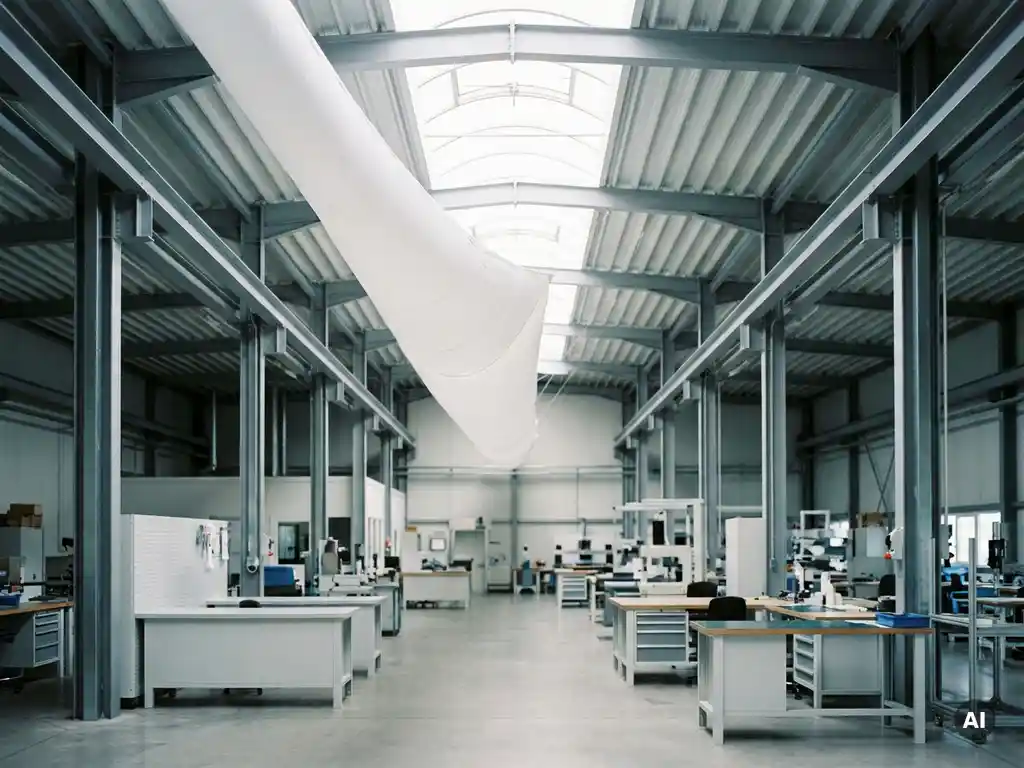
Employees freeze at floor level because warm air is lighter than cold air and therefore rises physically upward, directly beneath the hall ceiling, where it warms no one. In tall industrial halls, logistics centers, or sports halls, this effect can lead to temperature differences of up to 15 °C between the floor and ceiling. The following sections explain why this happens, what consequences it has, and how the problem can be solved permanently.
Why does warm air rise in halls?
Warm air rises in halls because it has a lower density than cold air. In physical terms: heated air molecules move faster, take up more space, and therefore become lighter. The surrounding cooler air displaces them upward — a process known as thermal buoyancy or convection.
In a living space with a normal ceiling height, this effect is barely noticeable. In an industrial hall with a clear height of eight, twelve, or even twenty meters, however, warm air has plenty of room to rise. The result: a stable cushion of warm air accumulates beneath the ceiling, which does not naturally mix with the cooler floor zone. Conventional heating systems that blow air from central outlets often amplify this effect, because the blown warm air immediately rises before it reaches the area where people work.
How large is the temperature difference between floor and ceiling?
In untreated industrial halls, the temperature difference between floor and ceiling is often 8 to 15 °C. In particularly tall halls or with unfavorable air distribution, it can be even more. As a rule of thumb: for every meter of height, the air temperature increases by approximately 1 to 3 °C, depending on the hall geometry, heat sources, and air distribution system.
In concrete terms, this means: if the heating system is designed for 18 °C in the working area, temperatures of 28 to 30 °C can easily prevail beneath the ceiling of a ten-meter-high hall. This energy is completely wasted — it heats the roof instead of the people. At the same time, the floor area remains cold, and the heating system runs at full capacity to reach the target temperature. The result: high energy costs combined with unsatisfactory comfort levels.
What are the consequences for health and productivity?
Cold floors and drafty temperatures in the working area directly burden the health of employees. Cold at floor level leads to cold feet, tense muscles, and an increased risk of colds — especially when workers stand or sit for extended periods and move little. Over time, absenteeism increases and performance measurably declines.
In addition to the health effects, productivity also suffers. Studies in occupational ergonomics consistently show that thermal comfort is one of the most important factors for concentration and work performance. Those who are cold make more mistakes, are less focused, and tire more quickly. For companies with physically active teams — such as those in production, logistics, or the trades — this is an economically significant problem.
There is also the energy aspect: a heating system working against the laws of physics consumes significantly more energy than necessary. Heating costs rise while comfort in the working area remains low. Industries and applications such as food production, logistics, or manufacturing are particularly frequently affected.
How can temperature stratification in halls be resolved?
Temperature stratification in a hall can be resolved by actively and evenly distributing air throughout the entire hall volume, so that warm and cold air layers mix and no stable warm cushion can form beneath the ceiling. There are various technical approaches to achieve this.
Destratifiers and ceiling fans
Destratifiers are fans mounted beneath the ceiling that push the accumulated warm air downward. They are comparatively easy to install and can be retrofitted in many existing halls. The disadvantage: they create air movements that can be perceived as drafts — particularly unpleasant for tasks where people stand or sit in one place for extended periods.
Surface-area air distribution systems
A more effective solution is the uniform introduction of conditioned air along the entire length of the hall, directly into the area where people are present, at a low discharge velocity. Textile air distribution systems work according to this principle: air exits across the entire surface of the textile duct and is distributed evenly and without drafts. This prevents the formation of temperature layers from the outset, rather than combating them after the fact.
How does textile air distribution work against temperature stratification?
Textile air distribution combats temperature stratification in halls by introducing conditioned air into the space at very low discharge velocity across the entire surface of a permeable textile duct. Instead of point-source injection at a few locations, a large-area, uniform airflow is created along the entire length of the hall.
The operating principle is based on the permeability of the textile material: air does not exit through nozzles or slots, but diffuses through the entire fabric. The discharge velocity is so low that no drafts are created — even sensitive applications such as laboratories, food production, or offices benefit from this. At the same time, air is distributed so evenly that temperature differences between floor and ceiling are minimized.
A further advantage: textile systems can be used for both heating and cooling applications. In winter, warm air is introduced close to the floor and distributed evenly, without immediately rising. In summer, cooled air is introduced in such a way that it does not sink and create cold zones at floor level. The result in both cases is a consistently uniform temperature distribution throughout the entire hall volume. You can find more information in the product overview for textile air ducts.
Which types of halls are best suited for textile systems?
Textile air distribution systems are particularly well suited for tall, large-area halls where temperature stratification is pronounced and uniform conditions throughout the entire working area are required. These include production halls, logistics centers, food processing facilities, sports halls, and hospitals.
In production and industrial halls, textile systems stand out for their robustness, ease of cleaning, and the ability to tailor them precisely to the hall geometry. In the food industry, they are especially sought after because they offer no dirt traps and are hygienically easy to clean. In sports halls, the draft-free air distribution ensures that athletes do not perceive disruptive air currents — a comfort feature that is difficult to achieve with conventional systems.
Logistics centers — such as those operated by companies like Amazon or major automotive suppliers — also rely on textile systems because they can be installed quickly, reconfigured flexibly, and operated cost-effectively. Compared to conventional sheet metal duct systems, savings of up to 60% can be achieved on material and installation costs. For existing halls where retrofitting without extensive structural intervention is desired, textile systems also offer clear advantages.
How Kienzler Klima helps combat temperature stratification in your hall
At Kienzler Klima, we have been developing and manufacturing textile air distribution systems for over 30 years — exclusively in Germany, at our location in the Allgäu region. Every textile duct is individually designed for the specific application and is typically manufactured within 14 days. This means: no off-the-shelf standard solution, but a system precisely tailored to your hall dimensions, your air volume flow, and your operational requirements.
What we specifically do for you:
- Individual planning and design of the textile air duct based on your hall geometry and climate requirements
- Manufacturing in Germany with short lead times and a dedicated point of contact
- Cradle-to-Cradle-certified materials for sustainable and long-lasting solutions
- Permanent fire protection, chemically anchored in the yarn — not washable out
- Service and maintenance throughout the entire lifecycle of the system
Whether it’s a production hall, logistics center, or sports hall: we find the right solution for your temperature problems. Get in touch now and receive a no-obligation consultation.