
Older people experience drafts more intensely than younger people because their bodies become less efficient at producing and regulating heat as they age. Blood circulation decreases, muscle mass declines, and the skin becomes more sensitive to air movement. The result: even moderate airflows that younger people barely notice can trigger a distinct feeling of cold in seniors. The following sections explore the physiological background, relevant medical conditions, and practical measures for a comfortable indoor climate.
What happens in the body when older people feel a draft?
When older people feel a draft, their bodies react faster and more intensely than those of younger individuals. This is primarily due to reduced heat production: as people age, muscle mass decreases, and muscles generate a significant portion of body heat even at rest. At the same time, blood circulation in the skin diminishes, meaning less warm blood reaches the body’s surface.
The skin itself also changes: it becomes thinner, loses fatty tissue in the subcutaneous layers, and therefore provides less insulation against temperature fluctuations. The thermoreceptors in the skin — the sensors that register temperature and air movement — remain functional. However, because the body retains less heat, even a slight draft immediately feels cooling. In addition, the autonomic nervous system responds more slowly to cold stimuli with age, and the counter-regulation mechanisms, such as muscle shivering or vasoconstriction, are delayed.
How does heat perception differ between young and old?
The heat perception of older people differs from that of younger individuals primarily in terms of sensitivity threshold and response speed. Younger people quickly compensate for brief cold stimuli through muscle activity and well-regulated blood circulation. In seniors, this compensatory mechanism is weakened, meaning the feeling of cold lasts longer and is perceived more intensely.
Another difference lies in the basal metabolic rate: young people burn more energy at rest and generate more body heat as a result. Older people often have a lower basal metabolic rate, which slightly lowers their core temperature at rest. This makes them more susceptible to draft sensitivity, even in rooms that are objectively considered comfortable. Experts refer to this as a shifted comfort zone: what feels pleasantly warm to a 30-year-old may already feel cool or drafty to a 75-year-old.
Which medical conditions intensify the sensation of drafts in old age?
Certain conditions that occur more frequently with age significantly increase draft sensitivity in seniors. These include, above all, circulatory disorders, rheumatic diseases, hypothyroidism, and diabetes. These conditions directly affect the body’s ability to generate, store, and distribute heat.
- Peripheral circulatory disorders: Arms, legs, hands, and feet receive less warm blood. Even slight air movement noticeably cools these parts of the body.
- Rheumatic diseases: Joints and muscles respond to cold with increased pain, which worsens the subjective perception of drafts.
- Hypothyroidism: Reduces metabolism and therefore the body’s overall heat production.
- Diabetes mellitus: Can damage nerve endings (diabetic neuropathy) and alter temperature perception.
- Heart failure: Weakens the heart’s pumping capacity, which impairs peripheral circulation and therefore heat distribution.
Anyone living or working with older or ailing individuals should plan the indoor climate for seniors with particular care. A well-designed ventilation system can make the difference between comfort and persistent discomfort.
What air velocity is considered draft-free for seniors?
An air velocity of less than 0.15 meters per second in the occupied zone is considered draft-free for seniors. This value is significantly below the general comfort threshold of 0.2 to 0.25 m/s that is considered acceptable for younger, healthy adults. For care facilities, hospitals, and rooms with a high proportion of seniors, the design should be even more conservative.
The European standard EN ISO 7730 describes thermal comfort and distinguishes between different comfort categories. For rooms with particularly sensitive groups of people, Category A is recommended, as it imposes the strictest requirements on air velocity and temperature uniformity. What matters is not only the average flow velocity, but also the turbulence intensity: fluctuating, uneven air movements are perceived as more unpleasant than constant, uniform flows with the same average velocity.
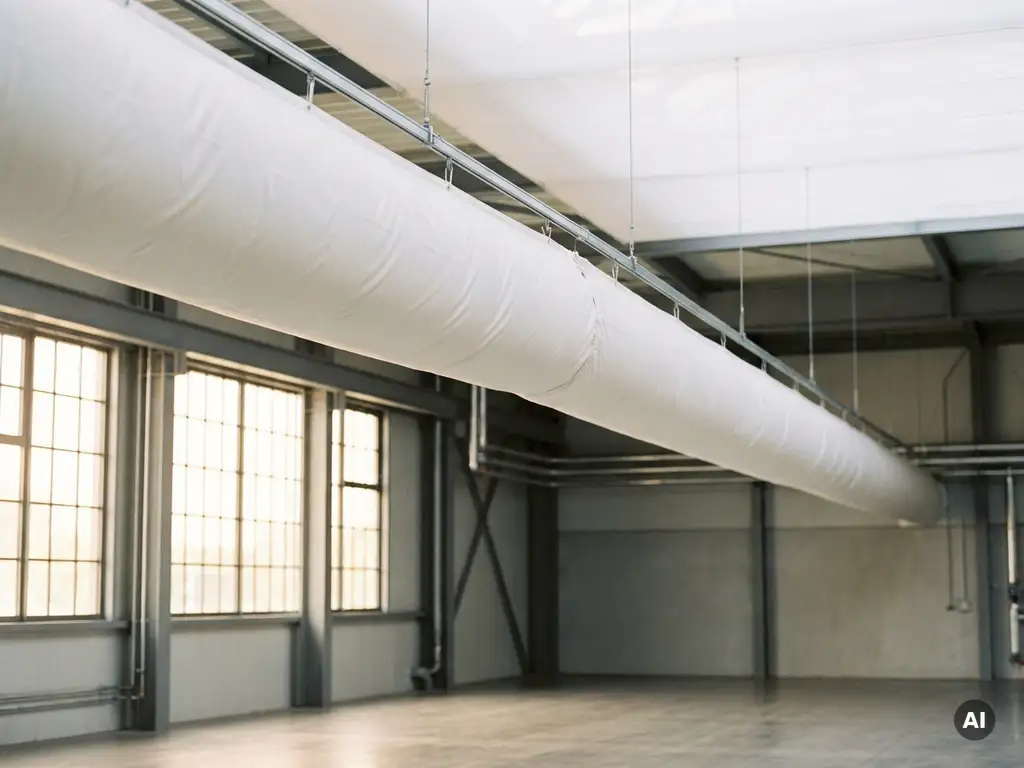
Conventional sheet metal ducts with slot nozzles or long-throw nozzles reach their limits here because they deliver air in a concentrated stream at higher velocities. Textile air distribution systems, on the other hand, allow air to exit evenly across the entire surface of the duct, enabling flow velocities well below the draft threshold. You can find more about the basics of textile air ducts in our overview.
How can drafts be avoided in rooms with a mixed age structure?
Drafts in rooms with a mixed age structure can be avoided most effectively through uniform, area-wide air distribution with low discharge velocities. The key is that air is not blown in a concentrated stream into the occupied zone, but instead spreads gently and evenly throughout the entire room. Careful zone planning and adapted temperature levels also help.
Specific measures to avoid drafts in mixed-use rooms:
- Choose area-wide air distribution: Systems that deliver air over a large surface at low velocity significantly reduce the risk of drafts.
- Check outlet positioning: Air outlets should not be placed directly above seating or areas where older individuals spend time.
- Raise room temperature slightly: A room temperature of 21 to 22 degrees Celsius instead of the usual 20 degrees noticeably reduces the feeling of cold in seniors.
- Identify draft sources: Leaky windows, poorly insulated exterior doors, and incorrectly adjusted ventilation systems are common but fixable causes.
- Plan for individual zone control: Where possible, areas with a high proportion of seniors should be controlled separately.
Especially in rooms where younger and older people work or spend time together — for example in offices, waiting areas, or communal rooms — professional planning of the ventilation concept is worthwhile. A look at possible products for air distribution shows what technical solutions are available today.
How Kienzler Klima helps with draft problems
Drafts are not an unavoidable fate, but a matter of proper system design. This is exactly where we come in with our textile ventilation and air conditioning systems. With more than 30 years of experience in air and climate technology, we develop solutions that create a comfortable indoor climate even for sensitive groups such as seniors.
What our systems specifically deliver:
- Draft-free air distribution: Due to the permeability of the textile material, air exits evenly across the entire duct surface at very low velocity — well below the draft threshold for seniors.
- Individual design: Every textile air duct is planned specifically for the respective room and usage requirements, with an average production time of just 14 days.
- Cost advantage over sheet metal systems: Our textile air distribution systems enable savings of up to 60 percent on material and installation costs.
- Made in Germany: All value creation steps take place at our site in the Allgäu region, with short lead times and high manufacturing quality.
- Cradle-to-Cradle certified: Sustainability is not a buzzword for us, but part of our entire value chain.
Whether it’s a care facility, an office with a mixed age structure, or a hospital corridor: we are happy to advise you on the solution that fits your room concept. Get in touch now and describe your situation to us. We will get back to you quickly and without complications.