
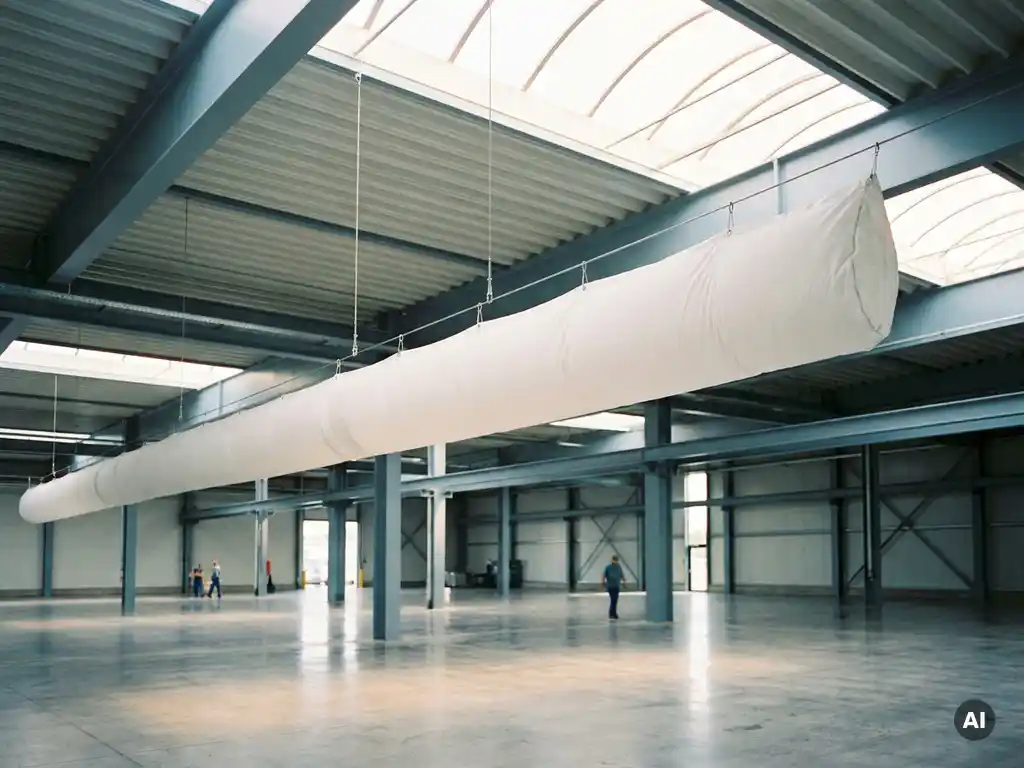
Displacement ventilation and textile surface diffusion take fundamentally different approaches in production halls: displacement ventilation introduces fresh air near the floor at low velocity and uses thermal buoyancy forces, while textile surface diffusion distributes air evenly across the entire surface of a textile air duct. Which system better suits your production hall depends on room geometry, heat load distribution, and usage requirements. The following sections examine both systems in a direct comparison.
How does displacement ventilation work technically in production halls?
Displacement ventilation introduces conditioned air into the space at very low flow velocities, typically below 0.5 m/s, near the floor or at working height. The cool, denser supply air spreads like a layer across the floor and displaces the warmer, pollutant-laden room air upward, where it is extracted. This principle uses natural thermal buoyancy forces and creates a stable, directed airflow.
In production halls, displacement ventilation is often implemented via displacement air outlets at walls or in the floor area. The advantage: pollutants, heat, and moisture generated at machines or processes are transported upward in a targeted manner without spreading into the occupied zone. Air quality in the work area is therefore often significantly better than with mixed ventilation systems.
Technically, however, displacement ventilation requires careful planning. The supply air temperature may only be a few degrees below room temperature, as air that is too cold does not rise but remains at floor level and causes drafts. High heat loads, such as those occurring in many production halls, therefore limit the application range of this system.
How does textile surface diffusion work in production halls?
Textile surface diffusion is based on the principle of permeability: air exits not at a single point but evenly across the entire surface of a textile air duct. Due to the fine fabric resistance, the air leaves the duct at a very low discharge velocity, enabling draft-free air distribution across large hall areas. Air distribution in production halls is thereby achieved comprehensively and without thermal stratification.
Textile air ducts are mounted below the ceiling or at mid-height and can be individually tailored in length, diameter, and perforation to the specific hall area. Depending on requirements, the air discharge can be controlled via fabric permeability, targeted openings, or combinations of both. This enables both cooling and heating through the same system.
Another advantage of textile ventilation: the system is easy to clean hygienically, as the ducts can generally be removed and washed in a washing machine. In the food industry or in laboratories, this is a decisive advantage over conventional sheet metal ducts.
What are the main differences between displacement ventilation and textile surface diffusion?
The central difference lies in the airflow principle: displacement ventilation works with directed displacement flow from bottom to top, while textile surface diffusion creates a uniform, omnidirectional air distribution without a pronounced flow direction. Both systems avoid drafts but achieve this goal in different ways.
Installation location and geometry
Displacement ventilation requires outlets arranged near the floor or along walls and relies on stable thermal stratification. Textile surface diffusion is installed at ceiling level and can be used more flexibly in terms of geometry, including in halls with irregular floor plans or changing usage areas.
Temperature and heat load
Displacement ventilation depends on small temperature differences between supply and room air. Textile surface diffusion can introduce significantly colder air because the low discharge velocity enables mixing without any sensation of drafts. With high heat loads, such as those frequently occurring in production halls, textile ventilation is therefore often the more powerful solution.
When is displacement ventilation the better choice for a production hall?
Displacement ventilation is particularly well suited for production halls where pollutants or heat are generated in a targeted manner at defined sources and should be removed as directly as possible. Typical applications include halls with welding workstations, paint shops, or chemical processes where a clear separation between a clean occupied zone and a polluted exhaust air zone is desired.
A prerequisite is that heat loads are not too high and that stable thermal stratification can develop. Halls with very high ceilings, uniform heat source distribution, and moderate air volume requirements benefit most from this principle. Where floor channels or wall-mounted installation positions are technically feasible, displacement ventilation is also a sensible option.
When is textile surface diffusion the better choice?
Textile surface diffusion is the better choice when large hall areas need to be supplied uniformly with conditioned air, when high heat loads must be managed, or when hygienic requirements call for easy cleaning of the air distribution system. It also has an advantage when flexible space usage or frequent layout changes are to be expected.
Particularly in food production, logistics centers, automotive plants, or industrial halls with many heat sources, textile ventilation demonstrates its strengths. The individual design of each textile air duct for the specific application allows precise adaptation to volume flow, room geometry, and temperature level. Where conventional systems reach their limits, textile surface diffusion often delivers the more flexible and efficient solution.
Which ventilation system saves more costs in production halls?
Textile surface diffusion offers the greater savings potential for material and installation costs in most production halls. Compared to conventional sheet metal duct systems, savings of up to 60% on installation and material costs are achievable, as textile air ducts are lighter, faster to install, and require less maintenance. Displacement ventilation can be useful for specific requirements but is generally more complex to plan and install.
Operating costs also play a role: textile systems operate at low pressure losses, which reduces the energy demand of the ventilation system. In addition, textile air ducts are durable and easy to maintain. Cleaning requires no special tools, which simplifies maintenance intervals and reduces costs.
For a reliable cost assessment, the entire life cycle should always be taken into account: investment, installation, energy demand, maintenance, and potential conversion costs for hall layout changes. In this overall picture, textile surface diffusion comes out more favorably in the majority of production halls.
How Kienzler Klima plans your ventilation solution for production halls
We at Kienzler Klima have more than 30 years of experience in the planning and manufacturing of textile ventilation systems for industrial applications. Whether you need a textile surface diffusion system for a new production hall or want to optimize an existing system: we support you from the initial needs analysis through to the completed installation.
Our range of services includes:
- Individual design of every textile air duct to your room geometry, heat loads, and air volume requirements
- Short production times of an average of 14 days thanks to fully integrated manufacturing at the Allgäu site
- Cradle-to-Cradle-certified products with permanently integrated fire protection that cannot be washed out
- Savings of up to 60% compared to conventional sheet metal systems on material and installation costs
- Service and maintenance throughout the entire product life cycle
Contact us and let us find out together which ventilation system is the optimal solution for your production hall. Get in touch now and receive a no-obligation consultation.