
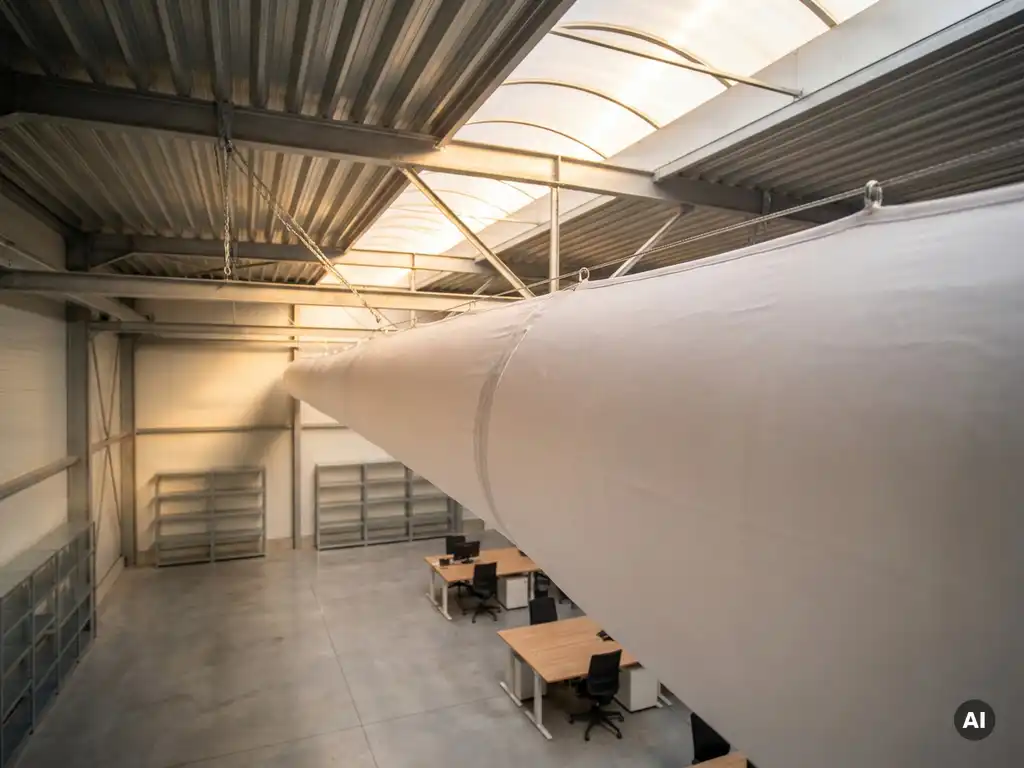
Yes, draft-free air distribution can significantly reduce or even completely replace the use of radiant heaters in many industrial halls. The key factor is the ability of textile air distribution systems to distribute warm air evenly throughout the entire hall volume, thereby breaking up the typical temperature stratification that makes radiant heaters necessary in the first place. The following questions shed light on when and why this switch makes sense.
How does draft-free air distribution work in industrial halls?
Draft-free air distribution in industrial halls works through permeable textile air ducts that do not discharge air at a single point but instead release it evenly across their entire surface. The air exits the textile material at a very low velocity, which prevents drafts and creates a uniform, area-wide temperature distribution.
Conventional metal duct systems channel air through slots or nozzles, creating locally high flow velocities. Textile systems operate on a different principle: the fabric is constructed so that air escapes through thousands of tiny pores. The result is a gentle, large-area air release with no perceptible draft at the workstation.
In practice, the textile air ducts are usually mounted centrally beneath the ceiling or along the longitudinal axis of the hall. Warm or cool air is channeled through the duct and exits along its entire length. This creates a uniform air cushion that covers the entire cross-section of the hall, without individual zones being over-ventilated or others being neglected.
Why are radiant heaters used in industrial halls at all?
Radiant heaters are used in industrial halls because they transfer heat directly to surfaces and people without having to heat the entire volume of air in the hall. In tall halls with large air volumes, this is energetically attractive, since radiant heat acts independently of air temperature and quickly makes work areas comfortable.
The reasoning behind this is understandable: anyone who wants to heat a 15-meter-high production hall to comfortable temperatures throughout needs enormous amounts of energy. Radiant heaters concentrate heat in the zone where people actually work, thereby circumventing the problem of temperature stratification—at least on the level of perceived comfort.
However, radiant heaters do not solve the underlying problem: the air in the hall remains unevenly tempered. Warm air collects near the ceiling while cold air remains close to the floor. This leads to high energy consumption because the heated air rises and is lost to the work areas. In addition, radiant heaters provide no cooling function, which can become a problem during warmer seasons.
What happens to temperature stratification when textile air ducts are used?
Textile air ducts address the problem of temperature stratification directly: the uniform release of air along the entire duct length ensures continuous mixing of the hall air. Warm air that naturally rises is continuously recirculated back into the work area by the active air distribution.
In unheated or poorly ventilated halls, temperature differences between floor level and the roof area can amount to several degrees Celsius. This stratification means that a significant portion of the heating energy introduced is simply wasted, collecting where no one works. A textile air duct breaks up this stratification by actively and evenly distributing air across a wide area.
This has measurable effects on energy consumption: when temperature stratification is eliminated, less energy is needed to reach the desired work zone temperature. The heat introduced actually reaches where it is needed, rather than lingering near the ceiling.
Can textile air ducts both heat and cool?
Yes, textile air ducts are equally suitable for heating and cooling. They distribute both warm and cool air evenly throughout the hall without requiring separate systems for different seasons. This makes them a year-round solution for climate control in industrial and commercial facilities.
In heating mode, warm air is channeled through the duct and exits through the permeable surface. In cooling mode, the system works identically, only with cooled air. The even distribution prevents individual zones from becoming excessively warm or cold, both in summer and in winter.
This dual-purpose capability is a significant economic advantage over radiant heaters: radiant heating systems cover only the heating requirement. Anyone who wants to cool in summer must install a separate system. Textile air distribution systems handle both tasks through the same infrastructure, reducing both investment and maintenance costs.
When does it make sense to switch from radiant heaters to textile air distribution?
Switching from radiant heaters to textile air distribution is particularly worthwhile when a hall needs to be both heated and cooled, when uniform temperatures across the entire work area are required, or when energy costs are disproportionately high due to temperature stratification.
Specific indicators that a switch makes sense:
- The ceiling temperature is significantly higher than the work zone temperature, indicating strong stratification
- Employees complain about drafts or uneven temperatures despite running radiant heaters
- In summer, there is an additional cooling requirement that would need to be covered by a separate system
- Hygiene regulations or air quality requirements call for controlled air management
- The existing radiant heater solution incurs high maintenance costs or no longer meets current technical standards
From an economic perspective, textile air distribution systems can save up to 60 percent of material and installation costs compared to conventional sheet metal duct systems. Combined with the reduced energy demand resulting from better temperature distribution, this frequently adds up to an attractive overall proposition.
Are there hall types where radiant heaters continue to make sense?
Yes, there are hall types and usage scenarios in which radiant heaters continue to represent a sensible solution. Particularly in open or semi-open halls where a closed air envelope cannot be established, textile air ducts do not develop their full effect, as the air cannot be retained in the space.
Further scenarios in which radiant heating retains its strengths:
- Halls with very frequently opened doors: When warm air is constantly escaping, targeted radiant heat is more efficient than area-wide air distribution
- Very tall halls with small work zones: When only a small area of a very large hall is in use, directing radiant heat specifically at that area can be more economical
- Temporary uses: For seasonal or short-term applications without a fixed ventilation infrastructure, radiant heaters offer flexibility without installation effort
In many cases, however, a combination of both approaches is conceivable: textile air ducts for the base supply and base temperature control, supplemented by radiant heaters in locations with particular heating requirements or frequent door openings. The optimal solution always depends on the specific hall situation, the type of use, and the requirements for air quality and energy efficiency.
How Kienzler Klima supports hall temperature control
We at Kienzler Klima have been developing and manufacturing textile air distribution systems for over 30 years, specifically designed for industrial and commercial halls. Whether the goal is to completely replace radiant heaters or to supplement an existing system: we accompany you from the initial consultation through to commissioning.
What we offer:
- Individual design: Every textile air duct is calculated and manufactured specifically for your application, with an average production time of just 14 days
- Year-round climate control: Our systems distribute both warm and cool air evenly, without the need for separate units
- Made in Germany: Production and all value-creation steps take place at our facility in the Allgäu region, Cradle-to-Cradle certified
- Permanent fire protection: Fire protection is chemically anchored in the yarn and cannot be washed out
- Up to 60% cost savings on materials and installation compared to conventional sheet metal duct systems
Would you like to know whether textile air distribution can replace the radiant heaters in your hall? Get in touch with us and we will analyze your situation together with you.