
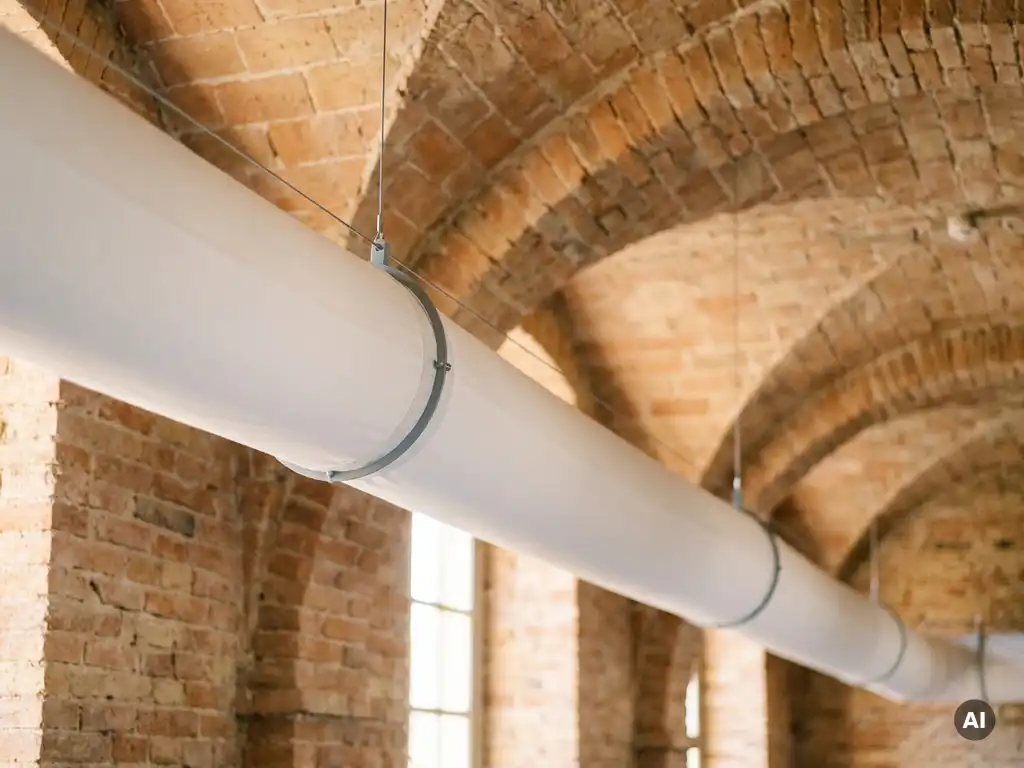
Draft-free air distribution can be most effectively retrofitted in historic buildings using textile air socks. These systems distribute supply air evenly across their entire surface without creating drafts, and thanks to their flexibility and low weight, they can be installed in sensitive existing structures without major structural interventions. The following sections address the most important questions surrounding the planning, suitability, and use of textile ventilation systems in historic buildings.
What challenges does retrofitting ventilation in listed buildings present?
Retrofitting a ventilation system in listed buildings is demanding because structural interventions are heavily restricted by heritage protection authorities. Load-bearing walls may not be breached, historic ceilings may not be damaged, and visible surfaces may not be altered. At the same time, many of these buildings require functional air conditioning for reasons of occupant comfort or legal compliance.
The challenges can be divided into three main areas:
- Heritage protection requirements: Every measure must be coordinated with the responsible authority. Reversibility is a key criterion: installations must be removable without leaving any trace.
- Integration compatible with existing fabric: Historic room geometries, irregular floor plans, and low ceilings make routing conventional duct systems difficult or impossible.
- Structural integrity and load capacity: Old ceiling structures are often not designed to bear the weight of heavy sheet metal ducts, which necessitates costly reinforcement measures.
Added to this is the aesthetic requirement: in representative spaces such as town halls, theaters, or church naves, visibly technical infrastructure significantly disrupts the appearance. Retrofitting ventilation here means reconciling technical function with architectural sensitivity.
Why do conventional sheet metal ducts cause particular problems in historic buildings?
Conventional sheet metal ducts are unsuitable for use in historic buildings for several reasons. Their high weight, rigid format, and the necessary wall penetrations for mounting and routing are in direct conflict with the requirements of heritage protection.
The specific problems that arise are as follows:
- Weight: Sheet metal ducts weigh many times more than textile systems. Historic ceiling beams or vaults are not designed for such loads.
- Installation effort: Installation requires drilling, suspension brackets, and connectors that are often not approvable in listed buildings.
- Drafts: Conventional outlets create localized airflows at high velocity, which are problematic in spaces containing sensitive exhibits, people, or historic surfaces.
- Condensation: In poorly insulated historic building ducts, condensation can lead to mold and structural damage.
Not least, sheet metal systems are significantly more expensive to install: according to industry experience, textile alternatives can save up to 60% of material and installation costs. In existing buildings, where every intervention is complex, this cost advantage carries particular weight.
How does draft-free air distribution via textile air socks work?
Textile air socks distribute supply air across the entire permeable surface of the sock, rather than blowing it in concentrated streams through individual outlets. Thanks to the micro-permeability of the fabric, air exits evenly at very low flow velocities, reliably preventing drafts and creating a homogeneous temperature distribution throughout the room.
The operating principle in detail:
- Supply air is blown into the textile sock and flows through the entire cross-section.
- Air exits evenly into the room through the fabric pores at discharge velocities well below the draft threshold.
- The large-area distribution ensures that no cold or warm air pockets form.
- Through individual design of sock geometry, permeability, and opening arrangement, the airflow pattern can be precisely tailored to each specific room.
In addition, targeted outlets or nozzles can be integrated into the sock to supply specific zones directly. More information on the fundamentals of textile air socks can be found in our overview of how they work and how they are constructed.
What advantages do textile air socks offer specifically when retrofitting in existing buildings?
Textile air socks offer decisive advantages over conventional systems when it comes to climate control in historic buildings: they are lightweight, flexible, reversibly mountable, and can be adapted to almost any room geometry. It is precisely these properties that make them the preferred solution when heritage protection, ventilation, and structural fabric must be brought into harmony.
The key advantages at a glance:
- Low weight: Textile socks place minimal load on the supporting structure and can be attached to existing suspension points.
- Reversibility: The systems can be dismantled without leaving any trace, fulfilling a central requirement of heritage protection.
- Individual shaping: Round, oval, or flat cross-sections and any desired lengths allow adaptation to historic room proportions.
- Fast installation: Without welding, screwing, or chiseling, installation time is significantly reduced.
- Hygiene and maintenance: Textile socks are washable, which is particularly relevant in museums, theaters, or public buildings.
- Fire protection: Fire protection is permanently chemically anchored in the yarn and cannot be washed out, ensuring permanently safe use.
An overview of the available versions can be found in the product overview for textile air socks.
In which types of historic buildings can textile ventilation systems be used?
Textile ventilation systems are suitable for almost all types of historic buildings where draft-free air distribution is desired or required. What matters is not the architectural style, but the ability to route a supply air connection and attach the sock to the ceiling or along walls.
Typical applications in historic buildings:
- Museums and exhibition buildings: Uniform temperature and humidity protect sensitive exhibits, while drafts would jeopardize the quality of the objects.
- Theaters, opera houses, and concert halls: Large volumes, demanding acoustics, and high occupancy require powerful yet unobtrusive ventilation.
- Town halls, administrative buildings, and palaces: Representative spaces with historic ceilings and stucco work require systems that can be integrated discreetly.
- Churches and sacred buildings: Tall spaces, sensitive furnishings, and infrequent use intervals place particular demands on flexibility and reversibility.
- Late 19th-century office and residential buildings: High ceilings and irregular floor plans can be efficiently served with textile socks.
Textile systems are also used in industrial heritage sites such as repurposed factory halls or railway stations. The breadth of industries and applications for textile air socks demonstrates how versatile this technology is.
What should be considered when planning and designing a textile ventilation system in a historic building?
When planning a textile ventilation system in a historic building, the specific room geometry, permissible fixing points, and the regulatory requirements of heritage protection authorities must above all be taken into account. A careful preliminary analysis of the building is the foundation for a functionally reliable and approvable design.
The following points should be systematically reviewed during the planning phase:
- Building survey: Room dimensions, ceiling construction, existing openings, and structural load capacity must be recorded before design begins.
- Coordination with authorities: Heritage protection authorities should be involved in planning at an early stage to clarify requirements regarding reversibility and the extent of intervention.
- Airflow calculation: The required air volume is determined by the use, number of occupants, and thermal loads of the room.
- Sock geometry and permeability: Diameter, length, opening types, and material permeability are individually matched to the specific application.
- Color and appearance: Textile socks are available in various colors and can be visually adapted to historic color schemes.
- Maintenance and cleaning: Washing cycles and dismantling effort should be taken into account already during planning.
Individual design is standard for textile systems: every sock is custom-made for the specific project, with an average production time of just 14 days from order placement.
How Kienzler Klima supports the climate control of historic buildings
We at Kienzler Klima support planners, architects, and installers from the initial inquiry through to the fully operational system. With more than 30 years of experience in textile air distribution and Cradle-to-Cradle certification for the entire value chain, we offer solutions that equally meet technical requirements and heritage conservation standards.
What we specifically provide:
- Individual consultation and design based on your room data and heritage protection requirements
- Precision manufacturing of every textile air sock in Germany, in the Allgäu region, with an average delivery time of 14 days
- Selection from various cross-sections, permeability levels, colors, and opening types for visually and functionally optimal integration
- Permanently integrated fire protection that cannot be washed out
- Service and maintenance after installation, including cleaning recommendations and replacement options
Whether museum, town hall, or industrial heritage site: we work together with you to develop the right solution for your existing building. Get in touch now and tell us about your project.