
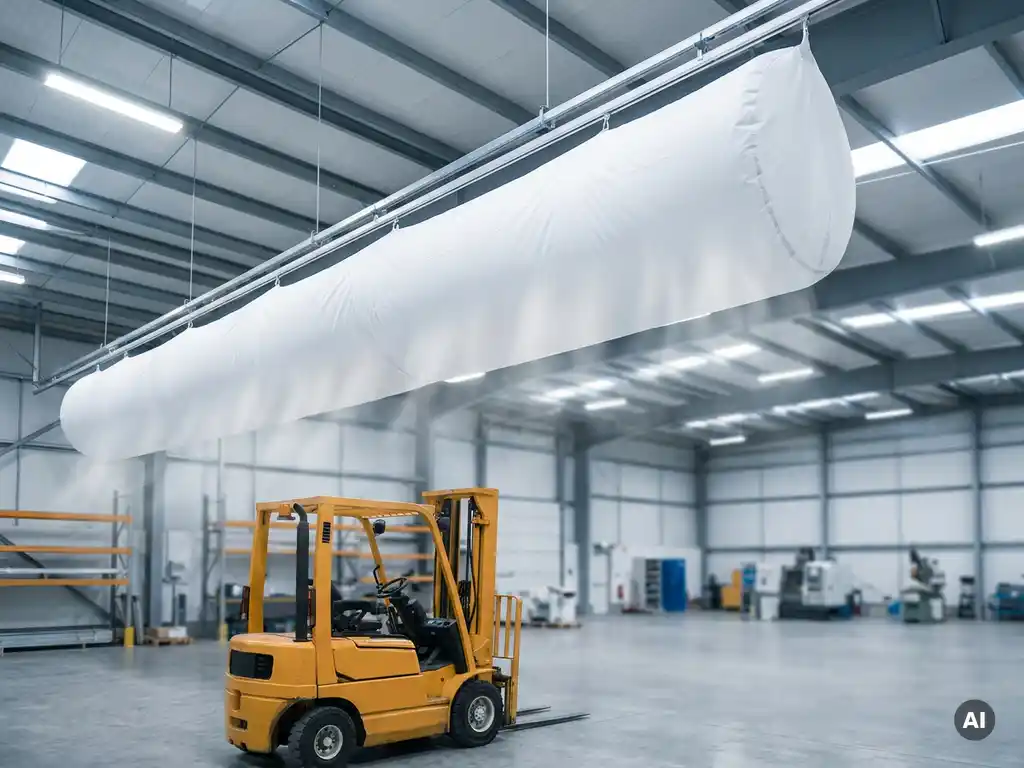
Forklift operators in warehouses complain particularly frequently about drafts because they sit at a fixed workstation for long shifts while simultaneously being exposed to the strongest airflows in the space. Their elevated body temperature from physical exertion and the constant getting in and out of the vehicle further increases their sensitivity to air movement. The following sections highlight the most important causes and show which solutions have proven effective in practice.
Why are forklift operators in warehouses particularly at risk from drafts?
Forklift operators in warehouses are particularly at risk from drafts because they maintain a nearly stationary posture for many hours while continuously working in areas of intense airflow. Someone sitting on a forklift cannot avoid drafts through movement the way a warehouse worker on foot could.
Several compounding factors also play a role: the repeated act of getting in and out of the vehicle puts the body through cycles between rest and activity phases. During the rest phase in the driver’s seat, skin cools down more quickly when air passes by at too high a speed. At the same time, forklift seats are often positioned at a height where cold air from poorly directed outlets strikes particularly directly. The result: neck, shoulder, and back complaints that many companies accept as inevitable, even though they can be resolved through ventilation engineering.
What exactly is meant by drafts — and when do they become a problem?
A draft refers to a localized air movement that the human body perceives as uncomfortable because it leads to uneven or excessive heat loss. What matters is not just the temperature of the air, but above all its flow velocity and the turbulence intensity at the body.
Technically speaking, air velocities at the point of occupancy of more than 0.15 to 0.20 m/s are considered the threshold range at which many people begin to perceive drafts. At low room temperatures, such as those found in cold storage facilities or in unheated halls during winter, this threshold is even lower. For forklift operators, the situation is particularly critical: they are exposed to the same airflow direction for hours on end, with no option to change their position. This fundamentally distinguishes them from individuals who move freely through the space.
What structural and ventilation-related causes generate drafts in warehouses?
Drafts in warehouses arise from the interplay of several structural and system-related factors. The most common causes are incorrectly positioned or oversized air outlets, inadequately sealed gate systems, and ventilation planning that does not sufficiently account for the actual locations where employees are present.
Structural weak points
Warehouses often feature large gate openings through which significant volumes of cold air flow in during operation. Poorly insulated hall doors, the absence of air curtain systems, and leaky building envelopes are classic structural causes. Particularly in older existing buildings, airlocks or antechambers that could buffer cold air ingress are often missing.
Ventilation-related causes
Conventional sheet metal duct systems with point-source outlets often generate high local air velocities directly below the discharge openings. When these outlets are not precisely matched to the room geometry and occupancy zones, cold air cones form that strike exactly where forklift operators travel their routes. An incorrectly set supply air temperature or an excessively high air volume per outlet also significantly exacerbates the problem. A well-conceived textile air distribution system can provide targeted relief here.
How does textile air distribution differ from conventional sheet metal duct systems?
Textile air distribution differs from conventional sheet metal duct systems primarily in the way air is delivered into the space. While sheet metal ducts blow air into the room through a few point-source outlets at high velocity, a textile air sock distributes air across a large area and at very low discharge velocity over the entire surface of the sock.
The principle is based on the permeability of the textile material used: air passes evenly through the fabric without creating local high-velocity zones. The result is a draft-free, homogeneous air distribution that supplies the entire occupancy zone uniformly. For warehouses with forklift operators, this means specifically: no cold air cones, no point-source flow peaks, no continuous airstream at neck and shoulder height. In addition, textile air distribution for warehouses enables savings of up to 60 percent in material and installation costs compared to sheet metal systems, making it economically attractive as well.
Can a new ventilation system resolve draft complaints in existing warehouses?
Yes, a new or retrofitted ventilation system can effectively resolve draft complaints in existing warehouses, provided it is designed to suit the specific room geometries and usage situations. What matters is not simply replacing the technology, but rather a well-founded redesign of the airflow routing and discharge characteristics.
Textile air distribution systems can also be retrofitted into existing buildings with relative ease. Since they are lightweight and do not require elaborate supporting structures, the installation effort is generally significantly lower than when renewing a sheet metal duct system. It is important to incorporate the actual work areas of forklift operators into the planning: Where do operators spend the most time? Which travel routes are used regularly? Based on this information, a system can be designed that provides uniform, draft-free air distribution precisely where employees actually are. Each textile air sock is individually engineered for the specific application, with an average production time of just 14 days.
Which industries have already solved draft problems in warehouses?
Draft problems in warehouses have already been successfully resolved in numerous industries, including the automotive and logistics sectors, the food industry, and the industrial and trades sector. These sectors share the challenge of large hall areas, fluctuating temperature levels, and permanently present employees at fixed workstations.
In the automotive industry, where precision and occupational safety are top priorities, textile ventilation systems are already widely used. In the food industry, they are also deployed because textile systems are hygienically easy to clean and low-maintenance. Logistics centers with intensive forklift operations benefit particularly from the uniform air distribution that consistently prevents drafts at the forklift. The application areas of textile air distribution extend further into hospitals, laboratories, and sports facilities — everywhere that draft-free conditions and comfort allow no compromise.
How Kienzler Klima solves draft problems in your warehouse
We at Kienzler Klima have been developing textile ventilation and climate systems for more than 30 years, specifically designed to meet the requirements of industrial and commercial hall applications. When forklift operators in your warehouse suffer from draft complaints, this is not an unavoidable problem for us — it is a solvable planning challenge.
What we do for you:
- Individual design: Every textile air sock is custom-engineered based on your room geometry, usage situation, and air volume requirements, with an average production time of just 14 days.
- Draft-free air distribution: Our textile systems discharge air across a large area at very low outlet velocity, without creating local cold air zones at forklift seats.
- Cost-effective retrofitting: Compared to conventional sheet metal duct systems, our solutions save up to 60 percent in material and installation costs — including in existing buildings.
- Made in Germany: All value creation steps take place at our site in the Allgäu region, with Cradle-to-Cradle certification and permanently integrated fire protection in the yarn.
- Comprehensive support: From consultation through planning and manufacturing to service and maintenance, we accompany you through the entire process.
Get in touch with us and describe your situation. We will show you concretely what a draft-free ventilation solution for your warehouse can look like. Contact us now and arrange a no-obligation consultation.