
Room temperature directly and measurably influences the sleep-wake cycle: a bedroom that is too warm makes it harder to fall asleep, shortens deep sleep phases, and increases nighttime restlessness. The reason lies in the close coupling between core body temperature and the circadian rhythm — the biological 24-hour cycle that regulates sleep and wakefulness. The following sections explain the most important connections and show when and how you should actively intervene.
Which bodily processes control the sleep-wake cycle?
The sleep-wake cycle is largely controlled by the circadian rhythm, an internal biological clock coordinated by the hypothalamus in the brain. This rhythm regulates, among other things, the release of the sleep hormone melatonin as well as fluctuations in core body temperature throughout the day. Both processes are inseparably linked.
Specifically, core body temperature drops during the evening hours — a signal to the body that it is time to sleep. This cooling process is initiated by heat dissipation through the skin and extremities. At the same time, melatonin production increases. In the early morning, the process reverses: core body temperature rises again, melatonin is broken down, and the body prepares to wake up.
What is crucial here: the ambient temperature in the bedroom can either support or hinder this natural cooling process. If it is too warm, core body temperature does not drop sufficiently, the process of falling asleep is delayed, and sleep remains shallower than it should be.
What is the optimal room temperature for restful sleep?
The optimal room temperature for restful sleep for most adults is between 16 and 19 degrees Celsius. Within this range, the room climate supports the body’s natural cooling process without taking it too far. Deviations in either direction — too warm or too cold — demonstrably impair sleep quality.
This guideline applies to healthy adults under normal conditions. Children and older people often find slightly higher temperatures more comfortable; here the upper limit can be around 20 to 21 degrees Celsius. Infants also require a somewhat warmer environment, as their thermoregulation is not yet fully developed.
Humidity is also important: ideal sleeping conditions occur at a relative humidity of 40 to 60 percent. Air that is too dry irritates the mucous membranes; air that is too humid feels stuffy and impedes the body’s natural heat dissipation. The interplay of temperature and humidity — that is, the overall room climate — is decisive for sleep quality.
How does heat in the bedroom specifically affect sleep quality?
Excessively high temperatures in the bedroom disrupt sleep on multiple levels simultaneously: they delay falling asleep, reduce the proportion of deep sleep and REM phases, and increase the frequency of nighttime awakenings. The result is sleep that is subjectively and objectively less restorative, even if the total sleep duration remains the same.
The mechanism behind this is physiologically clear: the body attempts to lower its core temperature by sweating more. This costs energy, disrupts sleep architecture, and leads to increased fluid loss. Anyone who wakes up exhausted in the morning despite sufficient hours of sleep should take room temperature seriously as a possible cause.
Especially during the summer months, when outdoor temperatures barely drop below 20 degrees even at night, the bedroom can quickly become a heat trap. Solid walls store heat during the day and release it at night — an effect that raises the sleeping temperature in the room well above the optimal level. Anyone living in such a building will immediately notice the difference between a cool spring night and a tropical night in August in terms of sleep quality.
What role does air distribution play in the bedroom?
The way air circulates in the bedroom is at least as important as the room temperature itself. Uneven air distribution creates cold and warm zones, drafts, or stagnant, stuffy air — all of which impair sleep quality and disrupt the body’s natural temperature drop.
Conventional ventilation systems often blow air into the room in a concentrated stream at high velocity. This leads to uncomfortable drafts, especially when the air outlet is located near the sleeping area. Anyone who has ever slept directly beneath an air conditioning unit knows the problem: the room cools down, but the air movement itself disturbs sleep.
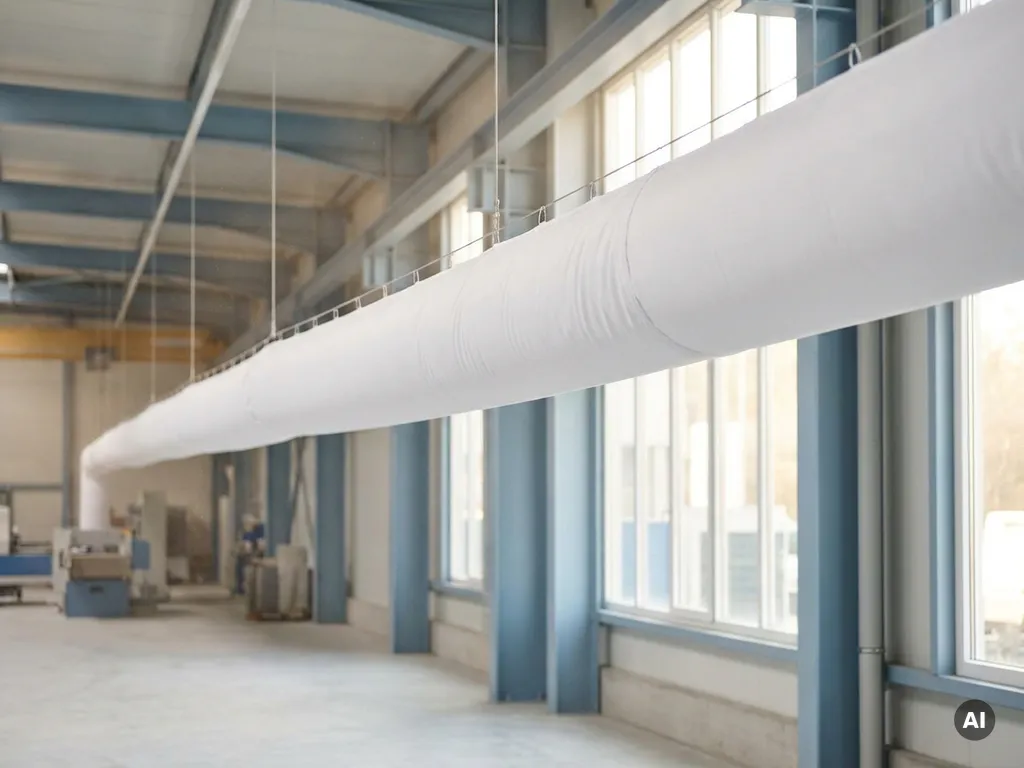
The goal is even, draft-free air distribution — air that spreads across the entire room surface without creating perceptible currents. This principle also underlies the concept of the textile air duct: air exits through the permeable surface of the fabric at very low velocity and distributes evenly throughout the room — without drafts, without temperature spikes.
When should you actively intervene in the room climate?
Active intervention in the room climate makes sense when the bedroom temperature regularly exceeds 20 degrees Celsius, sleep quality suffers on an ongoing basis, or those affected do not feel rested in the morning despite sufficient sleep time. Occasional warm nights do not yet require a technical solution — a persistent problem does.
Specific signs that the room climate should be actively improved:
- Difficulty falling asleep even though no other causes are present
- Frequent nighttime awakenings accompanied by sweating
- Dry mucous membranes or headaches in the morning despite a normal sleep duration
- Stuffy or stale air in the bedroom, especially in the second half of the night
- Bedroom temperatures that remain persistently above 20 degrees even at night
Simple measures such as cross-ventilating during the cool morning hours, darkening the windows during the day, and avoiding heat sources in the bedroom already help considerably. If these measures are not sufficient, a technical solution for targeted climate control makes sense — particularly in buildings with poor thermal insulation or in heavily urban locations with a pronounced heat island effect.
For new builds, renovations, or commercial sleeping areas such as hotel rooms, it is worth looking at specialized ventilation solutions for various applications that enable draft-free and uniform climate control.
How Kienzler Klima ensures an optimal room climate in sleeping areas
At Kienzler Klima, we develop and manufacture textile ventilation systems that offer exactly what a good sleep climate requires: even air distribution, no drafts, and a stable room climate throughout the entire night. Our textile air ducts are designed so that air exits across the entire surface of the duct at minimal discharge velocity — the result is a homogeneous temperature distribution without disruptive air movements.
What sets us apart:
- Over 30 years of experience in air and climate technology, with a specialization in textile systems since 1993
- Custom manufacturing for every application — each duct is tailored to the specific room and its requirements
- Made in Germany: production at our Allgäu facility with short lead times averaging 14 days
- Cradle-to-Cradle certification for sustainable solutions across the entire value chain
- Up to 60% savings on material and installation costs compared to conventional sheet metal systems
Whether for a hotel room, a residential building, or a commercial sleeping area — we are happy to provide specific and individual advice. Learn more about our textile air duct products or contact us directly — we look forward to your inquiry.