
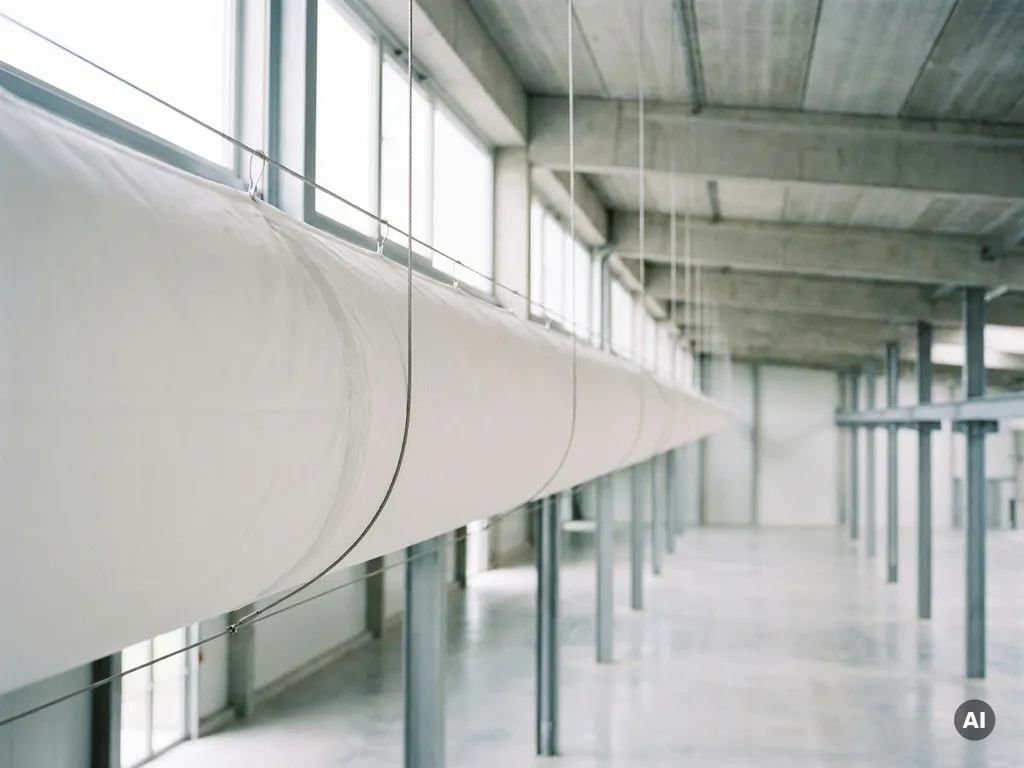
Installing a textile air distribution system in an existing hall typically takes one to three days – depending on the hall size and the number of ducts. This makes it significantly faster than installing conventional sheet metal ductwork, which often takes a week or longer. The following sections shed light on what specifically influences installation time and what you should keep in mind during planning.
How much preparation work is required before installation?
The preparatory work before the actual installation of a textile air distribution system is comparatively minimal. In most existing halls, it is sufficient to check the existing suspension points, mount the guide rails or cables, and prepare the connection points on the ventilation unit. This preparation step typically takes a few hours to half a day at most.
What is crucial is that the fundamentals of textile air ducts were already taken into account during the planning phase: room geometry, ceiling height, air volume, and discharge direction determine how the duct is designed and where it is mounted. Providing this information early on significantly reduces on-site effort. Special structural modifications are generally not required – this is one of the clear advantages over rigid sheet metal systems.
How long does the actual installation of a textile duct take?
Installing a single textile duct takes between two and eight hours, depending on the length and hall conditions. For straightforward installations with a single duct up to 30 meters in length, an experienced two-person team is often finished within half a day. Larger systems with multiple runs or complex geometries can take a full working day or more.
The principle is remarkably straightforward: the textile air duct is suspended from a cable or rail system, connected to the ventilation unit, and commissioned after a functional test. Heavy lifting equipment or specialized tools are generally not required. The product range of textile air ducts is also designed so that different lengths and diameters can be combined on-site without significant effort.
How much faster is installation compared to sheet metal ductwork?
In practice, textile air distribution systems can be installed significantly faster than sheet metal ducts – often by a factor of three to five. While a comparable sheet metal system requires several days of installation time and extensive preparatory work, a textile system is often ready for operation within a single working day.
The difference lies in the design: sheet metal ducts must be cut, folded, joined, and sealed on-site. Textile ducts, on the other hand, are individually prefabricated and arrive at the construction site ready for installation. This saves not only time but also material and installation costs – overall savings of up to 60 percent compared to conventional systems are possible. For existing halls where every operational interruption costs money, this is a decisive advantage.
Does hall operations need to be interrupted during installation?
In most cases, ongoing operations do not need to be completely interrupted. The installation of a textile ventilation system can often be organized so that only individual hall areas are temporarily cordoned off while the rest of operations continue. This is a particularly decisive advantage when retrofitting existing halls.
For especially sensitive areas – such as in the food industry or in hospitals – installation outside of core operating hours is recommended, for example on weekends or during shift breaks. Since the actual installation time is so short, this can generally be coordinated without difficulty. An overview of typical application scenarios can be found on the page about application areas and industries.
Which factors extend or shorten installation time?
The actual installation duration depends on several specific factors. Knowing these in advance allows for a realistic assessment of the timeline and helps avoid unnecessary delays.
- Hall size and duct length: Longer ducts and more runs mean more installation effort. A hall with 1,000 m² and three duct runs naturally requires more time than a simple single installation.
- Ceiling construction: Steel beams, purlins, or concrete ceilings require different mounting solutions. Difficult-to-access ceiling areas can extend the preparation time.
- Number of connection points: Each additional branch or connection increases the installation effort moderately but measurably.
- Quality of advance planning: Precise planning with complete room dimensions and air volume specifications significantly reduces installation time, as no on-site adjustments are necessary.
- Experience of the installation team: Installation teams that regularly work with textile systems are considerably faster than those encountering this system for the first time.
Conversely, installation time can be deliberately reduced: through early planning, complete documentation, and commissioning experienced specialist contractors. Retrofitting a textile ventilation system does not have to be a complex project – with the right preparation, it is in many cases a matter of one to two days.
How Kienzler Klima supports you with installation in your existing hall
We accompany you from the initial inquiry through to commissioning – with more than 30 years of experience in textile air distribution and all value-added steps under one roof in Günzach in the Allgäu region. For you, this means: short delivery times, individual manufacturing with an average production time of just 14 days, and a single point of contact for all phases of the project.
Specifically, we support you with:
- Technical consulting and system design based on your hall data
- Individual manufacturing of each textile duct for your specific application
- Installation planning that disrupts your hall’s ongoing operations as little as possible
- Service and maintenance after installation, so your system runs reliably in the long term
If you would like to retrofit a textile air distribution system in your existing hall, get in touch with us. Contact us now – we will provide you with a no-obligation quote.