
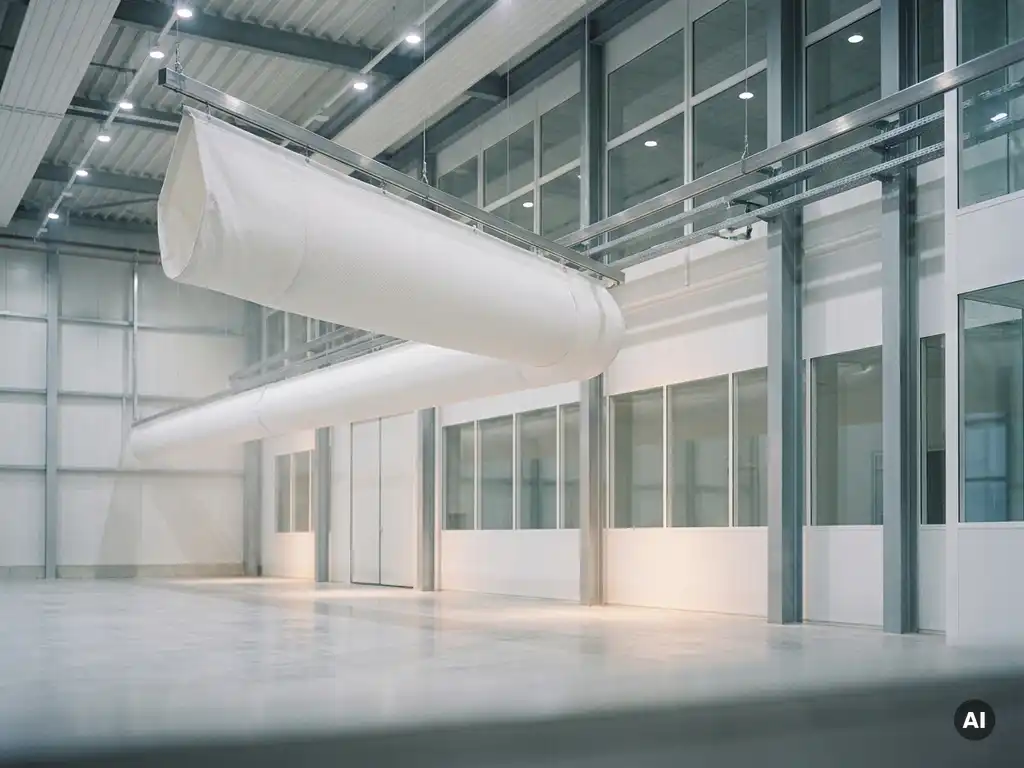
Textile ventilation ducts made from German materials offer hygienic advantages because the materials used are specifically designed for cleanliness, durability, and ease of maintenance. The key lies in the combination of a well-thought-out fabric structure, permanent fire protection, and controlled production conditions. The following questions shed light on the most important aspects of hygiene and material quality in textile climate components.
What material properties make textile air ducts hygienic?
Textile air ducts are hygienic because the fabric used distributes air evenly and at low velocity across the entire surface. This airflow pattern prevents dead zones where dust, moisture, or germs could accumulate. Unlike smooth sheet metal ducts, the textile material also provides no condensation surfaces on which mold can form.
The fundamentals of textile air ducts show that the permeability of the fabric is a central hygiene feature: air does not exit through individual nozzles at specific points, but diffuses across the entire duct surface. This prevents drafts and turbulent airflows that could stir up particles. The result is a calm, even air distribution that benefits both comfort and air quality.
Another advantage: the textile material can be completely removed and washed. Residues, dust, or microparticles can thus be regularly and thoroughly removed, which is significantly more complex with permanently installed sheet metal systems.
Why is fire protection permanently integrated into the yarn?
Fire protection in high-quality textile air ducts is chemically anchored in the yarn, making it a permanent component of the material rather than an applied surface coating. This means it can neither be washed out nor removed by mechanical cleaning. This property is not only relevant for safety, but also hygienically significant.
Flame retardants that are merely applied to the surface can leach out during washing or disinfection and distribute themselves as residues in the indoor air. Fire protection integrated into the yarn avoids this problem entirely. The protective function is maintained throughout the entire service life of the product, regardless of how frequently the duct is cleaned.
For areas with strict hygiene requirements, such as food processing or healthcare, this is a decisive advantage: cleaning and disinfection can be carried out without restrictions, without compromising the safety properties of the material.
How are textile ventilation ducts cleaned and maintained?
Textile ventilation ducts can generally be dismantled easily and cleaned in a standard industrial washing machine. The washing process completely removes dust, grease, bioaerosols, and other deposits without damaging the material. After washing, the duct can be reinstalled and put back into operation immediately.
This cleaning approach is a significant advantage over conventional sheet metal ducts, where internal cleaning is complex, expensive, and often only partially possible. Textile systems enable complete hygiene control because the material is fully accessible.
For maintenance, a regular cleaning schedule is recommended, tailored to the area of use:
- Food industry and pharmaceuticals: more frequent cleaning intervals, often several times per year
- Offices and commercial spaces: generally one to two cleanings per year are sufficient
- Production halls and storage areas: depending on dust accumulation and operational requirements
Simple maintenance reduces operating costs and ensures that air quality remains at a consistently high level.
Which industries benefit most from hygienic textile ventilation?
Industries with high demands for air purity, low germ levels, and verifiable hygiene measures benefit most. These include above all the food industry, healthcare, laboratory environments, and the pharmaceutical industry. But offices, sports halls, and logistics centers are also increasingly adopting textile air distribution systems.
A look at the industries and applications overview makes clear how broad the range of applications is:
- Food industry: Strict hygiene regulations require systems that can be cleaned without residue and do not represent sources of contamination.
- Hospitals and laboratories: Germ reduction and controlled airflow are safety-critical here.
- Industry and production: Dust loads make regular cleaning necessary, which is easy to implement with textile systems.
- Sports and leisure facilities: High occupancy density and moisture input place special demands on air hygiene.
Reference customers such as Nestlé, Coca-Cola, and BASF demonstrate that textile ventilation ducts function reliably even in the most demanding industrial environments.
What does Cradle-to-Cradle certification mean for material quality?
Cradle-to-Cradle certification means that a product can be fully returned to a new cycle at the end of its useful life without leaving behind harmful substances. For textile ventilation ducts, this means specifically: the material used must be tested for safety throughout the entire value chain, from raw fiber to finished product.
This certification has a direct impact on material quality and therefore on hygiene. Products that are Cradle-to-Cradle certified contain no problematic chemicals that could dissolve under heat or cleaning agents and be released into the indoor air. This is particularly relevant for applications where air quality directly affects human health.
Furthermore, the certification signals consistent quality control across all production stages. Those who demonstrably rely on pollutant-free materials also make conscious decisions for quality and safety in other areas of manufacturing.
Why does the production location Germany matter for material quality?
Production in Germany means that strict legal requirements apply to materials, occupational safety, and quality control. For textile ventilation ducts, this means: every production step is subject to traceable standards that are not binding in many other countries. Short supply chains and the integration of all value-creation steps at a single location make quality issues faster to identify and resolve.
Another aspect is the traceability of the raw materials used. When yarns, weaving processes, and finishing steps all take place under one roof, it is always possible to trace which material with which properties was used. This is relevant not only for quality assurance, but also for certification requirements in sensitive industries.
Added to this is the speed of response: individual requirements, such as special fabric densities for specific hygiene areas, can be implemented directly in production. With an average production time of just 14 days, custom-made textile ventilation ducts can be realized quickly and precisely, without compromising on material quality.
How Kienzler Klima supports hygienic textile ventilation
We at Kienzler Klima have been developing and manufacturing textile ventilation ducts for more than 30 years, exclusively in Germany, at our site in Günzach in the Allgäu region. Every product is individually designed for the specific application, with all material decisions made directly by us. What this means for you:
- Cradle-to-Cradle certified materials free of problematic substances, tested throughout the entire value chain
- Permanent, wash-resistant fire protection that does not restrict cleaning processes
- Individual design for your specific hygiene requirements, whether food production, laboratory, or office
- Short delivery times of an average of 14 days thanks to fully integrated manufacturing in Germany
- Savings of up to 60% on material and installation costs compared to conventional sheet metal systems
Whether you are planning a new project or looking to convert an existing system to textile ventilation: we are happy to advise you specifically and independently of any manufacturer. Get in touch now and find out which solution is best suited to your requirements.