
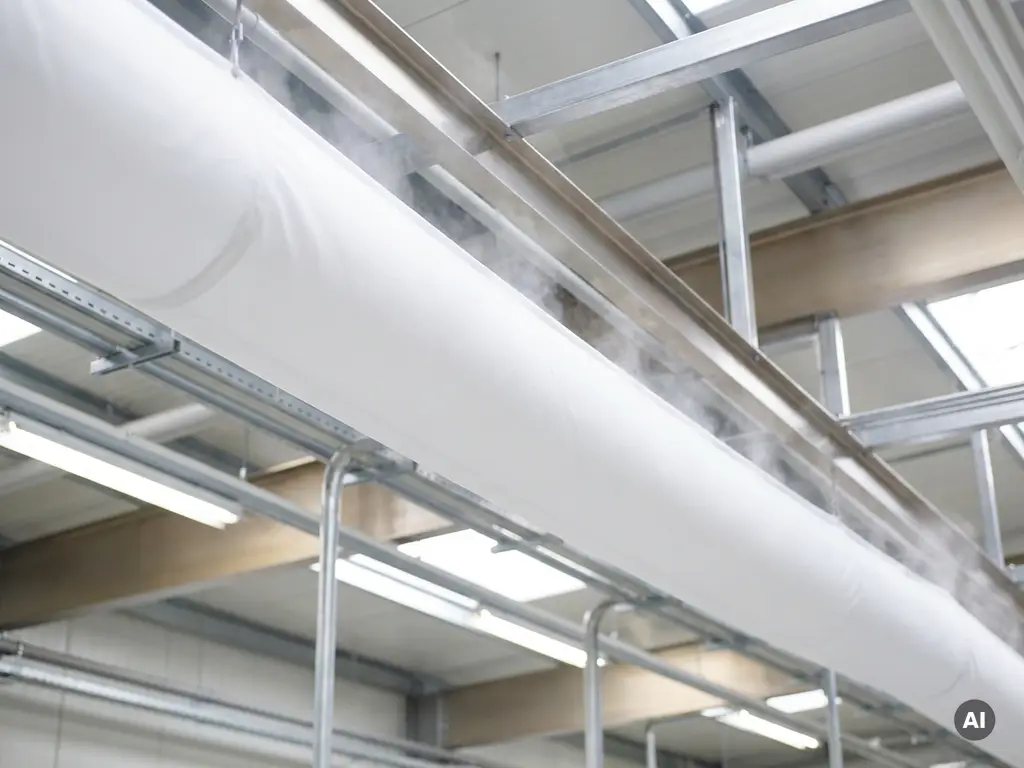
The maintenance of fabric ducts differs fundamentally from the upkeep of conventional sheet metal ducts: fabric ducts can be completely removed, washed in a washing machine, and then reinstalled. This process is significantly simpler, faster, and more cost-effective than the laborious inspection and cleaning of sheet metal duct systems. The following questions address all relevant aspects of the maintenance and care of textile air distribution systems in direct comparison.
How often do fabric ducts need to be cleaned?
Fabric ducts should generally be cleaned one to two times per year. The exact frequency depends on the area of use: in dust-intensive environments such as the food industry or production halls, more frequent cleaning may be advisable, while offices or commercial spaces can often manage with an annual wash cycle.
A practical advantage is that the cleaning needs of fabric ducts are easy to identify visually. Visible soiling or discoloration on the fabric surface is a reliable indicator. With sheet metal ducts, on the other hand, regular visual inspections by qualified personnel are required, as deposits inside the duct are not readily visible. The fundamentals of textile air distribution show why the open-pore fabric plays a decisive role here: air exits evenly across the entire surface, which significantly reduces dust accumulation inside the duct.
How are fabric ducts cleaned?
Fabric ducts are cleaned by detaching them from the suspension system and washing them in a standard industrial washing machine. After the wash cycle, they are rehung and automatically regain their original shape when filled with air. The entire process is completed within a few hours.
The specific procedure consists of a few steps:
- Detach and remove the fabric duct from the suspension system
- Wash in the washing machine at the temperature recommended by the manufacturer
- Allow to dry or dry in operation through air supply
- Rehang and put back into operation
Important: The permanently integrated fire protection remains fully intact during washing. The flame retardancy is chemically anchored in the yarn and cannot be washed out. This is a key difference from subsequently applied fire protection treatments, which can degrade over time.
What does the maintenance of fabric ducts cost compared to sheet metal ducts?
The maintenance of fabric ducts is significantly less expensive than the upkeep of sheet metal duct systems. While sheet metal ducts require specialized personnel, special cleaning equipment, and often multi-hour operational interruptions, fabric ducts only need a wash cycle and rehinging. The total costs for cleaning and maintenance of textile systems are considerably lower than those of conventional systems.
In addition: even at initial installation, textile air distribution systems offer savings of up to 60 percent in material and installation costs compared to sheet metal systems. This cost advantage continues throughout the entire lifecycle. Sheet metal ducts must be regularly inspected by certified cleaning companies, which incurs significant costs depending on the size of the system. For businesses that rely on low operating costs, this is a compelling argument in favor of textile systems.
What hygiene advantages do fabric ducts offer over sheet metal ducts?
Fabric ducts offer significant hygiene advantages over sheet metal ducts: they can be completely cleaned, as the entire system is removed and washed. With sheet metal ducts, corners, seams, and connectors remain difficult to access and can permanently harbor germs, mold, and dust.
This is particularly relevant in sensitive areas such as hospitals, laboratories, and the food industry. Strict hygiene requirements apply in these settings, which can often only be met with sheet metal ducts at considerable effort. Textile systems enable complete, residue-free cleaning because there are no hard-to-reach cavities. The wide range of applications for textile air ducts includes precisely these hygiene-sensitive industries, where this advantage carries particular weight.
Another aspect: the uniform air distribution across the entire fabric surface prevents dead zones in the airflow where moisture and particles could accumulate. This structurally reduces the risk of microbial contamination — not only through cleaning.
Can fabric ducts be maintained by the operator or is a specialist required?
Fabric ducts can in many cases be maintained by the operator themselves. Removing, washing, and rehinging does not require any special tools or expertise. Nevertheless, for complex systems or in regulated environments, it is advisable to involve a specialist who can simultaneously inspect the system for technical defects.
For self-cleaning, the following requirements are sufficient in most cases:
- Access to a suitable industrial washing machine
- Knowledge of the washing parameters recommended by the manufacturer
- Sufficient time for disassembly, washing, and reassembly
In areas with legally required hygiene documentation, such as food processing or healthcare, it is advisable to have the cleaning carried out and documented by a specialist. This provides legal certainty and facilitates future audits.
What happens if fabric ducts are not maintained?
If fabric ducts are not cleaned regularly, the air permeability of the fabric decreases. Dust and particle deposits reduce permeability, which lowers the air volume flow and deteriorates the energy efficiency of the entire ventilation system. In hygiene-sensitive areas, the risk of microbial contamination also increases.
Specifically, the following problems can arise:
- Reduced airflow: Uniform air distribution suffers, and individual zones receive poorer ventilation.
- Increased pressure loss: The ventilation unit must work harder, which increases energy consumption.
- Hygiene risks: Accumulated dust can promote microbial growth and impair indoor air quality.
- Premature wear: Permanently clogged areas can cause long-term damage to the fabric.
The good news: compared to neglected sheet metal ducts, where deposits settle inside and can only be removed with considerable effort, the damage in fabric ducts is generally reversible. A single wash cycle restores the original performance in most cases. The product overview of textile air ducts provides information on which materials and designs are best suited for each area of application.
How Kienzler Klima supports you in the maintenance and care of your fabric ducts
With over 30 years of experience in textile air and climate technology, we not only offer high-quality products but also support you throughout the entire product lifecycle. Our services related to maintenance include:
- Individual care recommendations for your specific system and area of use
- Technical consultation on the optimal cleaning frequency and appropriate washing parameters
- Documentation support for hygiene-sensitive industries with audit requirements
- Fast replacement delivery when needed, with an average production time of just 14 days
- Made in Germany: All systems are manufactured at our Allgäu location — short distances guarantee fast response times
Do you have questions about maintaining your fabric duct system or would you like to plan a new system? Get in touch with us and we will advise you without obligation and with expert knowledge.