
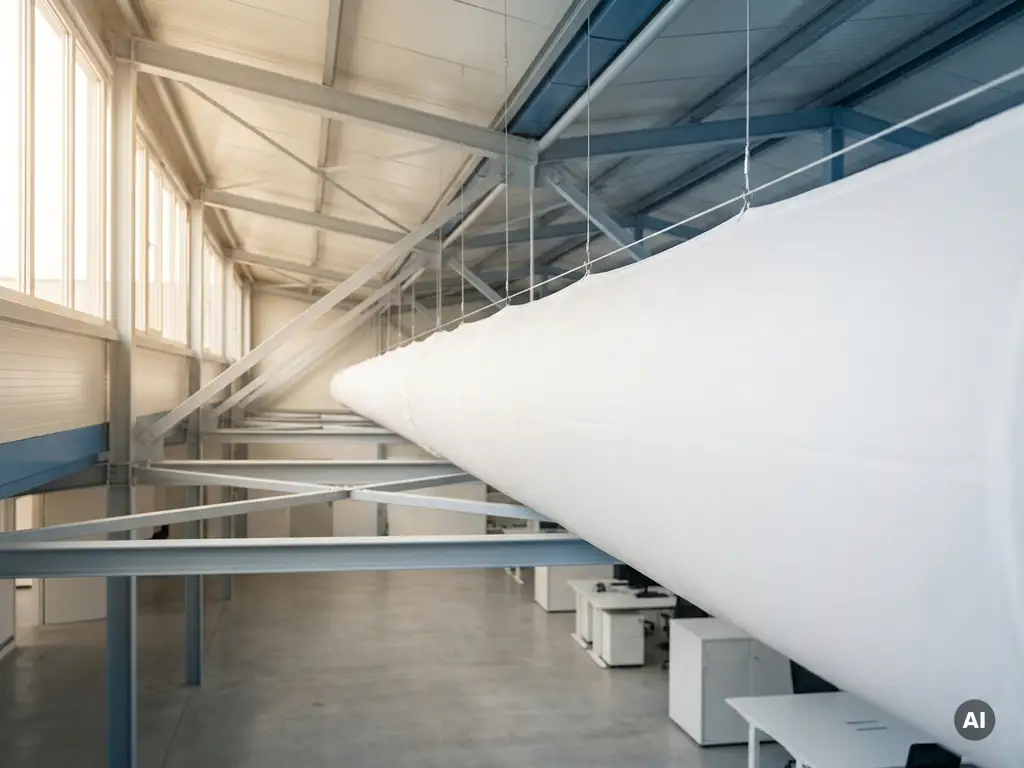
The industries that benefit most from draft-free air distribution are those with high hygiene requirements, sensitive production processes, or large hall areas that are difficult to temperature-control. These include above all the food industry, healthcare, automotive manufacturing, and sports and logistics facilities. What these sectors have in common: drafts are not merely a comfort issue there, but a tangible economic and quality risk. The following sections explain why textile ventilation systems are particularly compelling in these application areas.
What requirements do industrial hall operators have for air distribution?
Industrial hall operators need an air distribution system that supplies large volumes evenly and without disruptive drafts, while remaining hygienically flawless and economically viable to operate. Added to this are industry-specific requirements such as temperature consistency, noise protection, easy cleaning, and fire protection compliance. Conventional sheet metal ducts frequently reach their limits when faced with these requirements.
Typical challenges in hall ventilation include uneven temperature distribution, drafts at workstations, and high installation and maintenance costs. Textile air distribution systems address these problems through their specific mode of operation: air exits across the entire permeable surface of the tube at a very low discharge velocity. The result is a wide-area, uniform draft-free air distribution that conventional point outlets are structurally unable to achieve.
Why does the food industry benefit particularly from textile air systems?
The food industry benefits particularly from textile ventilation because hygiene, temperature consistency, and ease of cleaning must all be met simultaneously. Textile air tubes can be completely dismantled and cleaned in an industrial washing machine, which is a decisive advantage over hard-to-access sheet metal ducts in HACCP-regulated environments.
Especially in production areas for meat, baked goods, or dairy products, consistent temperatures and the prevention of condensation are operationally critical. Drafts can impair both product quality and employee health. Textile systems distribute conditioned air so gently that even sensitive production processes are not disrupted. In addition, fire protection in Kienzler products is permanently integrated into the yarn, meaning it is not lost through washing cycles. For facilities that must adhere to regular cleaning cycles, this is an essential safety aspect.
How does draft-free air distribution improve conditions in production and industrial halls?
Draft-free air conditioning measurably improves working conditions in production and industrial halls by eliminating temperature stratification, removing drafts at workstations, and ensuring consistent air quality across the entire hall area. This reduces illness-related absences and enhances the concentration of employees.
In automotive manufacturing, mechanical engineering, or electronics production, additional factors come into play: drafts can influence manufacturing tolerances when temperature-sensitive materials are being processed. At the same time, many industrial halls are very large and have varying heat sources, such as from machinery, lighting, or solar radiation. A textile air tube for industrial halls can be individually tailored to these load profiles, as every system is custom-planned and manufactured. Reference customers such as BMW, Volkswagen, and Bosch rely on this technology, underscoring its practical suitability in demanding production environments.
What role does draft-free air conditioning play in hospitals and laboratories?
In hospitals and laboratories, draft-free air conditioning is not optional but a medical and regulatory necessity. Drafts can promote the spread of germs, impair patient comfort, and falsify sensitive laboratory samples or measurement results. Textile air distribution systems meet these requirements through their wide-area, low-pressure air discharge.
Clean rooms, operating areas, and intensive care units place particularly high demands on air purity and flow uniformity. Textile systems can be designed to generate laminar or near-laminar flow conditions without creating turbulence that could stir up particles. The easy dismantling and washability of the tubes also greatly facilitates compliance with strict hygiene protocols. In laboratories, where temperature consistency and vibration-free operation are fundamental requirements, the low-noise and draft-free discharge of textile systems is a further practical advantage.
Are textile air systems also suitable for sports and logistics halls?
Yes, textile ventilation systems are very well suited for sports and logistics halls. Both hall types are characterized by large volumes, varying occupancy levels, and a high need for uniform temperature control, without drafts being allowed to affect users or stored goods.
Sports halls
In sports halls, people move intensively and are therefore particularly sensitive to drafts. At the same time, physical activity generates considerable heat and moisture loads. Textile air tubes can be positioned and designed so that air is introduced evenly into the occupied zone without blowing directly onto athletes. This noticeably improves the indoor climate and reduces the risk of catching a cold after intense exertion.
Logistics halls
In logistics centers, such as those operated by Amazon, the focus is not only on employee well-being but also on protecting temperature-sensitive goods. Textile systems distribute air so evenly that hotspots and cold zones in large storage areas are avoided. At the same time, they score points through fast installation and low self-weight, which is a practical advantage during ongoing operations or seasonal reconfigurations. The textile ventilation technology for halls can be flexibly adapted to changing layout requirements.
When is it worth switching to a textile air distribution system?
Switching to a textile air distribution system is worthwhile when existing systems cause draft problems, generate high maintenance costs, or fail to meet hygiene requirements. It also makes sense for new construction projects or hall expansions, as textile systems can save up to 60 percent of material and installation costs compared to conventional sheet metal ducts.
Specific reasons for switching include:
- Recurring complaints about drafts at workstations
- Uneven temperature distribution despite adequate system capacity
- High effort involved in cleaning and maintaining existing duct systems
- New hygiene or fire protection requirements that the existing system does not meet
- Planned hall expansion or new installation under cost pressure
Since textile tubes are lightweight and can be routed flexibly, retrofitting in existing halls is also possible with manageable effort. The average production time of just 14 days ensures that operators do not have to wait long for their individually manufactured solution.
How Kienzler Klima finds the right hall ventilation for your industry
We at Kienzler Klima support you from the initial inquiry through to completed installation, with more than 30 years of experience in textile ventilation technology and production carried out entirely in Germany. Our approach is consistently individual: every system is designed for your specific application, whether food production, hospital, industrial hall, or logistics center.
What we specifically offer you:
- Individual planning and design of the textile air tube based on your room situation and air load
- Manufacturing in Germany with an average delivery time of 14 days
- Cradle-to-Cradle-certified materials and permanently integrated fire protection
- Savings of up to 60 percent on material and installation costs compared to sheet metal systems
- Service and maintenance advice for ongoing operations
Would you like to know which system is the right solution for your hall? Get in touch now and receive a no-obligation consultation.