
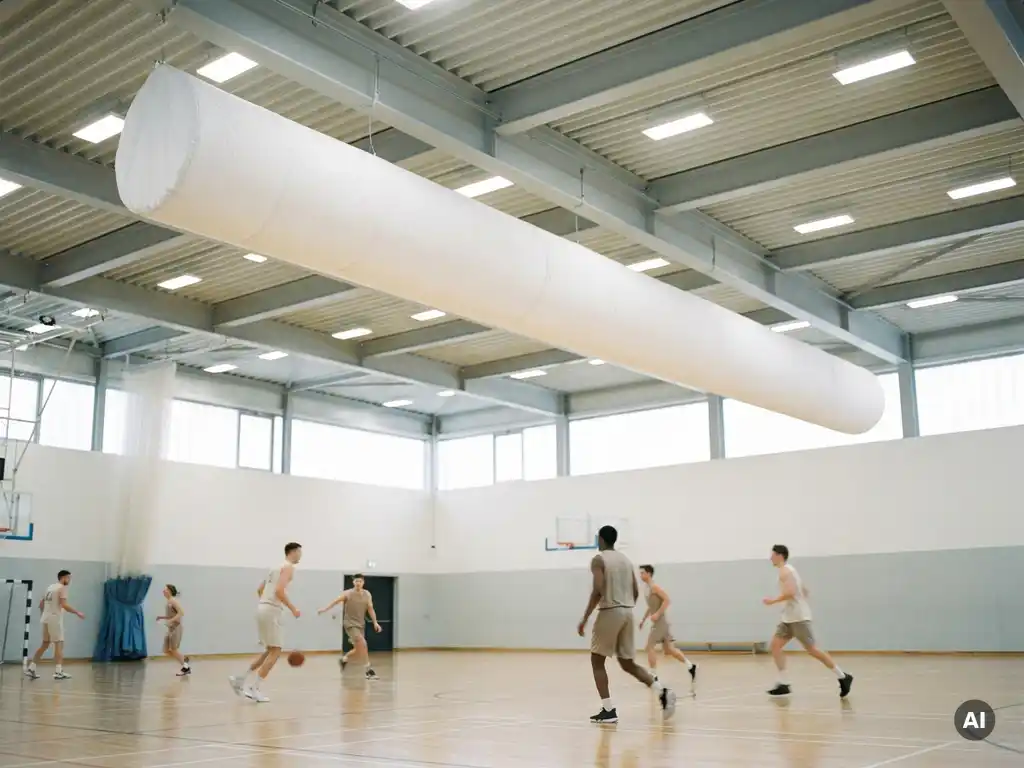
A well-designed air distribution system in sports halls measurably improves athlete well-being: it ensures uniform temperatures, reduces pollutant concentrations, and prevents uncomfortable drafts. What matters is not only the volume of air, but above all the way in which air is introduced into the space. The following sections answer the most important questions about hall climate, ventilation technology, and concrete optimization measures.
What effect does poor hall air quality have on athletic performance?
Poor air quality in sports halls directly and measurably impairs athletic performance. Elevated CO₂ concentrations, heat, and insufficient fresh air supply lead to faster fatigue, reduced concentration, and a noticeable decline in physical endurance. Athletes breathe in significantly more air under exertion than at rest, which is why air quality plays a particularly critical role in sport.
Specifically, the following problems arise in poorly ventilated halls:
- CO₂ increase: Even with moderate physical exertion, CO₂ levels in inadequately ventilated spaces quickly rise above recommended limits. This leads to drowsiness, headaches, and reduced responsiveness.
- Heat buildup: People engaged in sport release considerable amounts of body heat. Without a functioning air distribution system, local heat pockets develop that place additional strain on the body.
- Increased humidity: Sweat and exhaled air raise relative humidity. Excessively high humidity burdens thermoregulation and promotes the spread of germs.
- Drafts from point-source air injection: Conventional ventilation systems often generate local airflows at high velocity, which are perceived as uncomfortable and can cool down muscles.
For training sessions and competitions alike: uniform, draft-free air distribution in sport is not a matter of comfort, but a performance-relevant prerequisite.
How does uniform air distribution in sports halls work?
Uniform air distribution in sports halls is achieved when air is introduced into the space at low velocity across the largest possible area. Instead of injecting air at a single point with high momentum, a large-area system distributes conditioned air evenly along the entire length of the hall without creating drafts.
The underlying principle is known as displacement ventilation or surface diffusion: air exits at very low velocity and mixes gently with the room air. This prevents turbulence, cold air drops, and zones with significantly different temperatures. This is especially important in sports halls because the usable floor area is large, ceiling heights vary, and athletes move throughout all areas of the hall.
The following factors determine the quality of air distribution in a sports hall:
- Number and arrangement of air outlets along the hall axis
- Discharge velocity and air volume flow per meter of duct or channel
- Position of supply air introduction relative to heat sources and exhaust air openings
- Coordination of supply and exhaust air with the hall geometry
What is the difference between textile and conventional ventilation systems?
The key difference between textile and conventional ventilation systems lies in the way air is discharged: textile systems release air evenly across their entire surface, while sheet metal ducts inject air at individual outlets in a point-specific manner. This has a direct impact on comfort, installation effort, and operating costs.
Textile ventilation systems
Textile air ducts are made from an air-permeable fabric through whose pores air exits at very low velocity. The result is a large-area, draft-free air distribution along the entire duct length. For sports halls, this means: uniform temperatures throughout the entire hall, no cold air drops onto athletes, and no disruptive airflows during operation. Textile systems are lightweight, flexible, and can be installed or removed in a short time. They are machine washable and therefore hygienically maintainable, which is a decisive advantage particularly in heavily frequented sports halls.
Conventional sheet metal duct systems
Classic ventilation ducts made of sheet steel direct air to defined outlets that inject it into the space with greater momentum. In large halls, this can lead to uneven temperature distribution, draft complaints, and acoustic problems. Sheet metal systems are also material- and installation-intensive. In direct comparison, textile air distribution systems enable savings of up to 60% in material and installation costs, making them particularly economically attractive for new builds and renovations.
What standards and guidelines apply to the climate in sports halls?
In Germany, binding guidelines for the hall climate in sports halls are established in DIN 18032, as well as supplementarily in DIN EN 15251 and the VDI guidelines. These standards define permissible temperature ranges, minimum air volume flows, and air quality requirements for sports facilities.
The most important guidelines at a glance:
- Room temperature: For sports halls, room temperatures between 15 °C and 19 °C are generally recommended, depending on the type of sport and the intensity of use.
- Air volume flow: VDI 2089 recommends outdoor air volume flows for sports halls that are calibrated to the number of simultaneously active persons and the room size.
- CO₂ concentration: According to the Pettenkofer value, CO₂ levels in indoor spaces should not permanently exceed 1,000 ppm. In sports rooms with high occupant density, efficient ventilation is therefore particularly important.
- Air velocity: In the occupancy zone of athletes, the perceived air velocity should remain low to avoid draft complaints.
Planners and operators of sports halls are well advised to regard these standards not merely as minimum requirements, but as a starting point for performance-optimized ventilation planning.
How can the ventilation of an existing sports hall be optimized?
The ventilation of an existing sports hall can be optimized through a combination of existing system analysis, targeted system expansion, and the use of modern air distribution technology. Retrofitting with textile air ducts is often the most economical and fastest solution, as it can be integrated without extensive structural modifications.
A structured optimization process typically comprises the following steps:
- Inventory assessment: Analysis of the existing ventilation system, air volume flows, temperature distribution, and potential weak points such as draft zones or heat pockets.
- Needs assessment: Determining which usage scenarios the hall must accommodate, how many people are simultaneously active, and which climate targets are to be achieved.
- System planning: Dimensioning and arrangement of the new air distribution elements, coordinated with the hall geometry and the existing technology.
- Installation and commissioning: Textile systems can generally be installed and commissioned within a few hours without lengthy interruption to the hall’s ongoing operation.
- Verification and fine-tuning: After commissioning, a measurement-based verification of air distribution and fine-tuning of volume flows is recommended.
Particularly when renovating older sports halls, textile ventilation technology offers significant advantages: it can be connected to existing duct networks, is lightweight and therefore structurally unproblematic, and can be easily replaced or adjusted as needed.
How Kienzler Klima supports air distribution in sports halls
At Kienzler Klima, we have been developing and manufacturing textile ventilation systems specifically designed for demanding hall environments for more than 30 years. Our textile air ducts are individually dimensioned for each application and manufactured with an average production time of just 14 days, exclusively in Germany. This means for you: short delivery times, a precise fit, and a system tailored exactly to your sports hall.
What we specifically deliver for sports halls:
- Individual planning: We analyze your hall geometry, usage requirements, and existing ventilation system, and develop a customized concept from this analysis.
- Draft-free air distribution: Our textile ducts release air evenly across their entire surface, without cold air drops or disruptive airflows in the athlete zone.
- Easy maintenance: All textile ducts are machine washable and therefore easy to maintain hygienically, which is particularly valuable in heavily frequented sports halls.
- Sustainability: Our systems are Cradle-to-Cradle certified, and fire protection is permanently chemically anchored in the yarn — not washable out.
- Cost efficiency: Compared to conventional sheet metal systems, you save up to 60% in material and installation costs.
Would you like to specifically improve the air quality in your sports hall? Contact us — we will advise you without obligation and work with you to develop the right solution.