
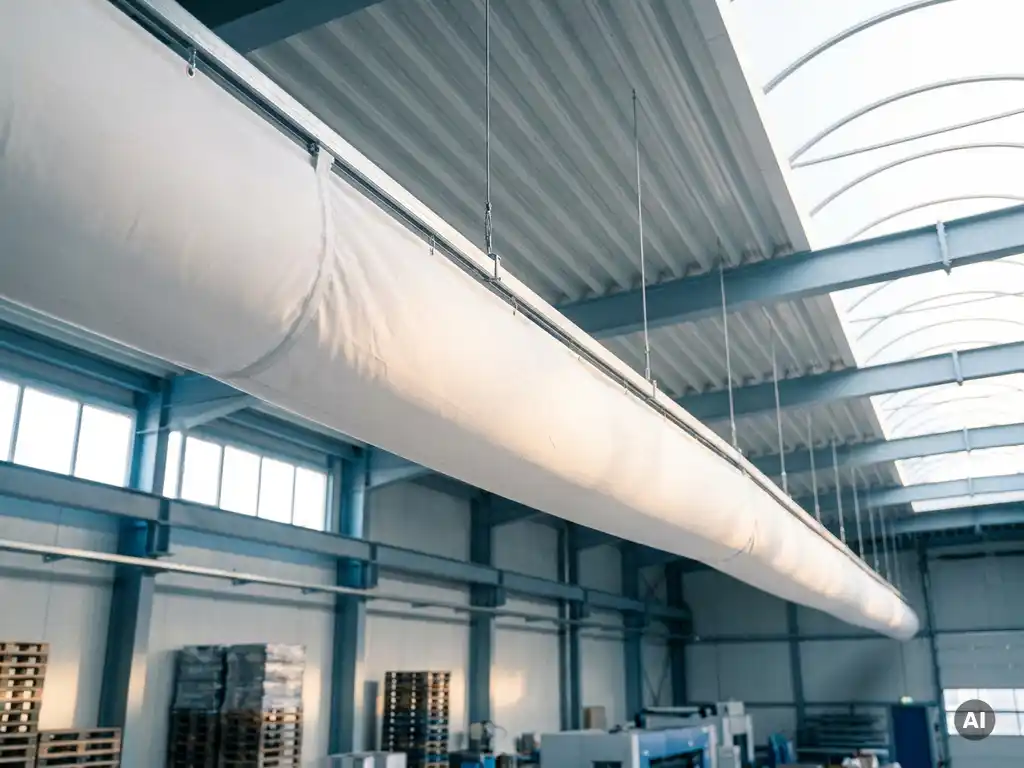
Textile ventilation technology produced in Germany is more sustainable than imported goods, because short transport routes, transparent supply chains, and high quality standards significantly reduce the ecological footprint across the entire product lifecycle. Those who rely on sustainable ventilation technology benefit not only from lower emissions during transport, but also from products that last longer and can be meaningfully recycled at the end of their service life. The following questions examine the most important sustainability aspects in detail.
What environmental advantages do short transport routes offer for ventilation technology?
Short transport routes significantly reduce CO₂ emissions in the delivery of ventilation technology. While imported goods from the Far East or Eastern Europe often travel thousands of kilometers by ship, rail, or truck, production in Germany generates considerably lower transport emissions. This directly impacts the ecological footprint of the finished product.
There is also an often-underestimated factor: shorter transport chains mean less packaging material, fewer handling steps, and a lower rate of damage. Damaged goods that must be replaced generate double the emissions. Those who rely on regionally produced textile air distribution therefore save not only on transport itself, but also on the associated follow-up costs and environmental impacts.
For planners and operators who must demonstrate sustainability targets, the origin of a product is today a relevant criterion. Environmental certifications and green building standards such as DGNB or LEED increasingly take transport distance into account as part of the life cycle assessment.
What does Cradle-to-Cradle mean for textile ventilation systems?
Cradle-to-Cradle (C2C) is a design principle in which materials are conceived so that after use they can be fully returned to biological or technical cycles. For textile ventilation systems, this means concretely: the textile material used must be recyclable without residue, and all substances used must be classified as safe.
A Cradle-to-Cradle certification covering the entire value chain goes far beyond mere recycling. It evaluates, among other things, material health, circularity, the use of renewable energy in production, water use, and social responsibility along the supply chain. For imported goods, such seamless certification is hardly achievable, since controlling all production steps abroad is extremely difficult.
Textile ventilation systems with C2C certification provide planners and building owners with a tangible sustainability proof that can be directly used in tenders and sustainability reports. This is a clear advantage over conventional imported goods without comparable certification.
How does German quality control affect product lifespan?
Strict quality control, as is standard in production in Germany, measurably extends the service life of textile air ducts. Products that last longer need to be replaced less frequently. This not only reduces operating costs, but also decreases resource consumption over the entire period of use.
For textile air ducts manufactured in Germany, material, seams, and function are tested directly at the production site. Short paths between development, manufacturing, and quality assurance enable close process control that is difficult to guarantee with imported goods produced across distributed supply chains. Defects are identified and resolved earlier, before the product is delivered.
Another aspect: fire protection that is permanently integrated into the yarn and chemically anchored cannot be washed out. This is a quality feature that ensures safety throughout the entire service life and does not depend on the frequency of cleaning. Imported goods with applied fire protection treatments generally cannot make this promise.
Are textile ventilation systems more sustainable than conventional sheet metal ducts?
Textile ventilation systems are more sustainable than conventional sheet metal ducts in several dimensions. They require less material in production, are easier to transport, simpler to install, and easier to recycle at the end of their service life than sheet steel systems.
Specifically, savings of up to 60% can be achieved in material and installation costs compared to conventional sheet metal systems. Less material also means less resource consumption in production and lower emissions. Textile air distribution systems are also significantly lighter, which reduces transport effort and simplifies installation.
There is also a functional advantage: due to the permeability of the textile material, air exits evenly across the entire surface at low velocity. This enables draft-free air distribution that requires less energy for readjustment or compensation. During ongoing operation, this can contribute to lower energy consumption. Sheet metal ducts, on the other hand, often require point outlets that can lead to drafts and uneven temperature distribution.
What role does supply chain transparency play in sustainable ventilation technology?
Supply chain transparency is a fundamental prerequisite for credible sustainability in ventilation technology. Anyone who cannot trace where raw materials come from, under what conditions they were produced, and how materials are recycled at the end of their life cannot present a reliable life cycle assessment.
For imported goods from third countries, this transparency is structurally difficult. Long supply chains with multiple suppliers and intermediaries make it nearly impossible to document every step seamlessly. This is not only a sustainability problem, but is increasingly becoming a compliance issue under German and European legislation. The Supply Chain Due Diligence Act obliges companies above a certain size to demonstrate due diligence along the entire supply chain.
Those who rely on products manufactured entirely in Germany have a significantly easier time providing this proof. The integration of all value creation steps at a single location enables seamless documentation that can be directly used in tenders, certifications, and sustainability reports. This is especially true for demanding industries such as the food industry, hospitals, or laboratories, where traceability is already mandatory.
How Kienzler Klima delivers sustainable textile ventilation technology Made in Germany
We at Kienzler Klima combine over 30 years of experience in textile ventilation technology with consistent production at our location in the Allgäu region of southern Germany. This makes us a reliable partner for all those seeking sustainable ventilation solutions with verifiable origins.
What we specifically offer:
- Cradle-to-Cradle certification for the entire value chain, from raw fiber to finished textile air duct
- Production in Germany with a fully transparent supply chain and short transport routes
- Individually manufactured textile air ducts with an average production time of just 14 days
- Permanent, chemically anchored fire protection that cannot be washed out
- Savings of up to 60% in material and installation costs compared to sheet metal systems
- Comprehensive consulting from planning through manufacturing to service and maintenance
Whether industrial hall, food production facility, hospital, or office building: we develop the right solution for your application. Get in touch and find out how we can implement your ventilation project sustainably and efficiently.