
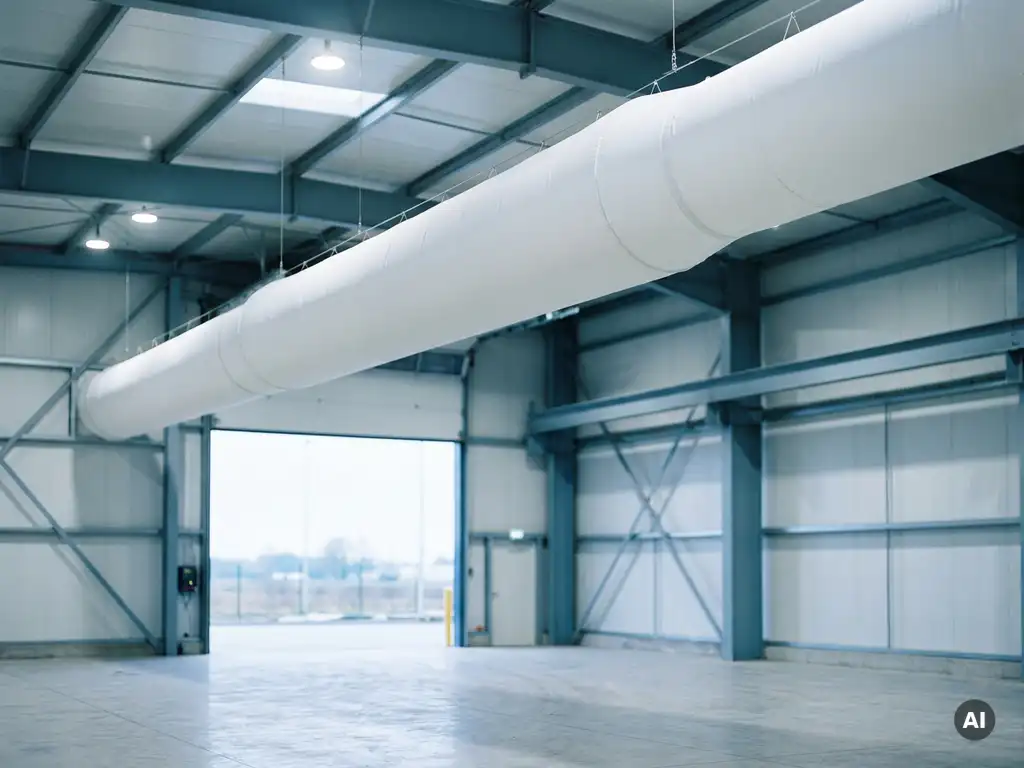
Halls with gate openings experience particularly severe draft problems because large openings allow direct, uncontrolled air exchange between the interior and exterior. Temperature and pressure differences drive massive airflows that spread throughout the entire hall. The following sections explain the physical causes, the types of halls affected, the economic consequences, and the most effective countermeasures.
What are the physical causes of drafts at gate openings?
Drafts at gate openings are caused by pressure equalization between two air masses of different temperatures and densities. Warm air is lighter and rises, while cold air is heavier and sinks. As soon as a hall door is opened, cold outside air flows into the hall at floor level, while warm hall air escapes to the outside in the upper area.
This effect is known in physics as thermal buoyancy or the chimney effect. The greater the temperature difference between inside and outside, the stronger the driving force behind this airflow. Wind also plays a role: even a light breeze outside significantly increases the air entering through the gate, because the windward side of the hall is under positive pressure while negative pressure develops on the leeward side.
Another physical factor is the so-called stack effect in tall halls. In buildings with a large ceiling height, a vertical pressure gradient builds up due to the temperature differential. The neutral pressure zone is typically located at the midpoint of the hall’s height. Below this zone, air flows in; above it, air flows out. At an open gate, these forces act simultaneously and create a rolling airflow that extends far into the interior of the hall.
Why do large gate openings intensify drafts so significantly?
Large gate openings intensify drafts because the flow rate increases proportionally to the free opening area. An industrial gate with an area of 16 square meters allows many times more air through than a standard door with two square meters under the same pressure conditions. The physical laws of fluid dynamics show: double the area means double the volumetric flow rate.
Compounding this is the fact that large gates are frequently opened completely and no aerodynamic barriers are present. With a standard door, the gap closes again quickly. A sliding gate or sectional gate, on the other hand, often remains open for several minutes to allow vehicle traffic. During this time, a considerable volume of cold air can flow in, lowering the local hall temperature by several degrees.
In addition, wide gates create wider inflow zones. The incoming cold air spreads out in a fan shape across the hall floor and reaches work areas located up to twenty meters from the gate. With a narrow gate, the affected area remains limited. With a wide hall gate, the cold air plume extends across the entire gate width and pushes deep into the work area.
Which types of halls are most severely affected by draft problems?
Most severely affected are production and logistics halls with frequent vehicle traffic, large room volumes, and multiple opposing gates. This combination of large openings, regular gate cycling, and through-drafts creates the most unfavorable conditions for a stable indoor climate.
Logistics and dispatch halls
In warehouses and distribution centers, forklifts and delivery vehicles continuously pass through loading gates. The gates are often open for short but frequent periods. If the entry and exit gates are positioned opposite each other, a direct air channel forms through the hall. Drafts in the hall are among the most frequently cited comfort issues for employees in these areas.
Production halls with heat sources
In manufacturing halls where machines or furnaces generate heat, the temperature difference with the outside air is particularly large. This elevated temperature gradient drives the chimney effect with greater force. At the same time, employees in such halls are often stationary at their workstations and therefore particularly sensitive to drafts at the hall gate.
Halls with lateral wind exposure
Halls in wind-exposed locations, such as industrial areas without windbreaks, are especially vulnerable. Even a moderate wind of five to eight meters per second generates inflow velocities at an open gate that significantly exceed the comfort threshold of 0.2 meters per second.
What damage and costs does drafts cause in industrial halls?
Drafts in industrial halls cause damage in three key areas: employee health, product quality, and energy costs. All three factors have direct economic consequences and should be considered when planning ventilation systems.
On the health side, prolonged exposure to drafts increases the risk of colds, muscle and joint complaints, and concentration problems. Studies in occupational medicine confirm that drafts are among the most frequently cited complaints in workplace risk assessments for industrial environments. More frequent sick days lead to production downtime and increased personnel costs.
In terms of product quality, uncontrolled drafts at hall gates can cause problems that are significant depending on the industry. In the food industry, temperature spikes can jeopardize the cold chain. In painting and coating operations, draft currents cause dust to swirl up and result in surface quality defects. In cleanrooms or pharmaceutical production facilities, uncontrolled air ingress can increase contamination risks.
Energy costs are often the most easily measurable factor. Every time cold outside air flows in, the heating system must compensate for the lost heat. In poorly sealed halls with frequent gate cycling, heating costs can be significantly higher than in comparable buildings. An industry-appropriate ventilation solution can significantly reduce this energy loss.
How can drafts at hall gates be effectively reduced?
Drafts at hall gates can be effectively reduced through a combination of structural measures, gate seals, and targeted air management. No single measure solves the problem completely. The most effective results are achieved by concepts that combine multiple approaches.
Structural measures include airlocks and canopies that shield the gate from direct wind exposure. A simple airlock with an inner and outer gate prevents both openings from being open simultaneously. High-speed doors reduce the opening duration to a minimum, thereby shortening the time during which cold air can flow in.
Air curtain systems mounted above the gate create an invisible curtain of rapidly flowing air. This curtain interrupts the free exchange of air between inside and outside without impeding vehicle traffic. Effectiveness depends heavily on correct sizing and alignment.
An often underestimated approach is the targeted maintenance of positive pressure inside the hall. If the supply air is regulated so that a slight positive pressure exists inside relative to the outside air, cold air cannot actively flow in. Textile ventilation systems are particularly well suited here because they distribute air evenly and at low outlet velocity along the entire length of the duct. More information on the basics of textile air ducts can be found in our overview.
Additionally, heat sources near the gate help to quickly warm the incoming cold air and mitigate the chimney effect. Infrared heaters above the gate or warm air blowers directed toward the gate entrance can noticeably reduce the perceived draft burden for employees. The product overview of textile ventilation systems shows which configurations are available for different hall geometries.
How Kienzler Klima helps with draft problems in your hall
At Kienzler Klima, we have been developing textile ventilation and climate systems specifically designed for the requirements of industrial halls for more than 30 years. We are familiar with draft problems at gate openings from numerous projects in logistics, the food industry, and vehicle production. Our approach is always individual: every textile air duct is designed for the specific application and manufactured within an average of 14 days.
What our solution means for your hall in concrete terms:
- Uniform air distribution along the entire duct length prevents cold air zones and reduces the pressure differential that drives drafts at gates
- Draft-free air discharge through permeable textile materials: air exits at very low velocity and does not create disruptive airflows at the workplace
- Up to 60% lower material and installation costs compared to conventional sheet metal systems
- Cradle-to-Cradle certified and permanently fire-protected through chemically anchored yarn that cannot be washed out
- Made in Germany: production at the Allgäu site with short delivery times and a direct point of contact
Whether new construction, renovation, or optimization of an existing system: we advise you from planning through to commissioning. Contact us now and describe your situation. We will get back to you promptly with a concrete assessment.