
Yes, a incorrectly configured heating system can actually cause draft problems in a room. When radiators or heating systems are misconfigured, uneven temperature distributions and air currents arise that feel like uncomfortable drafts. The following sections shed light on exactly how this happens, which settings are particularly problematic, and how you can permanently solve the problem.
How does draft from a heating system occur in the first place?
Draft from a heating system occurs when warmed air circulates unevenly in a room, creating noticeable air currents in the process. Radiators heat the air in their immediate vicinity intensely; this air rises, cools at walls and windows, and sinks back down. This convection current can reach speeds that the human body perceives as a draft.
This effect is particularly pronounced with radiators and convectors that release heat primarily through convection. The heated air rises at increased speed and creates a circulation that makes itself felt especially near the floor as a cool air current. Anyone who has walked past a poorly placed radiator and felt a distinct draft knows this phenomenon from personal experience.
In addition: poorly insulated windows and exterior walls significantly amplify this effect. Cold surfaces cool the warmed room air, which then sinks as a heavier, colder airflow. The result is a permanent air movement that feels thermally uncomfortable, even when the room temperature is actually sufficiently high.
Which heating settings promote draft problems?
Certain heating settings significantly worsen draft problems. These include above all excessively high flow temperatures, heavily throttled or fully opened thermostatic valves, and poor hydraulic balancing of the entire heating system. These factors lead to extreme temperature differences in the room and thus to more intense air currents.
In detail, the following settings are particularly problematic:
- Excessively high flow temperature: When the radiator becomes very hot, air rises at a higher speed. The resulting convection currents are stronger and therefore more noticeable.
- Missing hydraulic balancing: Without proper balancing, some radiators are oversupplied and others undersupplied. This leads to uneven temperatures and thus to stronger air circulation in individual areas of the room.
- Thermostat at maximum setting: A permanently fully opened thermostatic valve leads to overheating followed by cooling down. This cycling creates alternating air currents that are particularly uncomfortable.
- Incorrectly placed radiators: Radiators that are not positioned under windows or along cold exterior walls cannot usefully direct the convection current and instead create disruptive cross-currents in the room.
A carefully configured system with an adjusted flow temperature and hydraulic balancing significantly reduces these effects. For optimal room air distribution, however, the choice of heating system itself plays an equally important role.
What is the difference between actual draft and thermal discomfort?
Actual draft is a measurable air movement with a flow velocity of more than 0.15 to 0.2 meters per second that acts directly on the body. Thermal discomfort, on the other hand, arises from uneven temperatures in the room without any noticeable air movement necessarily being present. Both phenomena feel similarly unpleasant to the person affected, but have different causes and solutions.
Thermal discomfort occurs when the head and feet experience different temperatures. Standards such as DIN EN ISO 7730 define clear limit values for this: the temperature difference between head and foot level should not exceed three Kelvin. If this value is exceeded, many people perceive the room as drafty, even when no measurable air current is present.
The distinction is crucial for troubleshooting. Anyone combating actual draft must reduce air currents. Anyone addressing thermal discomfort must equalize the temperature distribution in the room. In practice, both problems frequently occur together, particularly with incorrectly configured heating systems with strong convective heat.
How can heating-related draft problems be resolved?
Heating-related draft problems can be permanently resolved through a combination of system optimization, structural measures, and the right choice of air distribution system. The first step is always a root cause analysis, because the solution depends on whether the draft is caused by the heating setting, the building envelope, or the ventilation system.
Measures on the heating system
Have hydraulic balancing carried out by a specialist company. In the process, all radiators are adjusted so that they are supplied evenly with heating water. At the same time, the flow temperature should be reduced to the necessary minimum. Modern low-temperature heating systems operate with flow temperatures between 35 and 55 degrees Celsius and generate significantly weaker convection currents than older high-temperature systems.
Structural and interior design measures
Seal windows and doors to prevent actual cold air infiltration. Radiators should ideally be positioned under windows or in front of cold exterior walls so that the rising warm air intercepts the incoming cold air. In addition, curtains and blinds help reduce the radiation from cold glass surfaces and thus weaken the convection current.
Which heating systems cause the least draft?
Radiant heating systems such as underfloor heating and radiant heaters cause the least draft because they release heat without strong convection currents. Textile air distribution systems in combination with an air conditioning or ventilation system also distribute air evenly and at very low outlet velocity, which structurally prevents draft problems.
A comparison of common systems shows clear differences:
- Underfloor heating: Heat is released evenly from below, no strong convection currents, minimal draft risk.
- Ceiling radiant panels: Radiant heat without significant air movement, very even temperature distribution.
- Conventional radiators: Strong convection, increased draft risk, especially at high flow temperatures.
- Convectors and fan coil units: Generate direct air currents via the fan, highest draft risk when incorrectly configured.
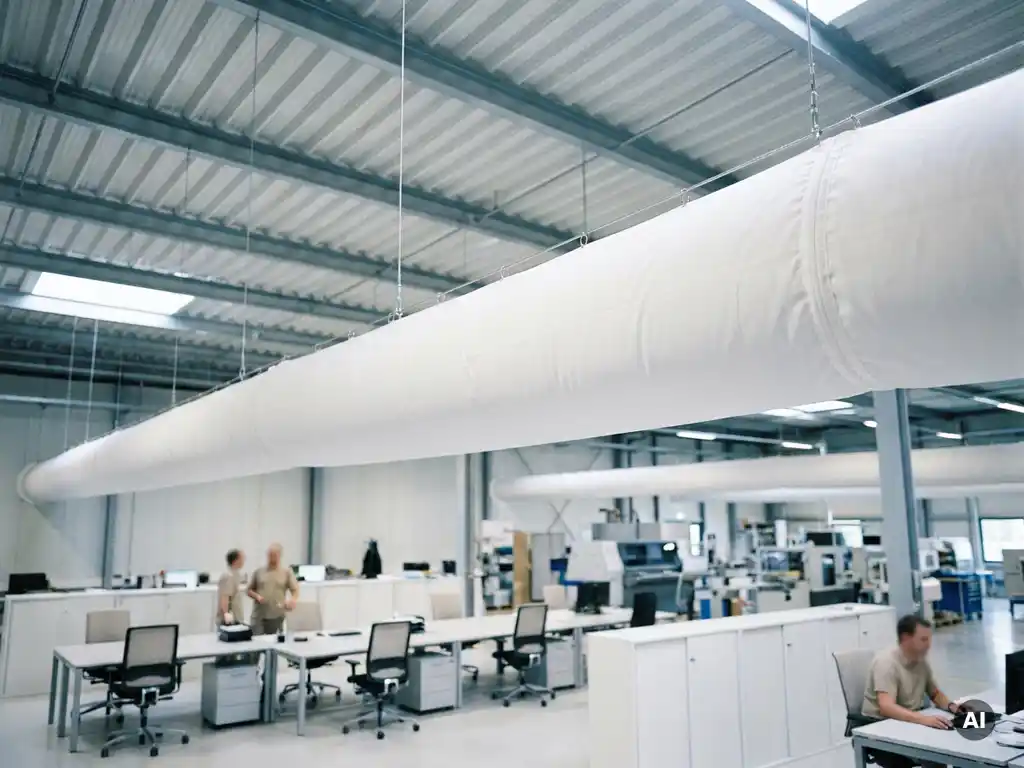
- Textile air distribution systems: Air exits evenly across the entire surface of the fabric duct at very low outlet velocity, which structurally eliminates draft.
What is decisive here is not only the heating system itself, but also the associated air distribution system. Even a well-configured heating system can create draft problems if air is blown into the room at high speed through conventional sheet metal ducts and point diffusers.
How Kienzler Klima permanently solves draft problems
In many cases, draft is not an unavoidable fate but a solvable system problem. This is exactly where we at Kienzler Klima come in. With more than 30 years of experience in air and climate technology, we develop textile air distribution systems that structurally avoid draft by allowing air to exit across the entire surface of the fabric duct at minimal speed and distributed evenly.
What sets us apart:
- Individual design: Every fabric air duct is designed precisely for the specific room, air volume, and application — no off-the-shelf compromise solution.
- Fast delivery: With an average production time of just 14 days, our systems are ready for use quickly.
- Made in Germany: Production and all value creation steps take place at our location in the Allgäu, with short lead times and full quality control.
- Up to 60% cost savings: Compared to conventional sheet metal systems, you save considerably on materials and installation.
- Cradle-to-Cradle certification: Our systems are sustainably designed and certified — from raw material extraction to recycling.
Whether office, production hall, hospital, or food processing facility: our fabric air ducts create a permanently draft-free indoor climate. Get in touch with us and let our team advise you. Contact us directly — we look forward to your inquiry.