
Yes, poor air distribution can actually worsen chronic neck and back pain. Cold air currents that hit muscles and joints directly trigger tension and impair circulation — both factors that intensify existing complaints. The following sections explain why this is the case and which ventilation situations are particularly critical.
How does drafts arise from poor air distribution?
Drafts occur when air is introduced into a room at too high a flow velocity and unevenly. Conventional ventilation systems direct air through a few, localized outlets, creating local high-velocity currents that are perceived as an uncomfortable draft — even when the overall room temperature is correct.
The problem lies in physics: a single air outlet must transport the entire volume of air through a small opening. The resulting flow velocity quickly exceeds the comfort range of approximately 0.15 to 0.25 meters per second recommended by standards such as DIN EN ISO 7730 for office and comfort areas. Anyone sitting in an office who feels the air conditioning repeatedly blowing cold air across their neck or shoulders is experiencing exactly this effect. Fundamentals of textile air distribution show how large-area air delivery solves this problem at its root.
Added to this is uneven temperature distribution: areas near the outlet are significantly colder than the rest of the room. This means that certain individuals are permanently exposed while others barely feel any air movement — a classic sign of poor air distribution.
Why is the musculoskeletal system so sensitive to cold air currents?
The musculoskeletal system responds to cold air currents with muscle contraction and reduced blood circulation. Cold activates protective reflexes: the muscles contract to retain heat. If this condition persists for hours — such as at an office workstation — a chronic baseline tension develops that promotes pain in the neck, shoulders, and back.
Areas with little active movement are particularly affected. Those who sit at a desk barely move their neck and shoulders — the muscles remain in a static holding position. If a cold air current hits exposed skin areas in this situation, local blood circulation deteriorates further. Tendons and fascia receive less adequate supply, tension develops more quickly and dissipates more slowly.
In people who already suffer from back pain or neck pain caused by air conditioning, drafts act as an amplifier: the already irritated muscles respond more sensitively to thermal stimuli. This explains why those affected perceive air conditioning as a major trigger of their complaints — even though the cause is not the air conditioning itself, but the way the air is distributed.
Which ventilation situations place the greatest strain on the neck and back?
The neck and back are most heavily burdened in situations where people sit or stand continuously and directly below or near air outlets. Particularly critical are offices with ceiling outlets directly above workstations, production halls with directed nozzle outlets, and vehicle cabins or server rooms with strong local cold air sources.
- Offices with ceiling cassettes: Air is blown downward onto the workstations. Anyone sitting directly beneath them is exposed to a continuous cold air current for hours — a classic trigger for neck pain caused by air conditioning.
- Industrial halls with slot outlets: High volumes of air are introduced through a few outlets. The high flow velocity affects employees who work in standing or seated positions at fixed locations.
- Open-plan offices with uneven distribution: Some seats are in the direct flow path while others receive barely any fresh air. The uneven air distribution in the office creates comfort zones and problem zones within the same room.
- Areas with high cooling loads: Air is introduced at particularly low temperatures there. Even brief exposure can trigger tension in sensitive individuals.
What matters is not only the temperature of the air, but the combination of temperature, flow velocity, and duration of exposure. All three factors together determine how heavily the musculoskeletal system is burdened.
How does textile air distribution differ from conventional systems?
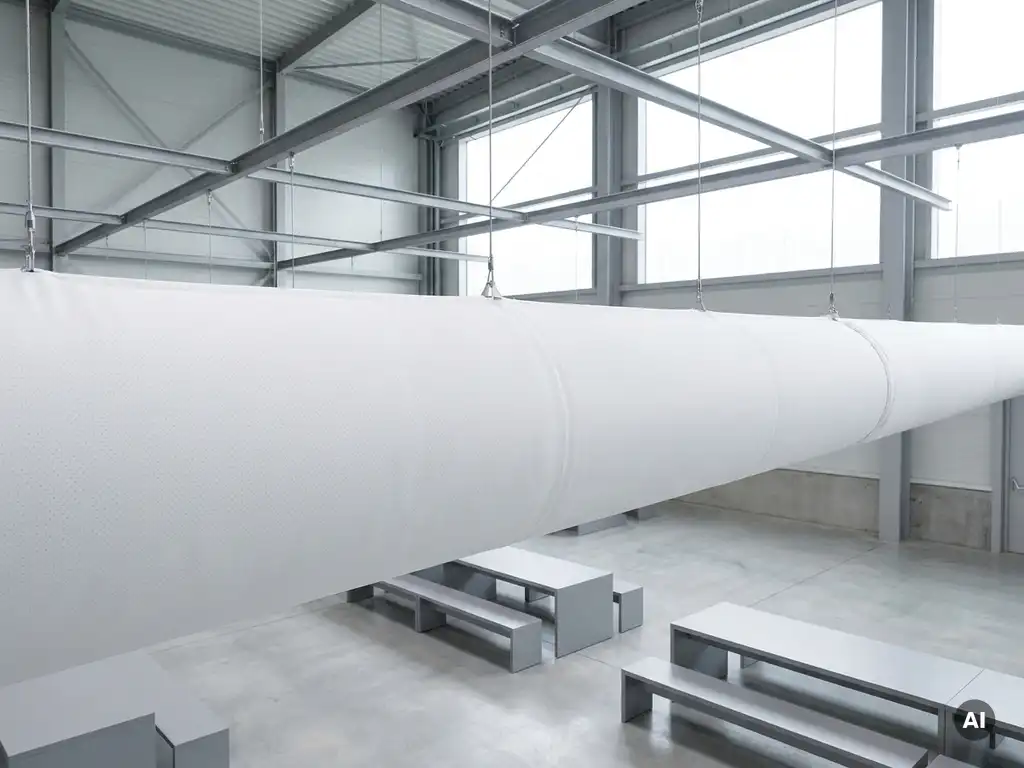
Textile air distribution systems release air evenly and at very low flow velocities across the entire permeable surface of the duct. Conventional sheet metal systems, by contrast, introduce air through localized outlets at high velocity. The decisive difference lies in area distribution: textile distributes, sheet metal concentrates.
With a textile air duct, air exits through the permeable fabric along the entire length of the system. This means: instead of a few high-velocity jets, a uniform, large-area air movement is created with flow velocities that are clearly within the comfort range. Drafts and the associated back pain caused by drafts are thus structurally prevented — not through regulation, but through the very principle of air delivery.
Further differences concern hygiene, installation, and cost-effectiveness. Textile systems can generally be cleaned completely and are therefore particularly suitable for areas with high hygiene requirements. In terms of material and installation costs, textile air distribution systems can save up to 60 percent compared to conventional sheet metal systems. The product overview of textile air ducts provides an overview of the available variants for different application areas.
When should a ventilation system be converted to textile components?
Switching to textile ventilation components makes sense when employees or users repeatedly complain about drafts, cold-related discomfort, or neck pain caused by air conditioning; when measurements show elevated local flow velocities; or when a new construction or renovation project offers the opportunity to fundamentally reconsider the distribution system.
Concrete indicators that action is needed include:
- Recurring complaints at specific workstations that cannot be explained by seating position or furnishings
- Visible draft problems, for example fluttering papers or discomfort when spending time in certain areas of the room
- Uneven temperatures in the room despite a functioning air conditioning system
- Planned expansions or renovations in which the existing sheet metal system would need to be adapted anyway
- Hygiene requirements that mandate regular cleaning of the air ducting
Textile systems can in many cases also be integrated into existing installations without replacing the entire ventilation infrastructure. The application areas of textile air ducts range from offices and commercial spaces to laboratories and hospitals through to production halls — the technology is broadly applicable.
How Kienzler Klima helps with drafts and climate-related complaints
We at Kienzler Klima have been developing and manufacturing textile ventilation and air conditioning systems for more than 30 years — systems that structurally eliminate drafts and the associated physical complaints. Our textile air ducts are individually designed for each application and manufactured with an average production time of just 14 days, exclusively at our location in the Allgäu region, Made in Germany.
What specifically sets our solution apart:
- Uniform air delivery: Air exits across the entire surface of the textile duct — no cold air jets, no draft peaks, no local temperature drop at individual workstations.
- Comfort throughout the entire room: The large-area distribution creates a permanent, uniform temperature across the entire cooling and heating load area.
- Cradle-to-Cradle certification: Our products are sustainably certified, and the integrated fire protection is permanently chemically anchored in the yarn — it cannot be washed out.
- Up to 60% savings: Compared to conventional sheet metal systems, our solutions significantly reduce material and installation costs.
- Individual planning: Every system is tailored to your specific room situation, usage requirements, and air volume.
If employees in your facility suffer from climate-related complaints or you are planning a new project, get in touch with us. Contact us — we will advise you without obligation and work together with you to develop the right solution.