
Air quality in passive houses is measurably better than in conventional buildings. The key difference lies in the controlled mechanical ventilation system: while in conventional buildings air exchange occurs uncontrolled through windows, gaps, and leaks, the passive house ventilation system provides a continuous, filtered supply of fresh air. The following questions shed light on how this system works in detail and what you should pay attention to during planning and operation.
How is air technically exchanged in a passive house?
In a passive house, a mechanical ventilation system with heat recovery handles all air exchange. The system extracts stale indoor air and brings filtered outdoor air into the building without the need to open windows. The heat exchanger transfers up to 90 percent of the heat from the exhaust air to the incoming fresh air, significantly reducing heating demand.
Technically, such a system consists of a central ventilation unit, a network of supply and exhaust air ducts, and filter stages that retain pollen, fine particulate matter, and other particles from the outdoor air. The air exchange rate is precisely calibrated to the building’s needs, typically between 0.3 and 0.5 air changes per hour. This is sufficient to keep CO₂ concentration permanently below the critical threshold of 1,000 ppm, beyond which concentration and well-being noticeably deteriorate.
In contrast, air exchange in conventional buildings is heavily dependent on user behavior and outdoor conditions. Those who rarely ventilate in winter live with elevated CO₂ levels and humidity, while those who ventilate frequently lose valuable heating energy. The passive house decouples this dependency through continuous, regulated ventilation.
Which pollutants are better filtered in passive houses?
Passive house ventilation systems systematically filter the incoming outdoor air through filter classes that, depending on the configuration, retain fine particulate matter, pollen, mold spores, and even ultrafine particles. In conventional buildings, these substances enter unfiltered through open windows or leaky building envelopes.
Typical filters in passive house systems meet at least the ISO ePM10 class (formerly G4); high-quality systems use ISO ePM1 filters, which can even separate very fine particles smaller than one micrometer. This is particularly relevant for allergy sufferers, asthmatics, and people with sensitive airways. Nitrogen oxides and other outdoor air pollutants that frequently occur in urban areas are also additionally reduced by suitable activated carbon filters.
At the same time, controlled mechanical ventilation prevents pollutants from inside the building — such as volatile organic compounds (VOCs) from building materials, cleaning agents, or furniture — from accumulating. The continuous removal of polluted indoor air keeps the concentration of such substances at a permanently low level.
What are the risks of a poorly maintained passive house ventilation system?
An unmaintained ventilation system in a passive house can significantly deteriorate air quality, in some cases even to below the level of conventional buildings. Clogged filters, contaminated ducts, or defective heat exchangers negate the advantages of the system and create new problems.
Specifically, the following risks arise when maintenance intervals are neglected:
- Clogged filters: Contaminated filters increase flow resistance, reduce air throughput, and can themselves become a source of particles and germs.
- Mold growth in the duct system: Moisture in the ventilation network — for example, due to condensation problems — promotes the growth of mold fungi, whose spores then enter the living spaces.
- Elevated CO₂ concentration: Reduced air throughput leads to poorer fresh air supply and rising pollutant levels in indoor air.
- Noise development and energy loss: Dirty or defective components increase the energy demand and noise output of the system.
A filter change is recommended at least once a year, and every six months in cases of high dust exposure or pollen allergies. A complete technical inspection of the entire system should be carried out every two to three years by a qualified service company.
Is humidity better regulated in passive houses?
In well-planned passive houses, relative humidity is more stable than in conventional buildings, because the controlled mechanical ventilation system continuously removes excess moisture. This significantly reduces the risk of condensation and mold, provided the system and building envelope are correctly dimensioned.
The ideal range for relative humidity in living spaces is between 40 and 60 percent. In conventional buildings, this range is often not reached, especially in winter, because dry heating air and insufficient fresh air supply disrupt the moisture balance. Passive houses with heat recovery systems maintain this range more consistently through continuous air exchange.
However, there is a limitation here as well: in very cold winters, the incoming outdoor air can be so dry that indoor humidity drops regardless. High-quality passive house systems are therefore equipped with moisture recovery, which transfers humidity from the exhaust air to the supply air, stabilizing indoor humidity even at extreme outdoor temperatures.
Which air distribution systems are suitable for passive house ventilation systems?
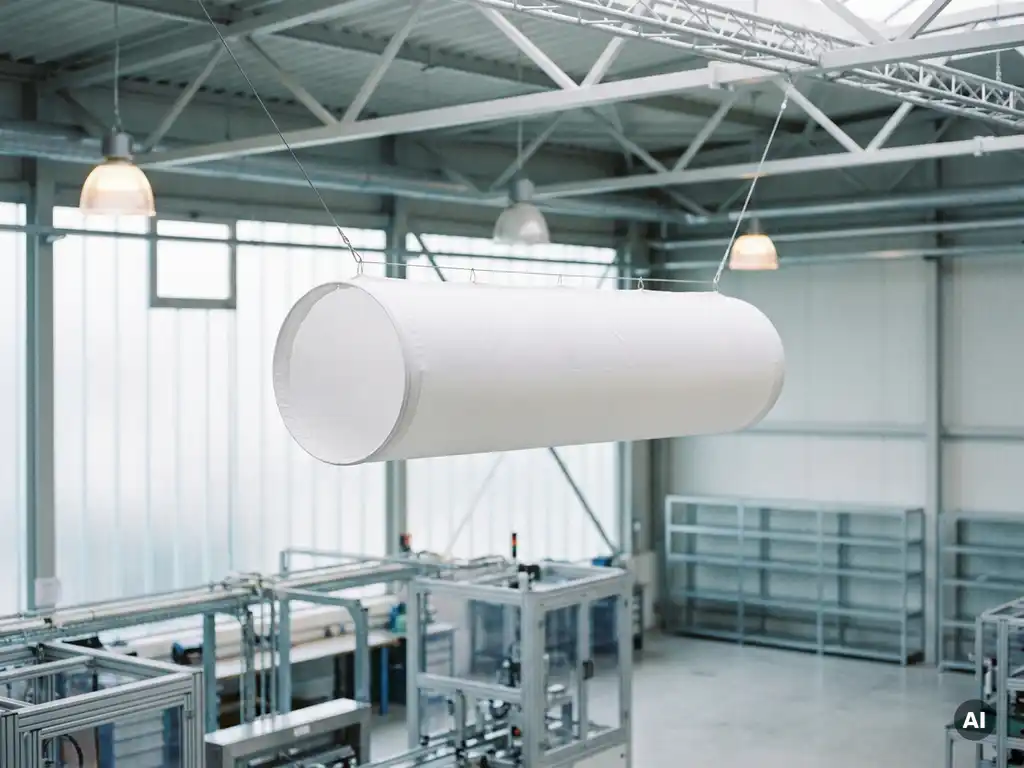
Air distribution systems that enable a uniform, draft-free airflow at low flow velocities are particularly well suited for passive house ventilation systems. Textile air distribution systems meet these requirements to a particularly high degree, as the air exits through the entire permeable surface of the duct and is thus distributed evenly without disruptive drafts.
Conventional sheet metal ducts with point outlets, on the other hand, generate flow peaks that can be disruptive in the sensitive low-energy context of the passive house. The requirements of passive house ventilation systems — low pressure losses, precise volume flow distribution, and draft-free operation — can be met particularly well with textile systems. In addition, textile air ducts are significantly lighter than sheet metal ducts, which simplifies installation and reduces the load on the supporting structure.
The following properties are particularly relevant for use in residential buildings with passive house standard:
- Low pressure losses: Textile systems operate at low working pressures, which supports the energy efficiency of the system.
- Uniform air distribution: Due to the permeable surface, air exits at very low velocity — typically below 0.2 m/s — and distributes draft-free throughout the room.
- Hygienic cleanability: Textile air ducts can generally be machine washed, which makes it easier to maintain hygiene standards.
- Individual design: Each system is tailored to the specific volume flow and room geometry, which is particularly important for the precise design of passive house ventilation systems.
An overview of possible configurations is provided by the product overview for textile air ducts, which shows various materials, diameters, and outlet variants.
How Kienzler Klima optimally supports your passive house ventilation
At Kienzler Klima, we have been developing and manufacturing textile air distribution systems for more than 30 years and know the special requirements of passive house ventilation systems from practical experience. Our textile air ducts are specifically designed to make full use of the strengths of controlled mechanical ventilation: uniform air distribution, minimal airflow noise, and permanently hygienic conditions.
What sets us apart:
- Individual design: Every textile duct is tailored to your specific application — volume flow, room geometry, and air velocity requirements are taken into account with precision.
- Short delivery times: With an average production time of just 14 days, we respond quickly to your needs, even for short-notice projects.
- Made in Germany: We manufacture exclusively at our site in the Allgäu region and integrate all value creation steps under one roof — for consistently high quality.
- Cradle-to-Cradle certification: Our systems are designed sustainably and meet the requirements of modern, resource-efficient building concepts such as the passive house standard.
- Up to 60% savings: Compared to conventional sheet metal systems, our textile solutions significantly reduce material and installation costs.
Whether new construction, renovation, or specific requirements for hygiene and acoustics — we are happy to advise you. Take a look at our application areas for textile air ducts or contact us directly — together we will find the right solution for your passive house ventilation system.