
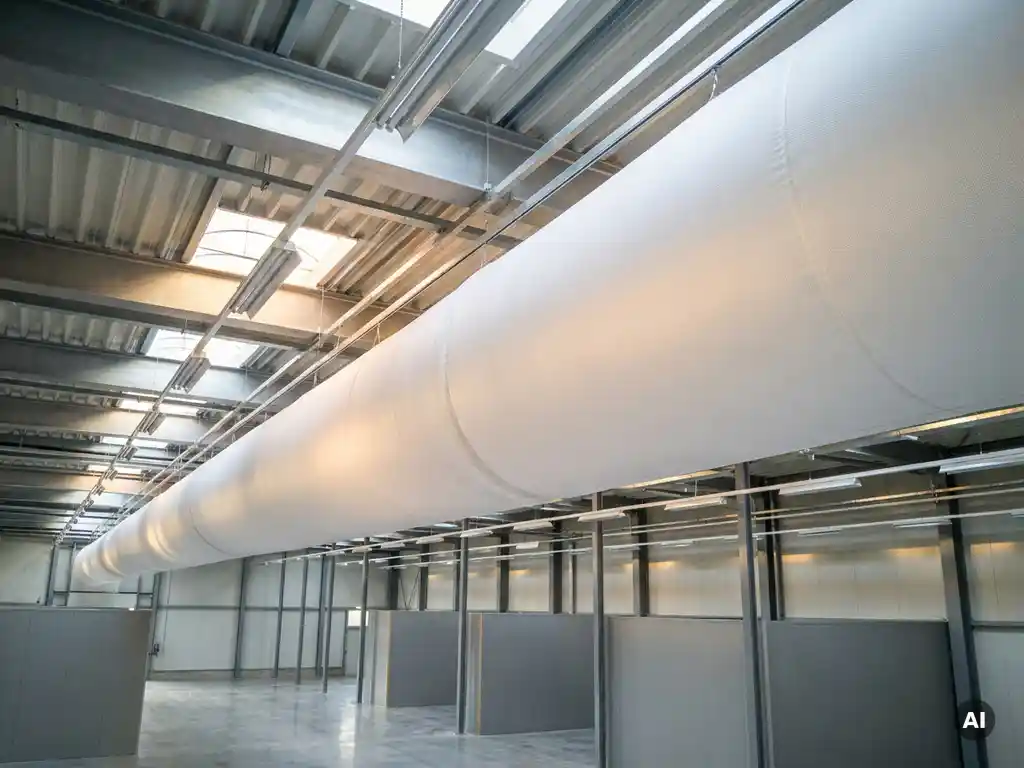
Draft-free ventilation has a direct positive impact on the energy efficiency of a building. The uniform, large-area air distribution at low discharge velocity reduces thermal losses and allows ventilation systems to operate more efficiently. The following questions shed light on why this is the case and who benefits most from this approach.
How much energy can be saved through draft-free ventilation?
Draft-free ventilation can noticeably reduce the energy demand of a ventilation system. Textile air distribution systems enable savings of up to 60% in material and installation costs compared to conventional sheet metal duct systems. During operation, the low discharge velocity reduces pressure loss in the system, which directly lowers the energy consumption of the fan.
A key factor here is the avoidance of drafts: when air is introduced into a room too quickly and unevenly, occupants respond by wanting higher room temperatures or switching the system off entirely. This drives up energy consumption. Draft-free systems create a comfortable indoor climate that is perceived as comfortable even at lower temperatures, which further reduces heating and cooling demand.
Why is uniform air distribution more energy efficient?
Uniform air distribution is more energy efficient because it minimizes temperature differences within the room. When air exits across the entire surface of a textile duct, no localized cold or warm zones are created. This means the system needs to make fewer adjustments, thermostats respond more stably, and the overall runtime of the system decreases.
Conventional point outlets introduce air into a room in concentrated streams. This creates turbulent airflow that leads to uneven temperature stratification, particularly in tall halls or large spaces. To compensate for these layers, systems must expend more energy. Large-area air distribution avoids this problem structurally — not through additional effort, but through better system design.
What is the difference between textile and conventional ventilation in terms of energy consumption?
The decisive difference lies in pressure loss, air velocity, and heat transfer behavior. Textile ventilation systems operate at significantly lower discharge velocities than sheet metal ducts with slot or nozzle outlets. This reduces the static pressure in the system, which relieves the fan and lowers electricity demand.
Textile ventilation: Low velocity, large surface area
With textile air ducts, air exits permeably across the entire surface. The discharge velocity is so low that no drafts are created. At the same time, air is distributed over a large area, enabling rapid and uniform temperature conditioning of the room without the system having to run at full capacity.
Conventional ventilation: High velocity, concentrated air injection
Sheet metal duct systems with point outlets generate high local air velocities. To still achieve uniform temperature distribution throughout the room, the system must move more air or run for longer. In addition, sheet metal ducts are less well insulated than textile systems, leading to heat losses along the way to the outlet. The textile alternative clearly outperforms in terms of energy efficiency.
How does air discharge velocity affect energy demand?
Air discharge velocity directly affects energy demand through the relationship between flow velocity and pressure loss. Physically, pressure loss increases with the square of the velocity. Halving the discharge velocity can therefore reduce pressure loss by up to 75%, which immediately lowers the energy demand of the fan.
Textile climate components are designed so that air exits at very low velocity over a large surface area. This is not a compromise in air volume, but a design principle: less pressure, more surface area, equal or better performance. For planners and system operators, this means that smaller fans are sufficient and operating costs remain permanently lower.
In which building types is draft-free ventilation particularly worthwhile?
Draft-free ventilation is particularly worthwhile in buildings with high requirements for air quality, comfort, or hygiene, as well as in large halls with high air volumes. These include industrial halls, logistics centers, hospitals, laboratories, food processing facilities, and sports venues.
In these applications, the advantages are especially pronounced:
- Industrial halls and logistics centers: Large volumes, many people, high heat input from machinery. Draft-free systems distribute air evenly without creating cold zones at workstations.
- Hospitals and laboratories: Hygiene requirements are high. Textile systems are easy to clean and offer no dead zones where germs can accumulate.
- Food industry: Temperature consistency is critical. Uniform air distribution protects products and processes from uncontrolled temperature fluctuations.
- Sports and leisure facilities: Drafts are particularly disruptive here. Textile ventilation creates a comfortable climate even with a high number of occupants.
More information on the areas of application for textile ventilation across various industries shows how versatile the technology is.
What role does Cradle-to-Cradle certification play in the energy balance?
Cradle-to-Cradle certification considers the energy balance of a product across its entire lifecycle, not just during operation. It takes into account how much energy is expended during the manufacture, use, and recycling of the material. A certified system is designed so that resources remain in circulation and no material value is lost.
For textile ventilation systems, this means in practice: the materials used are selected so that they can be fully returned or reused at the end of their service life. This significantly reduces the total energy input over the product lifecycle compared to systems whose materials must be landfilled or expensively disposed of. The certification is therefore not a marketing label, but a verifiable proof of the overall ecological balance — one that is also relevant for sustainability reports and building certifications such as DGNB or LEED.
How Kienzler Klima helps you with draft-free, energy-efficient ventilation
We develop and manufacture textile ventilation systems that are designed for energy efficiency and comfort from the outset. With over 30 years of experience in climate technology and complete value creation at our Allgäu location, we offer you solutions that are technically precise and sustainably certified.
What we do for you:
- Individual planning: Every textile duct is designed for your specific application, with an average production time of 14 days.
- Energy-optimized design: We calculate discharge velocity, pressure loss, and air distribution so that your system achieves maximum effect with minimal energy input.
- Cradle-to-Cradle-certified materials: Our products are certified across the entire value chain, including permanently integrated fire protection that cannot be washed out.
- Made in Germany: Short supply chains, close process integration, and a direct point of contact — from consultation to service.
Contact us and find out how draft-free textile ventilation can permanently reduce your energy costs. Get in touch now and receive a no-obligation consultation.