
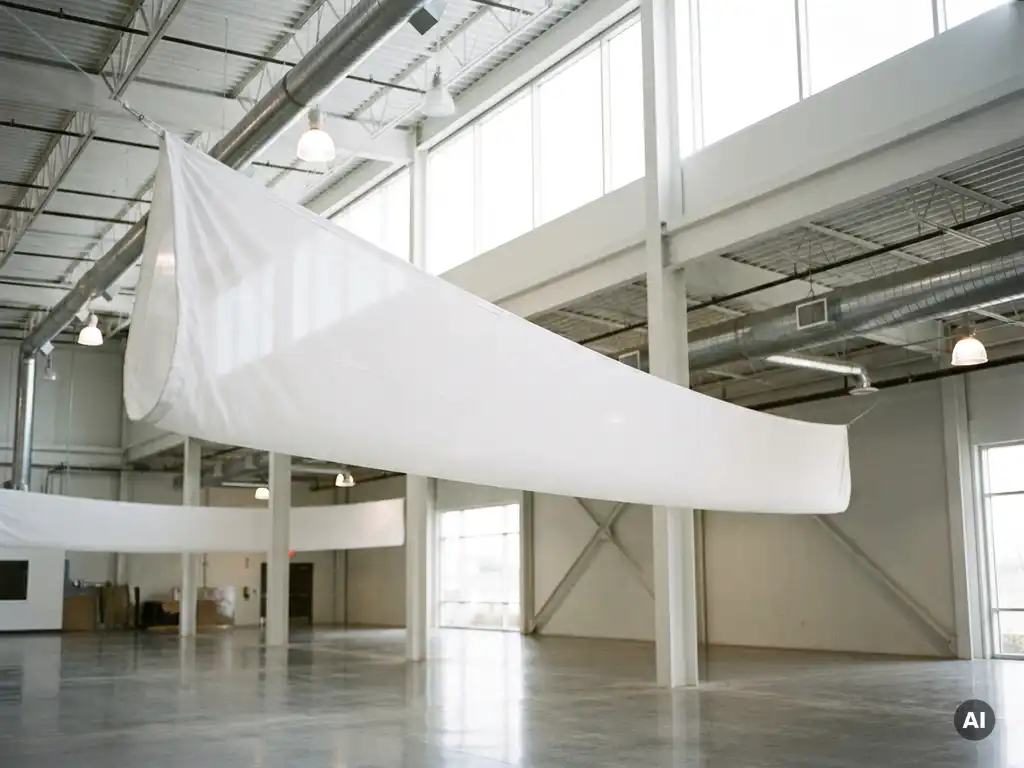
An eco-certification of a ventilation system has a direct positive impact on occupational health: certified systems avoid pollutants in indoor air, ensure even air distribution without drafts, and reduce long-term health burdens for employees. Particularly relevant are the type of materials used and their entire lifecycle.
For companies pursuing sustainability goals while also looking to improve the well-being of their workforce, a ventilation certification such as Cradle-to-Cradle offers measurable added value. The following sections shed light on the most important questions surrounding eco-certification, indoor air quality, and the practical benefits for businesses.
What pollutants does a certified ventilation system prevent in the workplace?
A certified ventilation system prevents pollutants such as volatile organic compounds (VOCs), formaldehyde, plasticizers, and chemical flame retardants that can be released into indoor air from uncontrolled or low-quality materials. Certification ensures that all materials used have been tested and cleared of health-hazardous substances.
Conventional sheet metal ducts can promote corrosion, dust accumulation, and biofilms on their interior surfaces, which can enter the room through the supply air. Textile ventilation systems with appropriate certification use materials that demonstrably do not release problematic substances. Fire protection plays a special role here: in certified textile solutions, flame protection is chemically and permanently anchored in the yarn and cannot be washed out. This means no additional flame retardants are applied that could decompose during operation or be released into the indoor air.
For sensitive applications such as hospitals, laboratories, or the food industry, this aspect is particularly critical: strict requirements apply to air purity, and every source of pollutants in the ventilation system represents a potential risk.
How does a Cradle-to-Cradle certification improve indoor air quality?
A Cradle-to-Cradle certification improves indoor air quality by ensuring that all materials in the ventilation system have been fully tested for freedom from harmful substances and are conceived within closed-loop cycles. This includes not only the end product, but the entire value chain from raw material to reuse.
The core of the Cradle-to-Cradle principle lies in material health: only substances that are safe for people and the environment may be used in certified products. For a textile ventilation system, this means that yarn, coatings, and auxiliary materials have been evaluated for their impact on indoor air. The result is a system that releases no unwanted emissions into the breathing air.
There is also the aspect of long-term stability: Cradle-to-Cradle-certified materials are designed to retain their properties throughout their entire service life. With inferior systems, pollutants often only emerge after years, when materials age, degrade, or are attacked by cleaning agents. A certified system provides a more reliable foundation for consistently high indoor air quality.
What difference does even air distribution make for workplace well-being?
Even air distribution without drafts measurably improves well-being in the workplace: it reduces fatigue, concentration problems, and complaints such as headaches or dry mucous membranes, which are often caused by uneven or excessively direct airflow.
Conventional ventilation outlets frequently create localized cold air pockets or draft zones that burden individual workstations, while other areas receive barely any fresh air. Textile air distribution systems operate on a different principle: air exits through the permeable surface of the textile at very low velocity along the entire length of the duct. The result is an even, virtually draft-free distribution of conditioned air throughout the entire room.
For businesses, this means in concrete terms:
- Fewer illness-related absences due to draft-related complaints
- Greater acceptance of the ventilation system among staff
- Uniform temperature conditions across the entire cooling and heating load range
- Better concentration and productivity thanks to a comfortable indoor climate
Especially in open-plan offices, production halls, or sports facilities, where many people work in close proximity, this difference becomes clearly noticeable in daily operations. The application possibilities of textile ventilation systems extend far beyond conventional office environments.
Does an eco-certification of the ventilation system count toward sustainability reports and LEED/BREEAM?
Yes, an eco-certification of the ventilation system can be taken into account in sustainability reports and contributes to the scoring in building certification systems such as LEED or BREEAM. What is decisive is which criteria the respective certification system recognizes and how documentation is maintained.
LEED and BREEAM evaluate, among other things, indoor air quality, the use of low-emission materials, and the ecological quality of the products used. A Cradle-to-Cradle certification of the ventilation system provides documented evidence of material health and circularity that can feed into these assessment frameworks.
For sustainability reports prepared according to GRI standards or within the framework of the EU Taxonomy, ventilation certification is a verifiable contribution to the category of indoor air quality and resource-efficient building operation. Companies seeking to improve their ESG metrics should systematically document the certification records of their ventilation components and incorporate them into their reporting.
Important: The exact creditability depends on the specific certification project, the auditor, and the version of the assessment system. Early coordination with the building certifier is recommended.
When does it make sense to switch to a certified textile ventilation system?
Switching to a certified textile ventilation system is particularly worthwhile for new construction projects, extensive renovations, or when existing systems no longer meet requirements for indoor air quality, energy efficiency, or sustainability certifications. Economic arguments also frequently support making the transition.
Specifically, an evaluation is recommended in the following situations:
- The existing sheet metal duct system is causing high maintenance and cleaning costs
- Employees regularly complain about drafts, uneven temperatures, or poor air quality
- The company is planning a LEED, BREEAM, or DGNB certification of the building
- Sustainability goals require a review of the technical systems in use
- An expansion or renovation of the operational space is planned
On the cost side, textile ventilation systems offer savings of up to 60% in material and installation costs compared to conventional sheet metal solutions. Additional savings come from lower operating costs due to easier cleaning and maintenance. The available textile air ducts are individually designed for each specific application and are typically produced and ready for delivery within 14 days.
How Kienzler Klima supports you in choosing the right ventilation system
We at Kienzler Klima accompany you from the initial consultation through to completed installation, with more than 30 years of experience in textile ventilation and air conditioning technology. Our systems are Cradle-to-Cradle certified, manufactured entirely in Germany, and individually tailored to your specific application. This means for you:
- Pollutant-free materials: All materials used have been tested for material health. Flame protection is permanently anchored in the yarn and releases no substances into the indoor air.
- Even, draft-free air distribution: Our textile air ducts distribute air across the entire surface at minimal discharge velocity.
- Documented certification: Our Cradle-to-Cradle certification covers the entire value chain and provides you with usable documentation for sustainability reports and building certifications.
- Short delivery times: Every textile duct is individually manufactured, with an average production time of just 14 days.
- Wide range of applications: From offices and production halls to hospitals, laboratories, and the food industry.
If you would like to find out whether a certified textile ventilation system is the right choice for your business, please get in touch with us. Contact us and we will advise you without obligation on your specific project.