
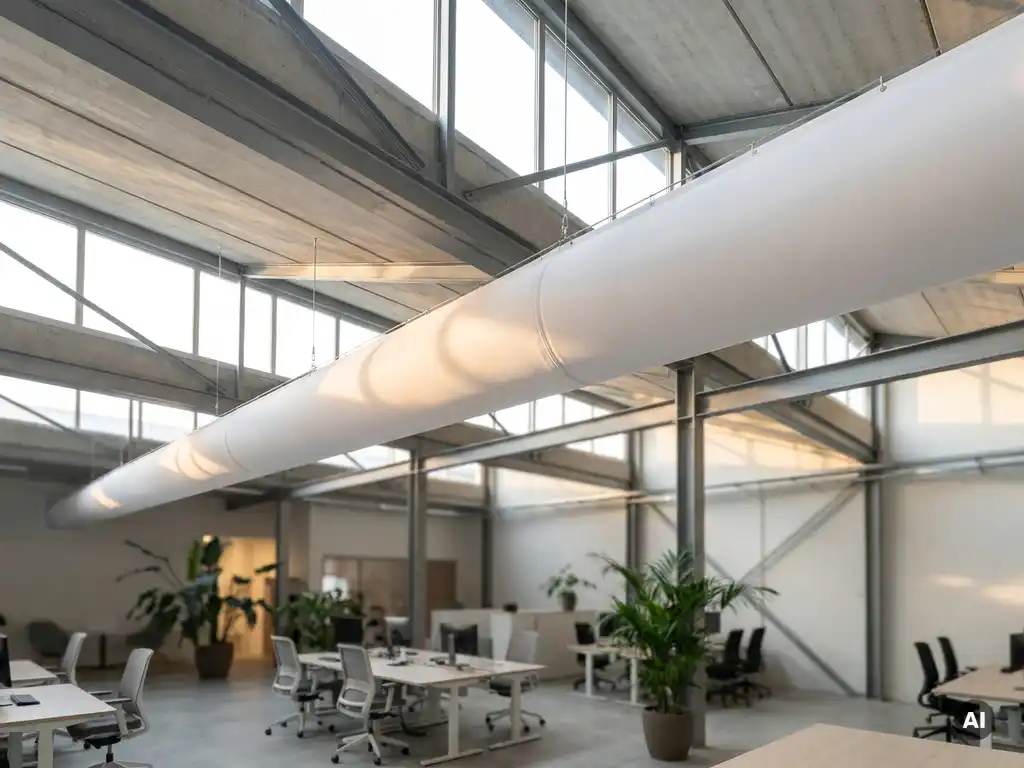
A well-planned hall ventilation system directly and measurably reduces the concentration of hazardous substances in the air: it dilutes pollutants, transports them away, and prevents dangerous accumulations in specific areas. What matters is not only the volume of fresh air supplied, but also how that air is distributed throughout the space. The following sections answer the most important questions about ventilation, air quality, and limit values in industrial halls.
How do hazardous substances get into the hall air in the first place?
Hazardous substances typically enter the hall air through production processes, machinery, storage, or the use of chemical substances. Common sources include welding fumes, solvent vapors, dust from machining processes, exhaust gases from industrial trucks, and off-gassing from paints, adhesives, or cleaning agents.
In enclosed industrial halls, the natural dilution of these substances is severely limited. Without targeted ventilation measures, pollutants accumulate continuously, especially in poorly ventilated areas such as corners, behind machinery, or near the floor in the case of heavy gases. Lighter vapors, on the other hand, rise and collect beneath the hall roof. The spatial distribution of hazardous substances therefore depends heavily on their physical properties and the airflow conditions within the hall.
How does the air exchange rate affect pollutant concentration?
The air exchange rate indicates how many times the entire hall volume is replaced with fresh air per hour. The higher the air exchange rate, the faster the concentration of hazardous substances in the hall air decreases. A higher air exchange rate dilutes pollutants more effectively and shortens the time until limit values are undercut.
In practice, the required air exchange rate is calculated based on the quantity of pollutants, the size of the space, and the applicable limit values. For simple office or commercial spaces, 3 to 6 air changes per hour are often sufficient. In production halls with a high pollutant load, 10 to 30 air changes per hour may be necessary. Important: a high air exchange rate alone does not guarantee uniform pollutant dilution. If the air is not distributed optimally, short-circuit flows occur, in which fresh air reaches the exhaust outlet directly without reaching the polluted zones.
What is the difference between dilution ventilation and capture ventilation?
Dilution ventilation and capture ventilation are two fundamentally different strategies for reducing hazardous substance concentrations. Dilution ventilation introduces large quantities of fresh air into the entire hall to dilute pollutants. Capture ventilation, on the other hand, acts directly at the source and extracts pollutants before they can spread into the room air.
Dilution ventilation: when it makes sense
Dilution ventilation is particularly suitable when pollutants arise diffusely and are distributed throughout the entire hall, for example from off-gassing of stored goods or uniformly distributed emissions. It requires high air volume flows and is more energy-intensive, but provides uniform air quality throughout the entire space, provided the air distribution is correct.
Capture ventilation: precision at the source
Capture ventilation, such as through extraction hoods or local extraction systems, is more efficient when pollutants arise at specific points, such as during welding, grinding, or painting. It significantly reduces the total air volume required and protects workers directly at the emission source. In many industrial halls, both approaches are combined: capture at the main sources, dilution for the base load.
Why is air distribution just as important as air volume?
A sufficient air volume is of little use if the air does not reach the areas where hazardous substances are generated. Poor air distribution leads to dead zones where pollutants stagnate, while fresh air is wasted elsewhere. Air distribution is therefore just as critical a factor as the air volume flow itself.
Conventional sheet metal ducts with slot nozzles often generate high discharge velocities that cause drafts and turbulently mix the room air without necessarily reaching all areas uniformly. Textile air distribution systems work differently: air exits over the entire surface of the textile duct at very low velocity. This ensures uniform, draft-free airflow throughout the entire hall area, which — especially in large industrial halls — makes the difference between effective ventilation and ventilation that only appears adequate. You can find more about the fundamentals of this technology in our overview of textile air ducts.
What limit values apply to hazardous substances in industrial halls?
In Germany, workplace limit values (AGW) apply to hazardous substances in the workplace, as set out in TRGS 900 of the Federal Institute for Occupational Safety and Health (BAuA). The AGW specifies the maximum permissible concentration of a substance in breathing air at which, based on current knowledge, no health damage is to be expected even with repeated exposure.
In addition, biological limit values (BGW) and short-term values exist that limit brief concentration peaks. Special regulations apply to particularly dangerous substances, so-called carcinogenic hazardous substances: here there are no safe limit values, but rather risk values and a minimization requirement. Operators of industrial halls are obliged, as part of the risk assessment under the GefStoffV, to measure actual concentrations and ensure that the ventilation system guarantees compliance with the limit values.
When is natural ventilation no longer sufficient?
Natural ventilation is no longer sufficient when the quantities of pollutants generated exceed the building’s self-cleaning capacity, when limit values cannot be maintained without technical measures, or when production processes require controlled airflow. In these cases, a mechanical ventilation system in the industrial setting is absolutely necessary.
Specific situations in which natural ventilation reaches its limits include, among others:
- Halls with high machine density and intensive manufacturing processes
- Buildings with a small exterior wall area or unfavorable geometry that generate little pressure differential
- Locations with low wind speeds or wind protection from neighboring buildings
- Processes involving heavy gases or vapors that accumulate at floor level and do not naturally dissipate
- Clean rooms, laboratories, or food production facilities with defined hygiene requirements for air quality
- Summer and winter operation with widely fluctuating outdoor temperatures that require regulated supply air temperature control
The threshold at which a mechanical ventilation system becomes necessary always arises from the risk assessment. Anyone who carries this out carefully will recognize at an early stage whether the existing ventilation situation is adequate or whether action is required.
How Kienzler Klima helps minimize hazardous substances in your hall
We at Kienzler Klima have been developing textile ventilation systems for more than 30 years, specifically designed for demanding industrial environments. Our textile air ducts ensure uniform, draft-free air distribution throughout the entire hall and thus help to keep hazardous substance concentrations effectively and permanently below the statutory limit values.
What specifically sets our solution apart:
- Uniform air distribution: Air exits over the entire surface of the textile duct at low velocity, reliably preventing dead zones and stagnation areas.
- Individual design: Every system is tailored to your specific application, including the type of pollutant, room geometry, and required air exchange rate.
- Fast delivery: With an average production time of just 14 days, we are ready for deployment quickly when action is needed.
- Savings of up to 60%: Compared to conventional sheet metal systems, our textile solutions significantly reduce material and installation costs.
- Made in Germany: All systems are manufactured at our facility in the Allgäu region, with permanent, non-washable fire protection anchored directly in the yarn.
Our systems are used in industries such as food production, in laboratories, production halls, and logistics centers. An overview of possible application areas can be found on our industries and applications page. If you would like to know which solution is right for your hall, please get in touch with us: we will advise you without obligation and design your system together with you. Contact us now and find out how we can permanently improve the air quality in your hall.