
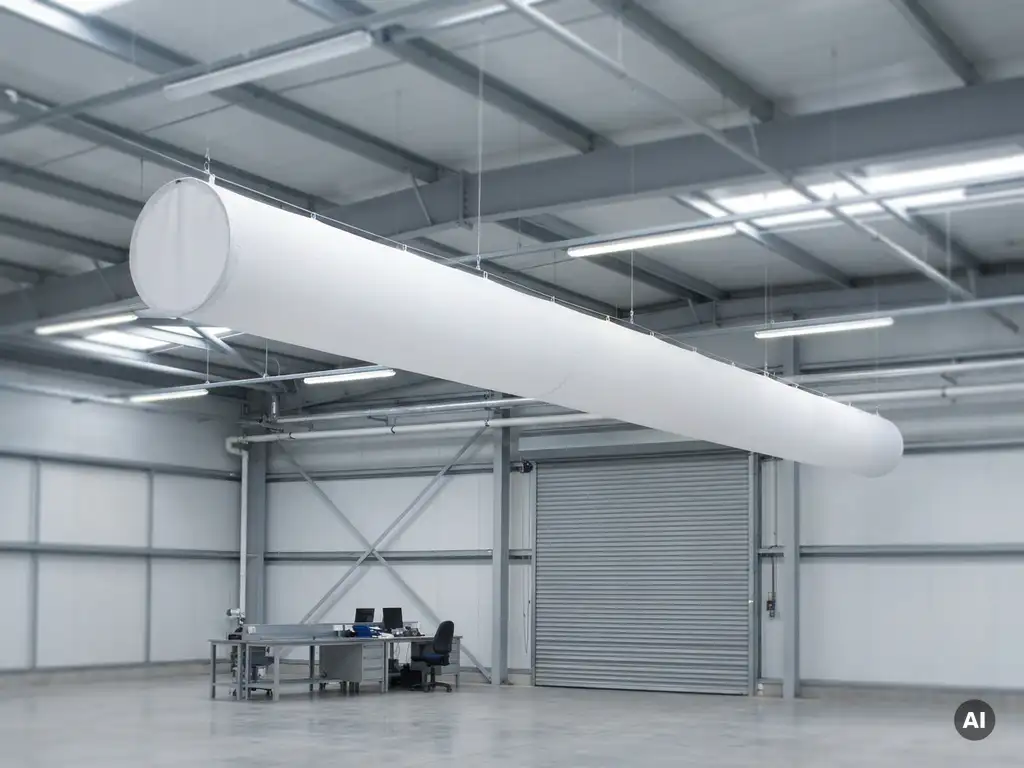
Workplaces near gates and doors are significantly more affected by drafts than other areas of a hall or building. The reason: every opening creates a pressure equalization when opened and closed, triggering air currents that hit adjacent workplaces directly. How serious the problem is depends on factors such as opening frequency, temperature differential, and the existing ventilation system. The following sections answer the most important questions about drafts in the workplace, health consequences, and suitable solutions.
Why do particularly strong air currents occur at gates and doors?
Strong air currents occur at gates and doors because every opening creates a pressure difference between the interior and exterior. Warm air inside and cold air from outside seek to equalize as soon as the opening is released. This equalization effect generates a directed airflow that, depending on the temperature differential and opening size, can reach considerable speeds.
Particularly problematic are industrial gates with large cross-sections that are regularly opened for delivery vehicles or forklifts. Here, two air masses with different temperatures and densities collide, creating turbulence. Added to this is the so-called chimney effect in halls with high ceilings: warm air rises, cold outside air flows in from below, and the area near the gate becomes the entry point for this cold air mass.
Doors in office buildings or laboratories should not be underestimated either. Even smaller openings, if used frequently, can cause measurable draft complaints, especially when the ventilation system does not compensate for the resulting airflows.
At what distance from gates and doors is a workplace at risk from drafts?
As a rule of thumb: workplaces within a radius of approximately three to five meters around a frequently used gate or exterior door are directly at risk from drafts. For large industrial gates, this zone can extend up to ten meters depending on the hall size and air distribution. What matters is not only the distance, but also the direction of the airflow.
If a workplace is positioned directly in the airflow axis of a gate — that is, in line with the opening — the exposure is significantly higher than if it is offset to the side. Opening frequency also plays a role: a gate that is opened ten times per hour generates an almost permanent air movement that reaches far into the hall area.
For individual assessments, a flow measurement with an anemometer is recommended. Air velocities above 0.15 m/s at head height are already considered potentially disruptive according to common comfort standards, and values above 0.25 m/s are perceived as uncomfortable by many employees.
What are the health and legal consequences of drafts in the workplace?
Drafts in the workplace can lead to muscle tension, colds, headaches, and difficulty concentrating. The neck and shoulder area is particularly affected when employees are permanently exposed to one-sided airflow. In the long term, the risk of musculoskeletal disorders increases, which are among the most common work-related health problems.
From a legal perspective, employers are obligated under the Workplace Ordinance (ArbStättV) and the associated Technical Rules for Workplaces (ASR A3.6) to prevent drafts in the workplace. ASR A3.6 specifies concrete limit values for air velocities and requires that ventilation systems be operated in such a way that no health-impairing draft conditions arise.
If these requirements are not met, employees can demand a risk assessment. In the event of repeated violations, employers may face regulatory orders or fines. Drafts are therefore not a comfort issue, but a serious compliance matter.
How do textile ventilation systems differ from conventional solutions when it comes to draft problems?
Textile ventilation systems distribute air over the entire surface of the duct at very low outlet velocities, rather than blowing it out in concentrated streams from individual nozzles or slots. This difference is crucial for the draft issue: conventional sheet metal ducts with perforated plates or long-throw nozzles generate directed air jets that can interact with other airflows and amplify turbulence.
Uniform air distribution instead of point-source injection
With textile air distribution systems, conditioned air exits through the permeable fabric at velocities well below the draft perception threshold. This means: the supplied air mixes gently with the room air without generating perceptible airflow impulses. At the same time, the supply air can be positioned specifically to buffer cold air intrusions through gates.
Flexibility for retrofitting and positioning
Another advantage of textile systems lies in their flexibility. The ducts can be placed exactly where the need is greatest — directly in the area of at-risk workplaces or as an air curtain in front of a gate. Conventional sheet metal systems are more rigid in their geometry and often require extensive modification work for subsequent adjustments.
Can a textile air duct be retrofitted to eliminate drafts at an existing workplace?
Yes, a textile air duct can be retrofitted and effectively reduce or eliminate draft problems at existing workplaces. The prerequisite is that a suitable air handling unit is available to which the duct can be connected. The installation itself is comparatively straightforward, as textile systems are lightweight and flexible.
The retrofitting follows a clear process: first, the airflow situation at the affected workplace is analyzed, then the duct is designed according to the room geometry and air volume flow. The outlet direction can also be adjusted to specifically create an air curtain in front of a gate that slows the entry of cold air.
The applications of textile ducts range from small office spaces to large production halls. In many cases, retrofitting is significantly less expensive than a complete overhaul of the existing ventilation concept, and the production time for a custom-designed duct averages just 14 days.
In which industries are drafts from gates and doors particularly critical?
Drafts from gates and doors are particularly critical in logistics, the food industry, automotive production, and healthcare. In these industries, high opening frequencies, strict hygiene regulations, or sensitive work processes converge, making draft problems especially consequential.
In logistics centers, loading gates are opened dozens of times daily, often for extended periods. Order-picking workplaces near these gates are permanently exposed to cold air intrusions, which impairs employee performance and increases absenteeism. In the food industry, drafts can additionally destabilize temperature zones and compromise hygiene areas.
In automotive production and mechanical engineering, halls are often large and accessed by heavy vehicles, requiring large gates. Fine-mechanical workstations located near gates are then exposed to thermal fluctuations that can cause quality problems. In healthcare — such as in hospitals or laboratories — drafts are not only a comfort issue but can also compromise sterile areas.
How Kienzler Klima helps with draft problems in your facility
At Kienzler Klima, we have been developing textile ventilation systems for more than 30 years that work precisely where conventional solutions reach their limits: at workplaces with complex airflow conditions, near gates, in large halls, and in sensitive production environments. Our textile air ducts are individually designed for each application and manufactured at our plant in the Allgäu region, with an average production time of just 14 days.
What we offer you:
- Individual planning: We analyze the airflow situation at your workplace and design the duct to fit precisely, including targeted outlet direction to buffer cold air intrusions.
- Retrofitting without major effort: Our systems can be integrated into existing ventilation systems without extensive modification work.
- Made in Germany, Cradle-to-Cradle certified: Permanent fire protection, high material quality, and sustainability are not promises for us, but documented standards.
- Up to 60% lower installation costs compared to conventional sheet metal systems.
- Use in demanding industries: From automotive manufacturers such as BMW and Mercedes-Benz to food producers such as Nestlé and Coca-Cola, leading companies trust our solutions.
Do you have draft problems at your workplaces and want to know which solution is best suited for your situation? Get in touch and let our experts advise you.