
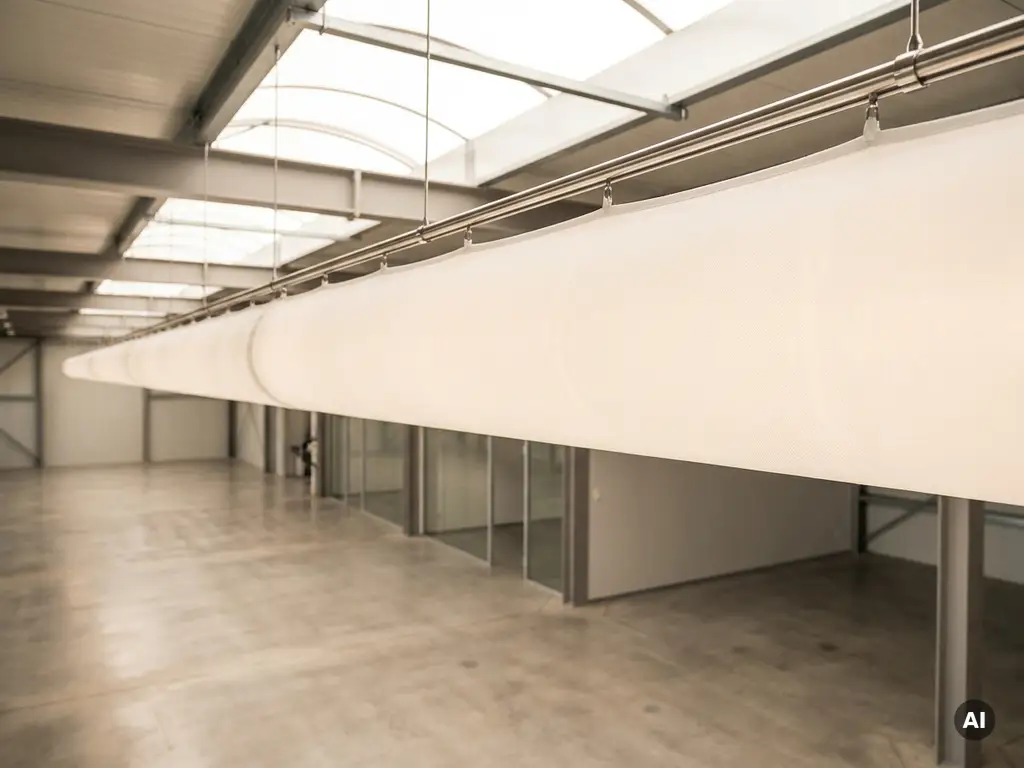
Whether a ventilation concept actually works draft-free can be reliably determined during commissioning through a combination of visual inspection, anemometer measurement, and smoke test. The decisive factor is that the air velocity in the occupied zone remains below the normative limit values and that air distribution occurs evenly across the entire area. The following sections address the most important testing methods, typical sources of error, and the comparison between textile and conventional systems.
How can you tell whether air is actually flowing draft-free?
Draft-free airflow is present when the air velocity in the occupied zone permanently remains below 0.15 m/s and no cold air plumes or turbulence are perceptible. The simplest indicator is subjective perception: anyone moving through the room should not notice any directional air movement. However, measurement-based verification is more reliable than physical sensation.
The following signs indicate a functioning draft-free ventilation system during visual inspection:
- The air jet does not detach from the outlet as a concentrated free jet but distributes itself broadly and diffusely.
- Smoke introduced for testing purposes rises evenly or disperses slowly, without directional flow.
- Thermographic images show no pronounced temperature gradients near the floor or on wall surfaces.
- Drafts do not occur even at maximum operating level.
Important: A visual inspection alone is not sufficient for a reliable commissioning. It is a first plausibility check, not a substitute for measurements.
Which measurement methods are suitable for commissioning a ventilation system?
For commissioning a ventilation system, vane anemometers, hot-wire anemometers, and smoke generators are particularly suitable. Vane anemometers reliably measure air velocities from approximately 0.3 m/s, while hot-wire devices capture even the smallest flows in the range of 0.05 m/s and are therefore especially suitable when draft-free ventilation needs to be verified.
Anemometer measurements in the occupied zone
Measurement is carried out in accordance with DIN EN 12599 at defined measurement points in the room, typically at heights of 0.1 m, 0.6 m, and 1.1 m above the floor. These heights correspond to the ankle, abdomen, and head regions of a seated person. If values below 0.15 m/s are achieved at all measurement points, the requirement for draft-free ventilation is considered fulfilled.
Smoke test and flow visualization
The smoke test makes the airflow visible and qualitatively supplements the measurement. It shows whether short-circuit flows exist between supply air and exhaust air, whether dead zones form in the room, or whether fresh air actually reaches the occupied zone. For a complete commissioning, the combination of quantitative measurement and flow visualization is recommended.
What are typical sources of error that cause drafts?
Drafts during ventilation system commissioning frequently arise from excessively high discharge velocities, incorrectly dimensioned outlets, or an unfavorable arrangement of supply and exhaust air elements. Planning errors that only become apparent during operation are also among the most common causes.
The most important sources of error at a glance:
- Oversized volume flows: If more air is blown in than planned, the discharge velocity increases and generates drafts.
- Incorrectly adjusted or blocked outlets: Defective louvre grilles or dirty perforated plates alter the flow direction in an uncontrolled manner.
- Unfavorable installation situation: Outlets directed straight at work areas or seating positions create a sensation of drafts even at code-compliant velocities.
- Missing or incorrect balancing: Without hydraulic balancing, uneven pressure conditions arise and thus uneven air distribution.
- Thermal buoyancy effects: Cold supply air that is blown in too low sinks down and creates cold air plumes near the floor.
How does a textile ventilation system perform during commissioning compared to sheet metal ducts?
Textile ventilation systems show clear advantages over sheet metal ducts during commissioning, because the air does not exit in a concentrated stream from individual point outlets but instead exits evenly across the entire permeable surface of the textile duct. This significantly reduces the local discharge velocity and makes drafts structurally less likely.
With conventional sheet metal ducts with point outlets, the flow guidance must be designed through swirl effects or induction so that the air is decelerated to occupied-zone velocity in the upper room area first. If this is not achieved, drafts occur. Textile air distribution circumvents this problem by design: the air exits at low velocity across the entire surface, without a directional free jet.
In practical terms, this means for the installer during commissioning: textile systems are generally easier to commission because the measured values in the occupied zone are structurally lower. At the same time, careful inspection of permeability and volume flow balancing is important, as deviations from the design volume flow can affect the uniformity of air distribution.
Which standards and limit values apply to the commissioning of ventilation systems?
For the commissioning of ventilation systems in Germany, DIN EN 13779, DIN EN 12599, and VDI 6022 are particularly relevant. The decisive limit value for draft-free ventilation is an air velocity of no more than 0.15 m/s in the occupied zone during standard operation.
The most important normative references at a glance:
- DIN EN 12599: Describes the testing and measurement procedures for the handover of air conditioning systems, including measurement points, measuring instruments, and evaluation.
- DIN EN 13779: Specifies requirements for ventilation systems in non-residential buildings, including air quality classes and comfort requirements.
- VDI 6022: Regulates hygiene requirements for air conditioning systems and sets requirements for maintenance, cleaning, and commissioning.
- ASR A3.6 (Workplace Regulation): Applies to commercial workplaces and stipulates that air velocities in the work area should not exceed 0.1 m/s for sedentary and 0.35 m/s for physically active work.
For ventilation system commissioning, the following applies: compliance with the standards is mandatory, not optional. Commissioning records should document all measurement points, measured values, and measuring instruments used.
When should an installer refuse commissioning or request remediation?
An installer should refuse commissioning if the measured air velocities in the occupied zone exceed the normative limit values, if drafts are subjectively perceptible, or if the actual volume flow deviates significantly from the planned value. Missing documentation is also a legitimate reason for refusal.
Specific situations requiring remediation:
- Measured values above 0.15 m/s in the occupied zone at normal operating level
- Uneven air distribution with significant temperature differences in the room
- Visible cold air plumes near the floor, detectable in the smoke test
- Volume flow deviations of more than 10% from the planned value
- Missing or incomplete balancing records
- Hygiene deficiencies at outlets or ducts that concern VDI 6022
As a general rule: commissioning is not a formality but the final quality check before handover to the operator. Anyone who inspects carefully here protects themselves from liability risks and ensures long-term satisfaction for the end customer.
How Kienzler Klima supports the planning of draft-free ventilation systems
We at Kienzler Klima have been developing textile ventilation systems designed by construction for draft-free air distribution for over 30 years. Our textile air ducts for various industries are individually dimensioned for each application and manufactured with an average production time of 14 days, Made in Germany in the Allgäu region.
What we specifically offer:
- Individual design: Every textile duct is tailored to the specific volume flow, room geometry, and usage requirements, so that commissioning succeeds with code-compliant measured values.
- Planning support: We accompany planners and installers from the initial concept idea through to commissioning documentation.
- Verifiable quality: Our systems are Cradle-to-Cradle certified, fire protection is permanently integrated into the yarn and cannot be washed out.
- Cost efficiency: Compared to conventional sheet metal systems, our textile air distribution systems enable savings of up to 60% in material and installation costs.
Are you planning a project and want to ensure that your ventilation concept passes commissioning without any issues? Get in touch and speak with our specialists about your requirements.