
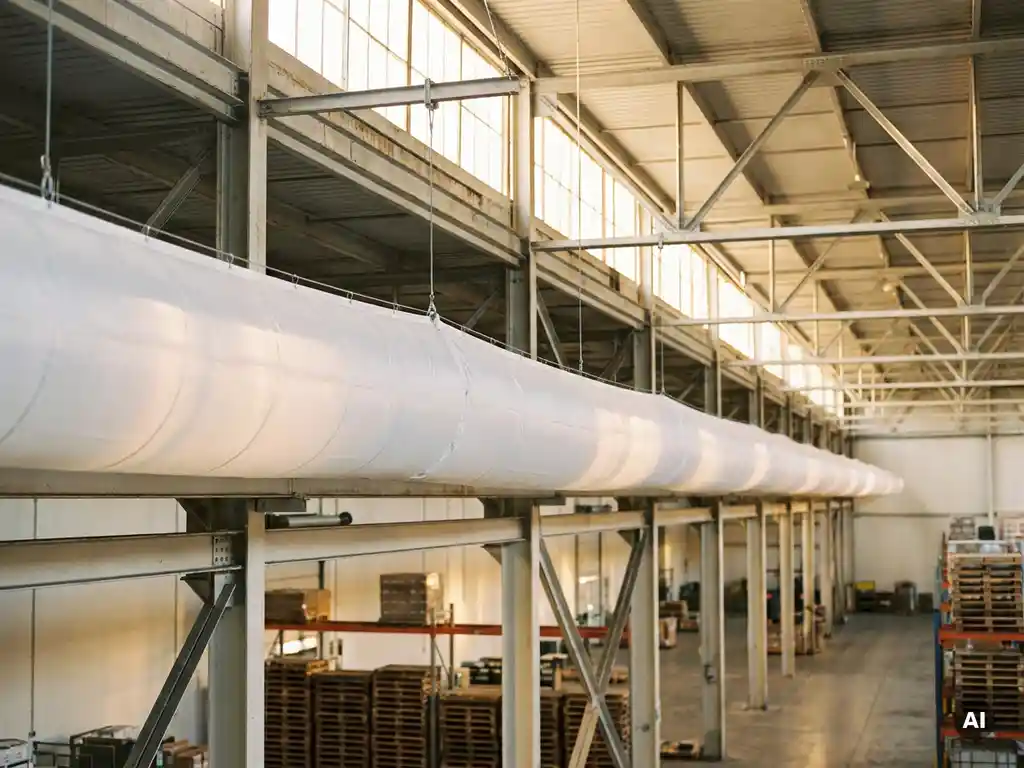
Low-turbulence air distribution prevents thermal stratification in halls by introducing conditioned air evenly over a large area at very low discharge velocities. This eliminates the momentum that would vertically separate warm and cold air masses. Instead, the supply air continuously mixes with the room air without creating stratification boundaries. The following sections explain the physical causes of stratification, the technical operating principle, and the specific benefits for different hall types.
What causes thermal stratification in industrial halls?
Thermal stratification in industrial halls occurs when air masses of different temperatures separate vertically due to their differing densities. Warm air rises, cool air sinks. In large halls with high ceilings and insufficient air mixing, stable temperature gradients form between the floor zone and the ceiling area, reinforcing the stratification effect.
Several factors specifically drive this effect. Heat sources such as machinery, lighting, or people generate convection currents that carry warm air up to the top of the hall. Conventional ventilation systems with localized air outlets and high discharge velocities exacerbate the problem: they introduce supply air with so much momentum that they locally displace the existing room air without truly mixing it. The result is a hall where conditions at working height are too warm or too cold, while above, under the ceiling, a disproportionate amount of conditioned energy is lost.
How does low-turbulence air distribution work technically?
Low-turbulence air distribution works by delivering supply air into the room through a very large discharge area at velocities typically below 0.5 m/s. The low discharge velocity minimizes the momentum of the incoming air, thereby preventing the formation of turbulences that could break down or create new stratification boundaries.
The decisive technical mechanism lies in the area distribution. Instead of blowing air through a few outlets at high pressure, a textile air sock distributes the supply air across its entire permeable surface. The textile material allows air to pass evenly through thousands of tiny openings. The air molecules leave the sock with virtually no directional momentum and glide gently into the surrounding room air rather than displacing it. This effect is referred to in fluid dynamics as laminar or quasi-laminar discharge and is the physical basis for supply air and room air mixing without stratification.
Why does uniform area distribution prevent stratification?
Uniform area distribution prevents stratification because it does not create localized temperature or pressure differences that would drive vertical air movement. The supply air exits so homogeneously along the entire length of the distribution system that no area of the hall is preferentially supplied with conditioned air and no other area is neglected.
Localized air injection, by contrast, creates zones of high kinetic energy directly at the outlet and zones with barely any air movement further away. This unevenness promotes the formation of stable temperature layers, because the air in the calm zones has time to thermally separate. A large-area, low-turbulence distribution keeps the entire room air mass in a uniform, gentle movement that ensures permanent, soft mixing. The result is a nearly constant temperature distribution from the floor zone up to mid-hall height — precisely where people and processes are located.
In which hall types does stratification occur most severely?
Thermal stratification occurs most severely in halls with large clear heights, high internal heat loads, and little natural air mixing. Typical problem cases include production halls, logistics centers, sports halls, and food processing facilities where ceiling heights of eight meters or more are not uncommon.
The taller a hall, the greater the potential temperature gradient between floor and ceiling. In logistics centers with heavy vehicle traffic, exhaust heat and mechanical convection additionally reinforce stratification effects. In automotive or food processing production halls, precise temperature requirements add another layer of complexity: even minor deviations in the working zone can compromise quality or occupational safety. Sports halls frequently suffer from the phenomenon where athletes in the active zone feel cold while heating energy accumulates unused under the ceiling. The application areas for textile ventilation systems encompass exactly these demanding environments.
What energy savings does eliminating thermal stratification enable?
Eliminating thermal stratification enables significant energy savings because conditioned air acts where it is needed rather than remaining unused under the ceiling. Eliminating stratification allows the system’s setpoint temperature to be reduced while still achieving the same thermal comfort in the occupied zone.
In practice, this means: a hall where the temperature near the floor is 20 °C while 28 °C or more accumulates under the ceiling loses a substantial portion of the heating energy to the unoccupied ceiling area. If this gradient is reduced to just a few degrees through uniform air distribution, energy demand drops noticeably. Added to this are the installation advantages: textile air distribution systems offer savings of up to 60 percent in material and installation costs compared to conventional sheet metal duct systems, further enhancing the economic benefit.
When is a textile air sock the right choice against stratification?
A textile air sock is the right choice against thermal stratification when a hall has large ceiling heights, uniform temperatures in the occupied zone are required, and draft-free conditions are also a criterion. It is particularly suitable when conventional systems with localized outlets fail to resolve the stratification problem or even worsen it.
Specifically, the following criteria support the use of a textile air sock:
- Hall heights from approximately four meters upward, where stratification gradients become relevant in terms of energy and comfort
- Applications with high internal heat loads, such as those from machinery, people, or lighting
- Areas with hygiene or air quality requirements, such as food processing facilities or laboratories
- Projects where short installation times and low system weight are advantageous
- Renovation projects where existing ceiling structures cannot accommodate heavy sheet metal ducts
The product overview of textile air socks shows which versions are suitable for which requirement profiles.
How Kienzler Klima solves thermal stratification in your hall
At Kienzler Klima, we have been developing and manufacturing textile ventilation systems for more than 30 years, exclusively in Germany at our site in the Allgäu region. Our approach to combating thermal stratification is consistently aligned with the physical requirements: low-turbulence area distribution, individual design for every application, and production that unites all value-creation steps under one roof.
What we do for you:
- Individual design: Every textile air sock is calculated specifically for your hall situation, with an average production time of just 14 days.
- Uniform air distribution: The permeable textile structure ensures draft-free, area-wide distribution that permanently eliminates stratification boundaries.
- Cradle-to-Cradle certification: Our systems are sustainably certified, and fire protection is permanently integrated into the yarn — not washable out.
- Cost efficiency: Compared to sheet metal systems, you save up to 60 percent in material and installation costs.
- Proven references: Companies such as Airbus, BMW, Nestlé, and Amazon Logistics rely on our systems.
Contact us if you want to solve the thermal stratification in your hall permanently and efficiently. Get in touch now and receive expert consultation for your project.