
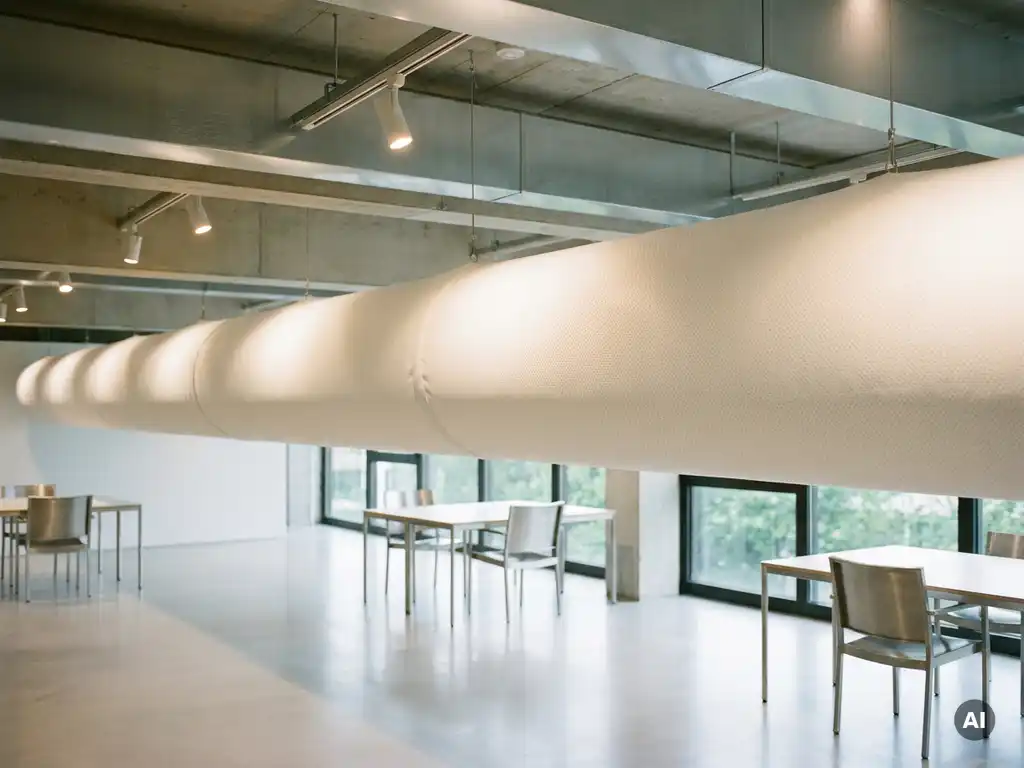
Poor air distribution directly affects mental health: when indoor CO2 concentrations rise above 1,000 ppm, concentration, reaction speed, and mood measurably decline. Anyone who works or lives daily in rooms with uneven air distribution risks chronic fatigue, headaches, and increased irritability. This article answers the most important questions about indoor air, well-being, and the options available to improve air distribution in a targeted way.
How does poor indoor air affect the brain and mood?
Poor indoor air impairs the brain because elevated CO2 levels reduce the oxygen supply to brain cells. Even at CO2 concentrations of 1,000 ppm, many people report fatigue and concentration problems. At levels above 2,000 ppm, headaches, irritability, and a noticeable decline in cognitive performance can occur. Air quality therefore has a direct influence on mood and mental health.
The brain consumes a disproportionately large amount of oxygen relative to its mass. If the fresh air supply is insufficient or air distribution within a room is uneven, so-called dead zones develop: areas where stale air accumulates without being replaced by fresh air. People who spend extended time in such areas often experience a gradual deterioration in their mood without making the connection to indoor air quality.
Additional pollutants such as volatile organic compounds (VOCs) from furniture, floor coverings, or cleaning products add to the problem. With poor air distribution, these substances accumulate locally and significantly amplify the negative effects on ventilation, productivity, and overall well-being.
What are the most common causes of uneven air distribution?
The most common causes of uneven air distribution are incorrectly sized ventilation systems, poorly positioned air outlets, and outdated systems that have not been adapted to changed room usage. Obstacles such as partition walls, shelves, or subsequently installed fixtures can also significantly disrupt airflow within a room.
Another frequent cause is discharge velocity: conventional sheet metal ducts and slot diffusers often create drafts near the outlet, while areas further away in the room receive barely any fresh air. The result is an uncomfortable indoor climate that negatively affects both air quality and the mood of occupants.
Last but not least, inadequate maintenance and clogged filters play a role: when airflow is throttled by dirty components, the entire flow pattern in the room changes. Regular inspection is therefore not an optional measure but a fundamental prerequisite for functioning air distribution systems.
How does textile air distribution differ from conventional systems?
Textile air distribution differs from conventional sheet metal systems primarily in the way air is released into the room: air exits evenly at very low velocity across the entire permeable surface of the fabric duct, rather than being blown out at a few points with high flow velocity. This eliminates drafts and ensures a consistently uniform distribution of temperature and air quality throughout the entire room.
Conventional sheet metal systems concentrate airflow at individual outlets. This frequently leads to thermal stratification: warm air rises, cold air sinks, and the zone where people are located receives only an inadequate supply of conditioned fresh air. Textile systems resolve this problem structurally, because air is discharged over a large surface area and is therefore physically more uniform.
There are also practical advantages: fabric air ducts can be easily removed and washed, are available in many colors and shapes, and can be custom-tailored to any room. Compared to sheet metal systems, material and installation costs are up to 60 percent lower.
Which rooms are particularly susceptible to poor air distribution?
Rooms with high occupancy density, unfavorable geometry, or special thermal loads are particularly susceptible to poor air distribution. These include open-plan offices, conference rooms, production halls, sports halls, and hospitals, as well as storage facilities with intensive logistics activity.
In open-plan offices, CO2 concentrations quickly rise to critical levels with inadequate ventilation, because many people are consuming air simultaneously and little natural ventilation takes place. The effects on air quality, mood, and productivity are especially pronounced in these environments.
Production halls and industrial buildings present different challenges: machines, process heat, and dust create localized pollution peaks that a conventional system can barely remove uniformly. Food production facilities, laboratories, and clean rooms also have hygiene requirements that textile systems meet particularly well thanks to their washable surfaces. An overview of typical industries and applications is provided in the corresponding overview.
When should an existing ventilation system be inspected or replaced?
An existing ventilation system should be inspected when occupants regularly complain of fatigue, headaches, or drafts, when room temperatures are uneven, or when the system is more than ten years old and has never been fundamentally overhauled. An inspection is also necessary after structural changes such as renovations or new room layouts.
Another warning sign is increased energy consumption without an apparent reason: when a system requires more energy than before, it is often operating inefficiently because flow resistance has increased or the design no longer matches current usage. In such cases, a professional analysis is worthwhile — one that takes into account not only technical parameters but also user feedback.
A complete replacement makes sense when repair costs and energy losses permanently exceed the investment costs of a new system, or when the system no longer meets hygiene or fire protection requirements. Modern textile systems fulfill these requirements from the outset: fire protection is chemically and permanently anchored in the yarn and cannot be washed out.
How can air distribution in existing buildings be improved?
Air distribution in existing buildings can be improved through targeted measures without necessarily replacing the entire system. Depending on the initial situation, various approaches are available:
- Optimization of outlets: Slot diffusers or ceiling outlets can be repositioned or replaced with models that have better flow characteristics.
- Retrofitting textile distribution systems: Fabric air ducts can often be integrated into existing duct networks and immediately and noticeably improve air distribution within the room.
- Flow simulation: A digital analysis of the indoor climate shows precisely where dead zones develop and which measures will achieve the greatest effect.
- Filter replacement and maintenance: Regular maintenance ensures that the air volume flow is not throttled by contamination.
- Control system adjustment: Demand-controlled ventilation that responds to CO2 sensors increases efficiency and significantly improves air quality in heavily used rooms.
Which combination of these measures makes sense depends on the type of building, its usage, and the existing system. Expert consultation is therefore the first and most important step.
How Kienzler Klima helps with poor air distribution
We at Kienzler Klima have been developing textile ventilation and air conditioning systems for more than 30 years — systems that address exactly the point where conventional systems reach their limits: uniform, draft-free air distribution throughout the entire room. Our solutions are individually tailored to each application and are manufactured in Germany with an average production time of just 14 days.
What we specifically offer:
- Individual planning: Every fabric air duct is designed specifically for your room, your usage, and your technical requirements.
- Easy integration: Our systems can be incorporated into existing duct networks and replace or supplement conventional outlets.
- Hygiene and fire protection: The ducts are washable and permanently meet all fire protection requirements, as fire protection is chemically anchored in the yarn.
- Sustainability: Our products carry Cradle-to-Cradle certification, covering the entire value chain.
- Cost advantage: Compared to sheet metal systems, you save up to 60 percent on material and installation costs.
Whether office, production hall, or hospital: if you want to improve air distribution in your building and thereby enhance the well-being, mood, and productivity of your occupants, get in touch with us. Contact us now and receive a no-obligation consultation from our team of experts.