
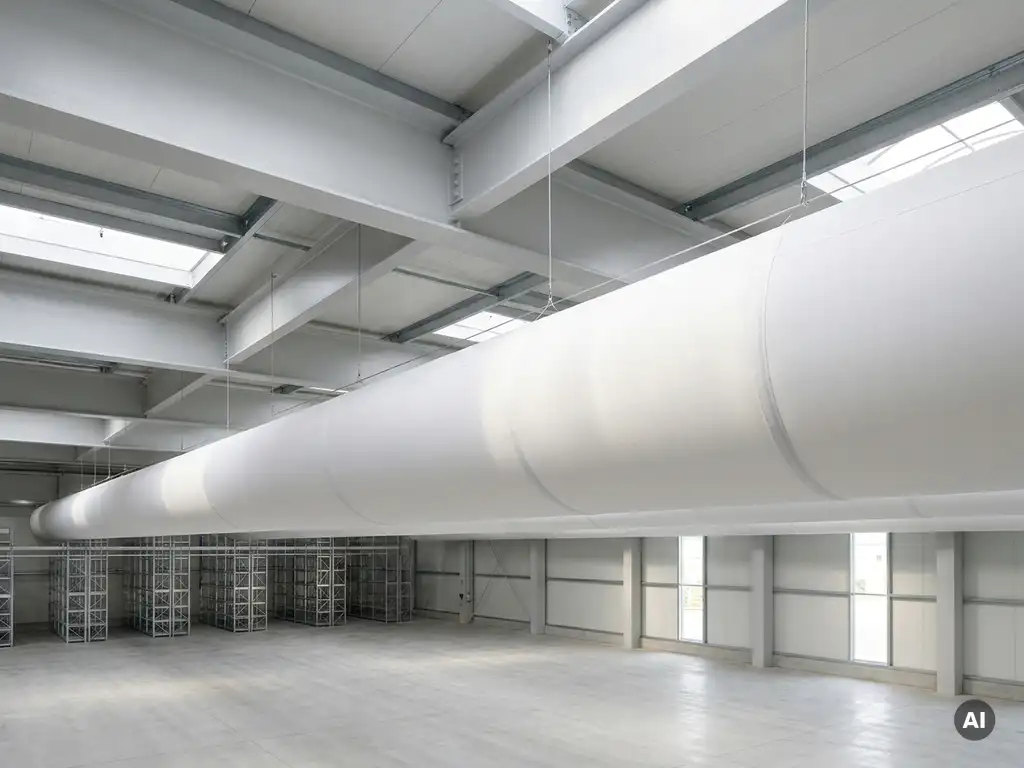
A ventilation system and an air conditioning system serve different purposes: the ventilation system ensures controlled air exchange, providing fresh, low-pollutant indoor air. The air conditioning system goes further, additionally regulating room temperature and often humidity as well. Which system better improves indoor comfort therefore depends on which problem you want to solve. The following sections answer the most important questions about ventilation and air conditioning.
What does a ventilation system regulate that an air conditioning system cannot?
A ventilation system regulates the continuous exchange of indoor and outdoor air. It removes CO₂, pollutants, moisture, and odors from the room and supplies fresh outdoor air. This targeted air exchange is the core competency of a ventilation system. An air conditioning system, on the other hand, in many configurations primarily recirculates the existing indoor air and cools it, without necessarily introducing fresh outdoor air.
The decisive difference therefore lies in air exchange: a pure air conditioning system can cool the indoor air, but CO₂ concentration still rises with windows closed. Anyone who needs to ensure consistently high air quality in offices, laboratories, or hospitals cannot do without a dedicated ventilation system. Modern central ventilation systems also often work with heat recovery, which can recover up to 90% of the thermal energy from the exhaust air.
How does each system affect indoor air quality?
A ventilation system improves indoor air quality directly by replacing stale air with filtered fresh air. An air conditioning system primarily influences thermal parameters — that is, temperature and partly humidity — without fundamentally reducing the pollutant content of the air.
Several factors are critical for indoor air quality:
- CO₂ levels: Rise quickly when there is no air exchange and impair concentration and well-being.
- Pollutants and particles: Ventilation systems with filter stages retain pollen, fine dust, and microorganisms.
- Humidity: Air conditioning systems with a dehumidification function can lead to excessively dry indoor air, which puts strain on mucous membranes.
- Air temperature: This is where the air conditioning system has its clear advantage over a pure ventilation system.
In sensitive areas such as the food industry or hospitals, clean, even air distribution without drafts is particularly important. This is precisely where textile ventilation systems excel: air exits over the entire surface of the fabric duct at very low velocity, reliably preventing drafts.
When is a ventilation system sufficient, and when is an air conditioning system needed?
A ventilation system is sufficient when the primary goal is fresh, low-pollutant indoor air and room temperature can be adequately controlled through passive measures or the building envelope. An air conditioning system is necessary when active cooling or precise temperature control is additionally required.
A practical decision guide:
- Ventilation system is sufficient: Offices with moderate heat loads, residential buildings with good insulation, rooms without intense solar radiation or technical heat sources.
- Air conditioning system necessary: Server rooms, production halls with high waste heat, retail spaces with large glass surfaces, rooms with southern exposure and strong solar radiation.
- Combination makes sense: In many commercial and industrial applications, both systems complement each other. The ventilation system ensures air quality; the air conditioning system regulates temperature.
What role does air distribution play in room comfort?
Air distribution largely determines whether a ventilation or air conditioning system is perceived as comfortable. Even a high-performance system creates discomfort if air is introduced into the room at too high a velocity or unevenly. Drafts are one of the most common comfort deficiencies in air-conditioned spaces.
Conventional sheet metal ducts with point outlets often create localized airflows that lead to a feeling of cold. Textile air distribution systems, on the other hand, distribute air broadly and evenly across the entire duct length. The result is a permanently uniform room climate without noticeable drafts. This is a decisive comfort factor especially in sports halls, laboratories, and production facilities, where people work or train continuously at fixed positions.
Can an air conditioning system also ventilate?
Yes, but only if it is designed accordingly. Many split air conditioning units or monoblock units operate in recirculation mode and do not technically ventilate. Central air conditioning systems with a fresh air component, however, can do both: cool and supply fresh air. The combination of cooling and ventilation is referred to as an air handling unit (AHU) system.
Whether an air conditioning system also ventilates can most easily be identified by the system type:
- Split air conditioning system (wall unit): Typically pure recirculation mode, no fresh air supply.
- Central AHU system: Combines cooling, heating, filtration, and ventilation in one system.
- Decentralized ventilation units: Supply fresh air, but usually offer only limited cooling.
Anyone who wants to ensure both air quality and temperature comfort in an office or production hall should opt for a full AHU system, not a simple recirculation unit.
What are the cost and installation differences between the two systems?
Ventilation systems are often less expensive to purchase and install than full air conditioning systems, as they do not require a refrigeration unit. Air conditioning systems require additional refrigeration technology, refrigerant lines, and in many cases approval under the F-Gas Regulation. Ongoing operating costs depend heavily on the system type and plant efficiency.
Relevant cost aspects at a glance:
- Capital costs: Air conditioning systems with refrigeration technology are significantly more expensive than pure ventilation systems.
- Installation effort: Conventional sheet metal duct systems are material- and labor-intensive. Textile ventilation systems can save considerable costs here.
- Operating costs: Refrigeration units consume more energy than pure ventilation fans. Heat recovery significantly reduces heating costs for ventilation systems.
- Maintenance: Air conditioning systems with a refrigerant circuit require regular maintenance by certified specialist companies.
An often underestimated cost factor is the air distribution system itself. Textile fabric ducts can save up to 60% of material and installation costs compared to conventional sheet metal systems, while simultaneously providing better air distribution. You can find more information in the product overview for textile fabric ducts.
How Kienzler Klima supports ventilation and air conditioning
Whether ventilation system, air conditioning system, or a combination of both: the right system stands or falls with the quality of air distribution. This is precisely where we at Kienzler Klima come in. With more than 30 years of experience in air and climate technology and consistent production in Germany, we develop textile air distribution systems that integrate seamlessly into existing and new ventilation and air conditioning systems.
What we specifically offer:
- Individual planning and design of each fabric duct for your specific application
- Short production time of an average of 14 days from order placement
- Savings of up to 60% on material and installation costs compared to sheet metal systems
- Draft-free, even air distribution through permeable textile materials
- Cradle-to-Cradle certification and permanent, non-washable fire protection
- Ready for use in laboratories, hospitals, food production facilities, offices, sports halls, and more
Would you like to know which air distribution system suits your ventilation or air conditioning system? Contact us now and we will advise you without obligation.