
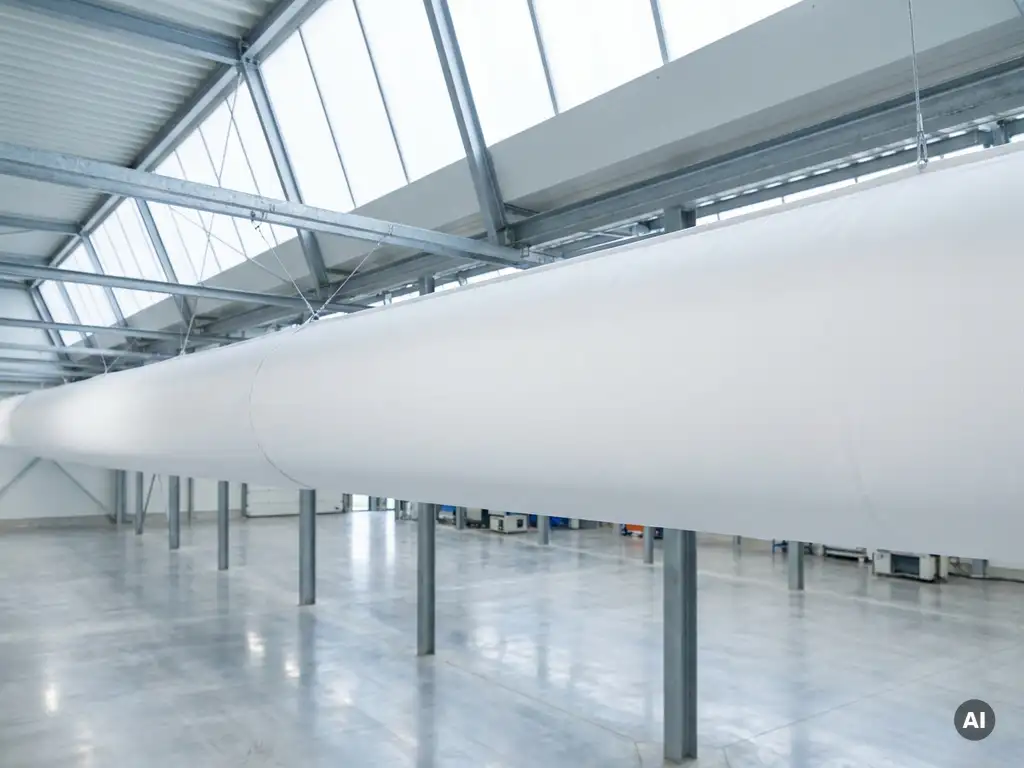
Air distribution plays a central role in compliance with hygiene regulations in industrial halls, because it directly determines how germs, particles, and pollutants are distributed or removed from the space. Poorly planned airflow can promote contamination, create dead zones, and violate statutory requirements for air quality and microbial load. The following sections answer the most important questions about hygiene-compliant air distribution in production and storage halls.
What hygiene regulations apply to ventilation in production and storage halls?
Ventilation in production and storage halls is governed by different sets of regulations depending on the industry. The most important foundations are DIN EN 13779, VDI guidelines 6022 and 2052, as well as industry-specific requirements such as the EU Food Hygiene Regulation (EC) No. 852/2004 and GMP guidelines for pharmaceutical operations.
At their core, these regulations require that ventilation systems be designed and operated in such a way that they do not represent a source of microbiological or particulate contamination. In concrete terms, this means: adequate air exchange rates, defined pressure conditions, controlled airflow, and regular maintenance. In the food industry, additional requirements from HACCP concepts apply, which include ventilation systems as a potential contamination pathway. For cleanrooms in the pharmaceutical industry, even stricter classifications apply under ISO 14644.
Important: The regulations refer not only to the technical design of the system, but also to materials, cleanability, and documentation. Anyone planning or operating a hall must be familiar with the applicable standards for their industry and must demonstrably comply with them during operation.
How does airflow behavior affect germ distribution in halls?
Airflow behavior largely determines whether germs and particles are stirred up, distributed, or selectively removed from the space. Turbulent, high-velocity airstreams dislodge deposited particles from surfaces and spread them widely, while uniform, draft-free airflow guides contaminants in a controlled manner toward the extraction point.
Particularly critical are so-called dead zones: areas where the air is barely exchanged. In these areas, germs, moisture, and organic particles accumulate and create ideal conditions for microbial growth. Conventional sheet metal duct systems with point outlets frequently create exactly these kinds of areas, because air is introduced in a directed rather than a planar manner.
Uniform airflow throughout the entire hall volume is therefore the decisive criterion for hygienically safe air distribution. Low outlet velocities over a large area reduce turbulence and ensure that germs and particles are not stirred up but are continuously removed with the airstream.
Why are textile air distribution systems hygienically advantageous over sheet metal ducts?
Textile air distribution systems are hygienically advantageous because they allow air to exit uniformly and at low velocity across the entire surface of the duct. This prevents turbulence, reduces particle agitation, and avoids the dead zones that are typical with point-type sheet metal outlets.
There are also structural advantages: textile ducts have no hard-to-reach internal surfaces such as bends, sleeves, or connectors where dirt and germs can accumulate. They can be completely removed and cleaned in standard industrial washing machines, enabling thorough and verifiable hygiene. Sheet metal ducts are often barely accessible on the inside and must be cleaned with considerable effort or even replaced.
Another point: high-quality textile systems such as those from Kienzler Klima are equipped with permanently integrated fire protection that is chemically anchored in the yarn and cannot be washed out. This is particularly relevant in hygiene-critical environments where regular washing is mandatory. More information on the fundamentals of this technology can be found at textile air distribution systems.
In which industries is air distribution particularly hygiene-critical?
Air distribution is particularly hygiene-critical in the food industry, the pharmaceutical industry, hospitals and laboratories, and in beverage production. In these sectors, faulty airflow can directly lead to product contamination, infection risks, or regulatory violations.
In the food industry, HACCP concepts and the EU Hygiene Regulation stipulate that ventilation systems must not represent a source of contamination. This applies to both the materials of the system and the airflow behavior. Manufacturers such as Nestlé or Coca-Cola therefore rely on systems that are easy to clean and demonstrably hygienic.
In hospitals and cleanrooms, defined air purity classes apply. Here, not only germ-free conditions are decisive, but also the direction and velocity of airflow, in order to prevent cross-contamination between areas. In laboratories, additional requirements regarding the handling of biological or chemical hazardous substances apply.
In the pharmaceutical industry and electronics manufacturing, particulate contamination of the air is also a central issue, since even the smallest impurities can render products unusable. An overview of industry-specific applications is provided on the page covering application areas of textile ventilation.
How often must ventilation systems be cleaned in hygiene-critical areas?
Cleaning intervals for ventilation systems in hygiene-critical areas depend on the industry, the intensity of use, and the applicable standards. As a guideline, VDI 6022 recommends an inspection of air handling systems at least once a year and cleaning according to the degree of soiling.
In food production, significantly shorter intervals may be required, such as quarterly or even monthly when working with highly perishable products. HACCP concepts define the specific intervals based on the risk posed by the system. For cleanrooms in the pharmaceutical industry, even stricter requirements may apply, oriented to production cycles and classification requirements.
Textile air distribution systems offer a practical advantage here: they can be completely dismantled and machine-washed, enabling short cleaning cycles without significant effort. Sheet metal duct systems, on the other hand, often require laborious manual cleaning with specialized equipment, making short intervals difficult in practice. In every case, it is essential to document the cleaning in order to provide proof during audits and inspections.
What should planners consider when designing hygiene-compliant ventilation in halls?
When designing hygiene-compliant ventilation in halls, planners should place industry-specific standards, airflow behavior within the space, and the cleanability of all components at the center of their planning from the outset. Subsequent adaptation is technically complex and costly.
The most important planning aspects at a glance:
- Clarify normative foundations: Which guidelines apply to the respective industry? DIN EN 13779, VDI 6022, HACCP, GMP, or ISO 14644 define different requirements.
- Use flow simulation: Computer-aided flow analyses (CFD) help identify and avoid dead zones and turbulence as early as the planning phase.
- Material selection based on hygiene requirements: All components must be made of materials that are resistant to the cleaning agents and disinfectants used.
- Prioritize draft-free airflow: Low outlet velocities and planar air distribution reduce particle agitation and improve indoor air quality.
- Plan for maintenance access: All components must be accessible for inspection and cleaning. Textile systems score points here through easy dismantling.
- Incorporate documentation from the start: Cleaning records, maintenance logs, and inspection reports are mandatory in many industries and should be integrated into operational planning.
Another aspect that is often underestimated in practice: the pressure conditions between different hall areas. In hygienically sensitive zones, a slight positive pressure should prevail to prevent the ingress of germs from less clean adjacent areas.
How Kienzler Klima supports you with hygiene-compliant air distribution
With more than 30 years of experience in air and climate technology and a specialization in textile ventilation systems since 1993, we offer planners, installers, and operators a complete solution for hygiene-compliant air distribution in halls. Our textile air ducts are individually designed for each application and manufactured in Germany, with an average production time of just 14 days.
What we do for you:
- Individual design: Every system is planned on the basis of your room geometry, type of use, and the applicable hygiene standards.
- Hygienically optimized materials: Our fire protection is permanently anchored in the yarn and cannot be washed out, enabling short cleaning cycles without material degradation.
- Cradle-to-Cradle certification: Our products are certified and cover the entire value chain.
- Up to 60% savings on material and installation costs compared to conventional sheet metal systems.
- Made in Germany: Production at our Allgäu site, short delivery routes, close process integration.
Whether food production, pharmaceutical operation, or industrial hall: if you are planning a hygiene-compliant ventilation solution, get in touch with us. An overview of our products can be found in the product overview of textile air ducts, or contact us directly here to discuss your project.