
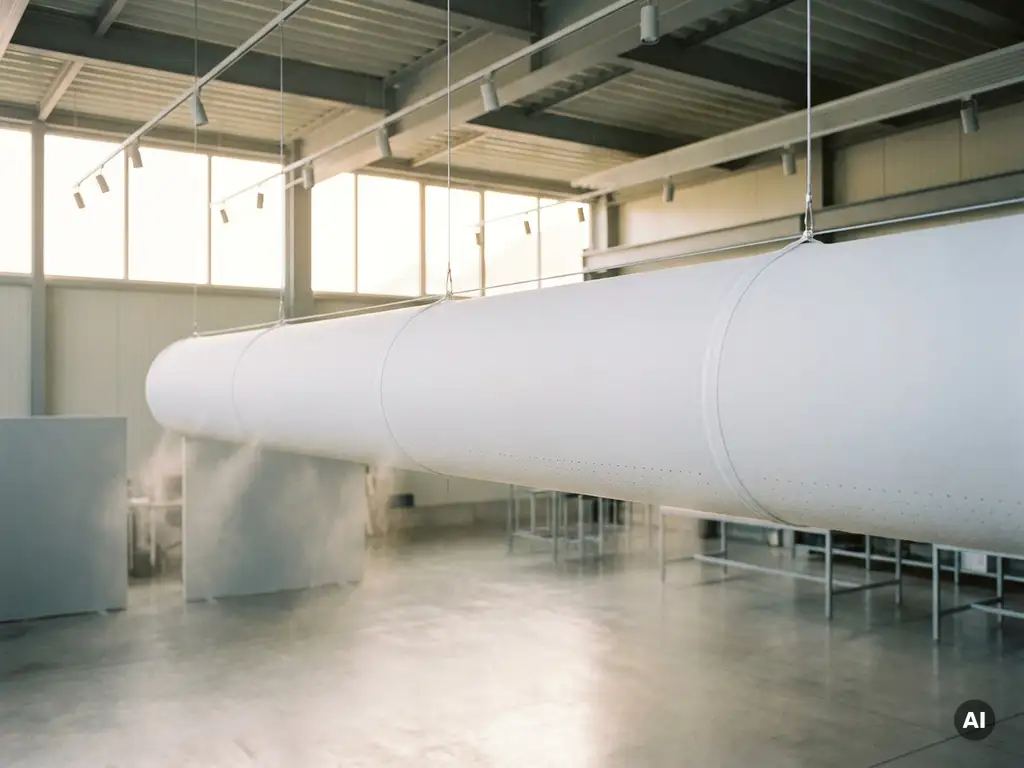
The air supply velocity plays a decisive role in comfort at industrial workplace environments: even at an air velocity of around 0.2 m/s in the occupied zone, drafts can be perceived as uncomfortable. For planners and operators of industrial halls, this is a central design parameter that determines the well-being, health, and performance of employees. The following sections shed light on the most important relationships surrounding air velocity, standards, and system comparisons.
At what air velocity does drafts become a problem in the workplace?
Drafts occur in the workplace when the air velocity in the occupied zone permanently exceeds 0.2 m/s. Above this value, many people perceive the air movement as disturbing, especially when the air temperature is below room temperature or when the airflow is intermittent. As an upper limit for sedentary activities, 0.25 m/s is generally accepted.
What matters is not only the velocity itself, but also the turbulence intensity of the flow. Fluctuating, uneven air movements are perceived as significantly more uncomfortable than a steady, laminar flow of the same velocity. In addition, there is the so-called operative temperature: the cooler the supplied air, the more sensitive the human body is to air movement. In halls operating in cooling mode, the risk of draft complaints is therefore fundamentally higher than in temperature-controlled spaces.
Particularly critical are high-pressure slot nozzles and ceiling diffusers with long-throw nozzles that introduce air into the room at high supply velocities. The air must then be sufficiently decelerated and mixed with room air on its way to the occupied zone so that limit values are maintained. If this is not achieved, drafts occur directly in the work area.
Why does supply air velocity affect productivity in industrial halls?
Supply air velocity affects productivity in industrial halls because drafts and thermal discomfort lead to loss of concentration, more frequent breaks, and an increased risk of illness. Studies in occupational medicine consistently show that thermal comfort is one of the strongest individual factors influencing cognitive and physical performance in the workplace.
In concrete terms, the effects manifest on several levels:
- Concentration and error rate: Drafts are distracting and increase the error rate in precision work.
- Muscular tension: One-sided cold exposure from directed airflows promotes neck tension and back complaints.
- Illness-related absenteeism: Prolonged draft exposure weakens the mucous membranes and increases susceptibility to respiratory infections.
- Employee satisfaction: Persistently uncomfortable climate conditions have a negative effect on motivation and employee retention.
In large production and logistics halls where many people work simultaneously, these effects multiply. A well-designed ventilation system for industrial halls is therefore not just a matter of comfort, but a business-relevant investment.
How do textile and conventional systems differ in air distribution?
The decisive difference between textile and conventional systems lies in the supply air velocity: conventional sheet metal ducts with nozzles or slot outlets supply air at specific points with high velocity, while textile air distribution systems release air evenly over the entire surface of the duct at very low velocity.
Conventional sheet metal systems
Metal ducts channel air in concentrated form to individual outlets. The supply velocity at these points is high, often several meters per second. The momentum of the flow must then be dissipated through induction with room air before the air reaches the occupied zone. If the design is not precise, draft zones form directly below the outlets.
Textile air ducts
In textile systems, air exits evenly over the entire duct length through the permeability of the fabric. The discharge velocity is in the range of a few centimeters per second, well below the draft threshold of 0.2 m/s. The result is a uniform, draft-free air distribution without thermal short circuits or dead zones. At the same time, complex readjustments are eliminated, as the system distributes evenly by design. More on the technical fundamentals can be found in the textile air duct product overview.
Which standards and limit values apply to air velocities in workplaces?
Several binding and advisory regulations apply to air velocities in workplaces in Germany and Europe. The most important limit values come from DIN EN ISO 7730, ASR A3.6, and VDI 6022.
- ASR A3.6 (Workplace Ventilation Rule): For workplaces in work environments, a maximum air velocity of 0.2 m/s applies for sedentary activities and 0.35 m/s for physical work while standing or walking.
- DIN EN ISO 7730: This standard defines the Fanger comfort model and sets limit values for the percentage of dissatisfied persons (PPD) and the predicted mean vote (PMV). It recommends a maximum mean air velocity of 0.19 m/s at 20 °C for Category B.
- VDI 6022 (Indoor Air Technology): Regulates hygiene requirements for air handling systems and provides guidance on design to avoid drafts and contamination risks.
- DIN EN 13779: European standard for ventilation of non-residential buildings, defining requirements for air volumes and indoor air quality categories.
Important: The standards always refer to air velocity in the occupied zone, not the supply velocity at the outlet. Between these two values, a factor of 10 to 50 can exist, depending on the system type and room geometry. Compliance with the limit values must therefore be ensured through careful design of the entire air distribution system.
How can air velocity in existing halls be optimized retroactively?
Air velocity in existing halls can be optimized retroactively through targeted measures to the air distribution, system controls, or by replacing individual components. A complete redesign is not required in many cases.
The following approaches have proven effective in practice:
- Volume flow reduction and pressure adjustment: Systems are often oversized or operated at excessively high pressure. Throttling via frequency converters on the fans reduces supply velocity without sacrificing air volume comfort.
- Replacement of outlets: Localized high-pressure nozzles can be replaced by area-type outlets with lower discharge velocities without replacing the entire duct.
- Retrofit with textile air ducts: Existing sheet metal duct networks can be retained as supply air distributors, while the actual air distribution into the hall area is handled by retrofitted textile ducts. This significantly reduces the supply velocity in the occupied zone.
- Zone-based control: In halls with different usage zones, zone-based volume flow control allows targeted responses to different requirements, such as between an assembly area and a warehouse.
- Airflow measurement and simulation: Before structural measures are taken, it is advisable to measure actual air velocities in the occupied zone and carry out a CFD simulation to identify optimization potential.
It is crucial that not just the symptoms, but the root cause of the excessive air velocity is addressed. Simple throttling without adjusting the air distribution can lead to undersupply of individual zones.
How Kienzler Klima helps with air velocity optimization
We at Kienzler Klima have been dealing with exactly this challenge for more than 30 years: distributing air in halls so that it arrives where it is needed, without generating drafts. Our textile air distribution systems are designed by construction for low discharge velocities, which makes it significantly easier to comply with the limit values specified in ASR A3.6 and DIN EN ISO 7730.
What we specifically deliver for your project:
- Individual design: Every textile air duct is calculated and manufactured specifically for your hall, your air volumes, and your usage requirements.
- Retrofit solutions: We integrate textile systems into existing installations without requiring you to replace the entire infrastructure.
- Short delivery times: With an average production time of 14 days, we respond quickly to your needs.
- Made in Germany: All components are manufactured at our facility in the Allgäu region, with permanently integrated fire protection and Cradle-to-Cradle certification.
- Cost advantage: Compared to conventional sheet metal systems, our solutions enable savings of up to 60% in material and installation costs.
Contact us if you would like to improve air velocity in your hall. Get in touch now and receive a no-obligation consultation from our expert team.