
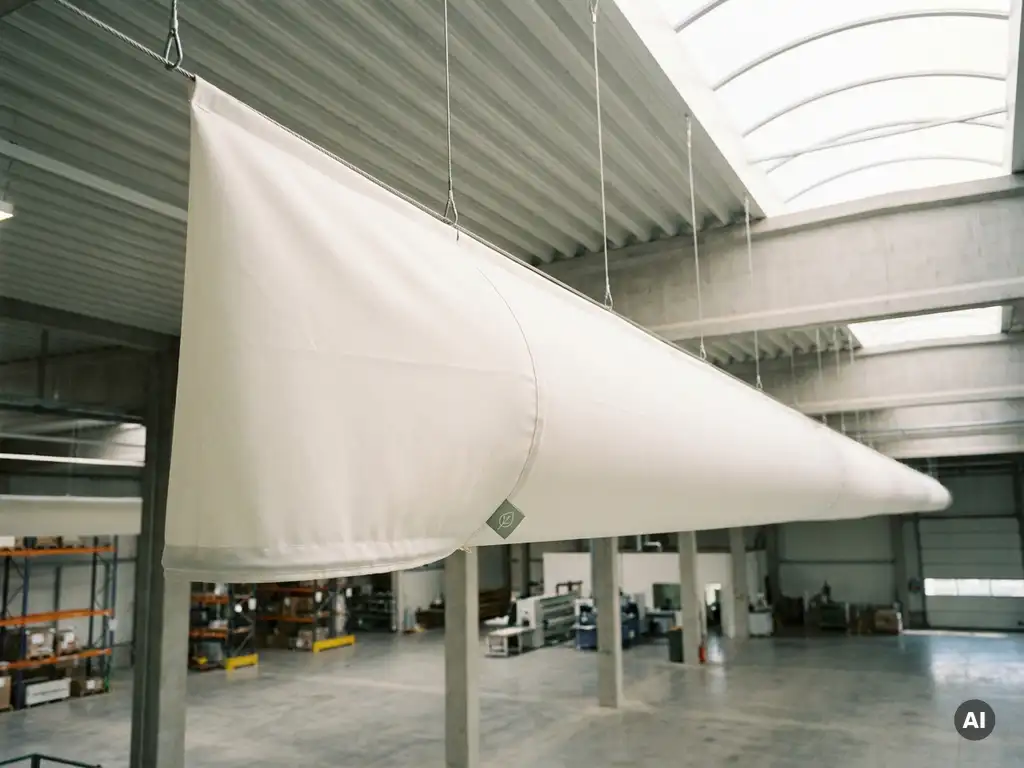
Textile ventilation systems with eco-certification are relevant for sustainable businesses because they directly connect environmental requirements with operational efficiency. Certifications such as Cradle-to-Cradle demonstrate that a product has been designed to conserve resources throughout its entire lifecycle, not just during the usage phase. The following questions shed light on what specifically matters when selecting a certified textile ventilation system.
Which eco-certifications are relevant for textile ventilation systems?
For textile ventilation systems, Cradle-to-Cradle, OEKO-TEX, and ISO-14001-based environmental management systems are the most relevant. Cradle-to-Cradle is the most demanding of these, because it evaluates not only freedom from harmful substances, but the entire circular economy of a product, from raw material extraction to recycling.
Other certifications that may play a role in the context of sustainable climate technology include:
- OEKO-TEX Standard 100: Tests textile materials for harmful substances and is particularly relevant in sensitive environments such as food production facilities or hospitals.
- ISO 14001: Certifies a manufacturer’s environmental management system, not the product itself, but provides information about production processes.
- Cradle-to-Cradle (C2C): Evaluates material health, circularity, renewable energy, water management, and social fairness across five categories.
For businesses that produce sustainability reports or must meet supply chain requirements, choosing a manufacturer with comprehensive certification is a verifiable proof of quality for customers, authorities, and investors.
What does Cradle-to-Cradle mean for a ventilation system in practice?
Cradle-to-Cradle means for a ventilation system in practice that all materials used are selected and processed in such a way that, at the end of their service life, they can be fully returned to a biological or technical cycle. The product is designed from the outset for recycling, not merely for disposal.
Specifically, this means: the yarns and textiles used must be free of harmful substances that would prevent later recycling. Flame retardant treatments that are chemically permanently anchored in the yarn rather than applied to the surface meet this requirement more effectively than subsequently treated materials. A C2C-certified ventilation system documents these properties through independent testing.
For the operator, the certification also means that the manufacturer transparently discloses its entire value chain — an aspect that is becoming increasingly important in the context of EU supply chain regulation and the Corporate Sustainability Reporting Directive (CSRD).
How do textile and conventional sheet metal systems differ in their life cycle assessment?
Textile ventilation systems perform better than conventional sheet metal systems in several categories of life cycle assessment. The decisive difference lies in material intensity, installation effort, and operational efficiency over the entire lifecycle.
Manufacturing and Installation
Sheet metal ducts require energy-intensive metal processing, complex joining technology, and considerable installation effort. Textile systems are significantly lighter, can be installed more quickly, and require fewer supporting structures. In practice, this results in savings of up to 60 percent in material and installation costs compared to conventional sheet metal systems — an advantage that is also reflected in the CO2 balance of the construction phase.
Operation and Air Distribution
Textile air distribution systems operate on a different principle than sheet metal systems: air exits evenly across the entire permeable surface, at low velocity and without drafts. This enables more efficient temperature control of the space, because no oversupply of individual zones is required. Less fan power for the same level of comfort means less energy consumption during operation.
End-of-Life
Sheet metal ducts can be recycled, but this requires complex dismantling and sorting. Textile systems produced under Cradle-to-Cradle requirements are designed from the outset for material cycles and can be specifically returned after their service life. More information on the technical fundamentals of textile air ducts can be found in our overview.
For which industries is an eco-certification for ventilation systems particularly important?
An eco-certification for ventilation systems is particularly important for industries with strict hygiene requirements, statutory sustainability obligations, or high public sustainability pressure. These include above all the food industry, healthcare, the pharmaceutical industry, and companies subject to CSRD reporting obligations.
Specifically:
- Food industry and beverage production: Materials that come into contact with air must be demonstrably low in harmful substances. An OEKO-TEX or C2C certificate provides this proof.
- Hospitals and laboratories: Hygiene and air quality are prescribed by regulation. Certified systems facilitate documentation for supervisory authorities.
- Industry and logistics: Large halls with high energy consumption benefit from efficient air distribution. Companies such as Amazon Logistics already rely on textile systems.
- Office and commercial spaces: Employers with sustainability strategies and Green Building certifications (LEED, DGNB) require certified components as proof.
- Sports and leisure facilities: Public operators are under increasing pressure to document operating costs and environmental impact.
A detailed overview of industries and applications for textile ventilation systems can be found in our industry overview.
Can a certified textile ventilation system be cleaned and maintained without difficulty?
Yes, certified textile ventilation systems can generally be cleaned without difficulty — often more easily than conventional sheet metal ducts. Most textile systems are machine washable, enabling thorough hygiene maintenance without dismantling complex duct sections.
For businesses in the food industry or healthcare sector, this is a practical advantage: textile ducts can be removed at defined intervals, washed, and reinstalled. Since the flame protection in high-quality systems is permanently chemically anchored in the yarn, the protective function is retained even after repeated washing cycles. This is a significant difference from systems with applied flame retardant treatments, where washing can reduce the protective effect.
For planning regular maintenance intervals, it is advisable to consult with the manufacturer, as washing temperatures and care instructions may vary depending on the material composition.
When is investing in a certified textile ventilation system worthwhile?
Investing in a certified textile ventilation system is worthwhile when businesses factor in not only the purchase price but also total operating costs, sustainability obligations, and air quality requirements in their decision. Those who compare only the purchase price underestimate the economic advantages over the lifecycle.
Specific situations in which the investment is particularly worthwhile:
- New construction or renovation: Lower installation and material costs compared to sheet metal systems make the initial investment economically attractive.
- Businesses with reporting obligations: Those subject to CSRD or similar regulations require documentable sustainability evidence for operating equipment.
- Hygiene-sensitive environments: Easier cleaning reduces maintenance effort and lowers operating costs in the long term.
- Energy efficiency as a goal: More uniform air distribution enables lower system output at the same level of comfort.
- Green Building projects: Certified components are a prerequisite for certain building certifications.
Individual system design tailored to the specific application is decisive for the actual benefit achieved.
How Kienzler Klima supports you with certified textile ventilation systems
We at Kienzler Klima have been developing and manufacturing textile ventilation systems for more than 30 years, exclusively at our site in the Allgäu region of Germany. Our systems are Cradle-to-Cradle certified, and this certification covers the entire value chain, not just the end product. What this means specifically for your business:
- Individual planning: Every textile duct is designed for your specific application, with an average production time of 14 days.
- Verifiable sustainability: Our C2C certification provides you with documentable evidence for sustainability reports and tenders.
- Permanent flame protection: The flame protection is chemically anchored in the yarn and is fully retained even after cleaning processes.
- Economic efficiency: Compared to conventional sheet metal systems, you save up to 60 percent on material and installation costs.
- Comprehensive service: From consultation and planning through to maintenance, we support you at every stage.
A first overview of our product portfolio can be found in our product overview. If you have specific requirements or are planning a project, please get in touch: we are happy to advise you and work with you to design the right system.